Tico Explorers

Nature Field Guide

Birds

Explore wildlife, plants and trees. Learn what to look for and where to find them.

All Nature

72 profiles

Nature Field Guide

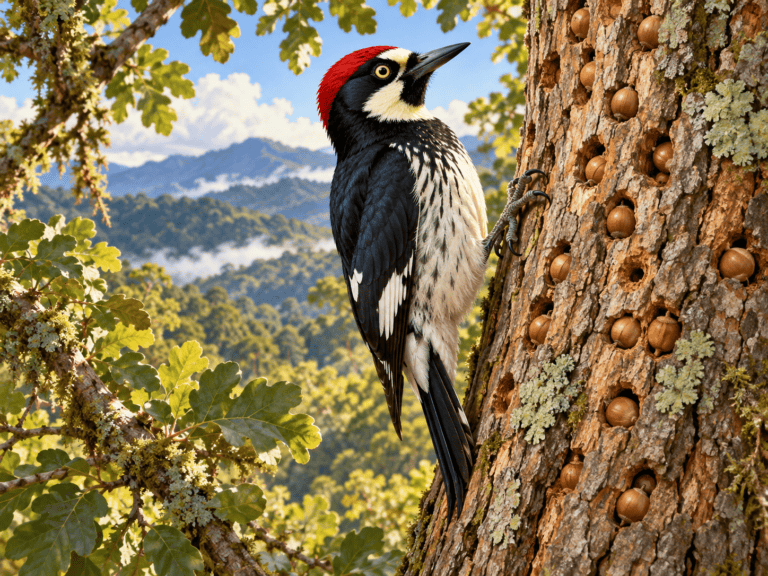
Acorn Woodpecker

Spanish name
Carpintero careto
Scientific name
Melanerpes formicivorus

What Do Pico & Tati Think?

Pico: “That face has bold black, white and red shapes!”

Tati: “Let’s look for clues on the tree without touching them.”

Identification

Key Features of the Acorn Woodpecker

  • Red cap, pale face and black patch around the bill.

  • White wing patches and white rump in flight.

  • Straight bill and stiff supporting tail.

Habitat & range

Mainly middle and high elevations in the Central and Talamanca ranges, especially oak landscapes. South Pacific refers to upland slopes, not the coastal plain.

Conservation & care

Stay on authorized trails or viewing routes. Give birds space, keep voices low and leave nests undisturbed. Observe without bait, feeding or recorded calls.

View full profile →

Nature Field Guide

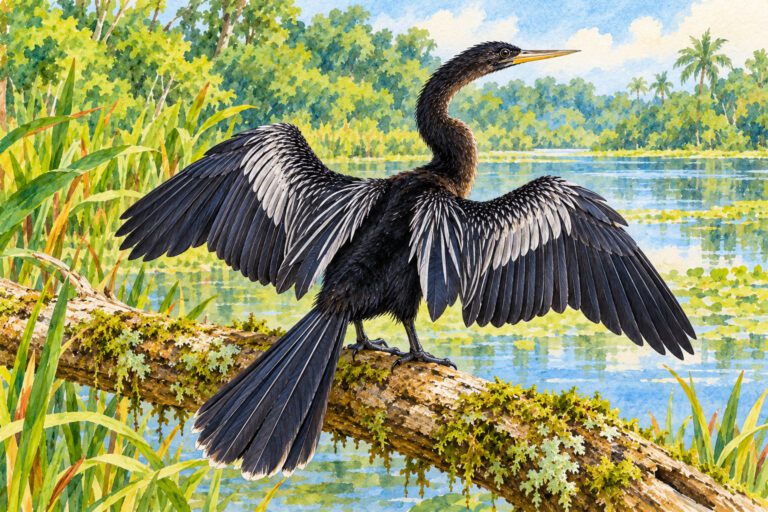
Anhinga

Spanish name
Aninga o pato aguja
Scientific name
Anhinga anhinga

What Do Pico & Tati Think?

A long neck rises above the water like a question mark. Pico waits while Tati looks for the rest of the bird.

Identification

Key Features of the Anhinga

  • Very long slender neck

  • Straight pointed bill

  • Long tail and pale wing markings

  • Often rests with wings spread

Habitat & range

Scan sheltered freshwater wetlands and wooded lagoon margins for swimming birds or a resting bird on a branch. Observe from a permitted viewpoint.

Conservation & care

Give feeding and resting birds space. If a bird stops feeding, repeatedly looks at you or moves away, increase your distance. Keep dogs away from flocks, avoid playback and feeding, and leave nests and natural shoreline debris undisturbed.

View full profile →

Nature Field Guide

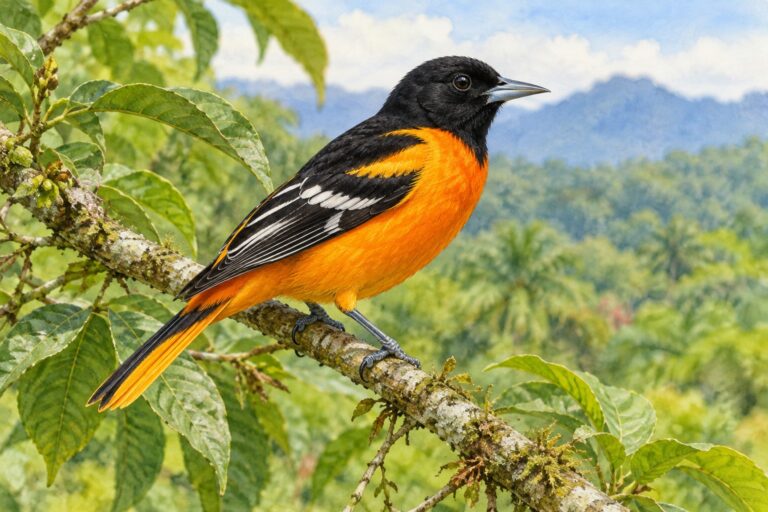
Baltimore Oriole

Spanish name
Bolsero norteño
Scientific name
Icterus galbula

What Do Pico & Tati Think?

Pico: “Did that bird travel here?”

Tati: “Baltimore orioles connect Costa Rica with places farther north.”

Identification

Key Features of the Baltimore Oriole

  • Male orange body and black head

  • White wingbar

  • Slender pointed bill

Habitat & range

A migrant and nonbreeding visitor, generally September to early May. Occurs on both slopes, especially the northern Pacific and Central Valley, in wooded gardens, edges and plantations.

Conservation & care

Observe quietly from trails or established viewing areas. Give nests, roosts and feeding birds space. Do not handle, chase or lure birds with playback. Keep pets away from wildlife.

Threats & pressures

Migrants depend on suitable habitat across their full annual journey. Protect native vegetation, reduce collision hazards around glass and keep cats away from birds. These are practical prevention priorities, not a claim of a measured decline at a specific Costa Rican site.

View full profile →

Nature Field Guide

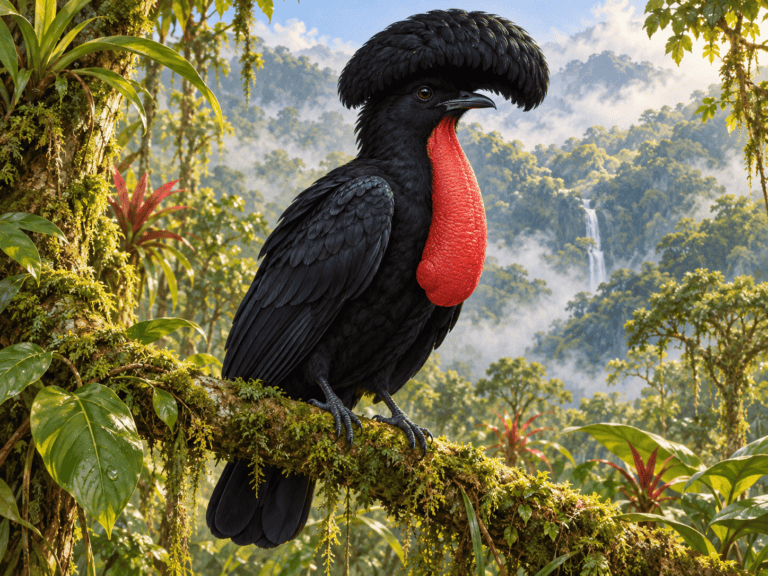
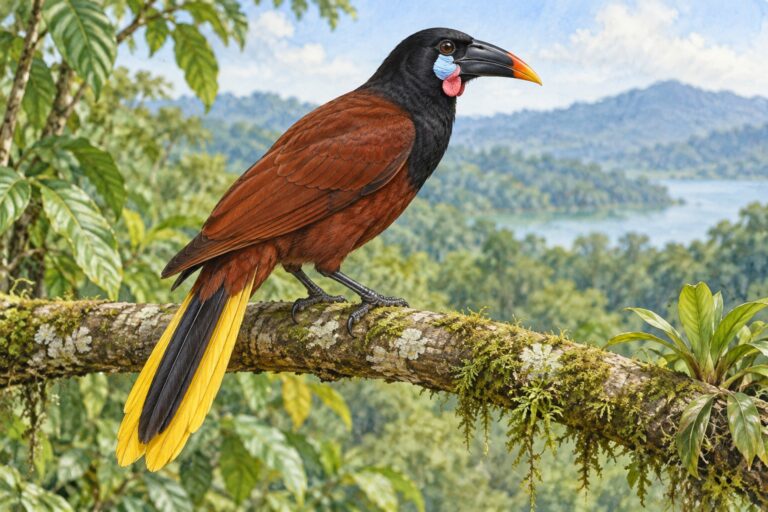
Bare-necked Umbrellabird

Spanish name
Pájaro sombrilla
Scientific name
Cephalopterus glabricollis

What Do Pico & Tati Think?

Pico: “That crest makes such an unusual shape!”

Tati: “We can learn about a shy bird without following it.”

Identification

Key Features of the Bare-necked Umbrellabird

  • Large dark bird with a heavy crest.

  • Short, square tail.

  • Male and female throat structures differ.

Habitat & range

Humid Caribbean-facing foothills and adjacent lowlands, with seasonal movement into montane breeding forest. Guanacaste refers to humid mountain slopes, not its dry coastal plain.

Conservation & care

Stay on authorized trails or viewing routes. Give birds space, keep voices low and leave nests undisturbed. Observe without bait, feeding or recorded calls.

Threats & pressures

UCAN identifies forest fragmentation and climate pressures on seasonal fruit availability as conservation concerns.

Conservation assessment

UCAN identifies the species as Endangered. Source checked 7 October 2026. This is a global species category, not a count of birds in the tagged towns.

View full profile →

Nature Field Guide

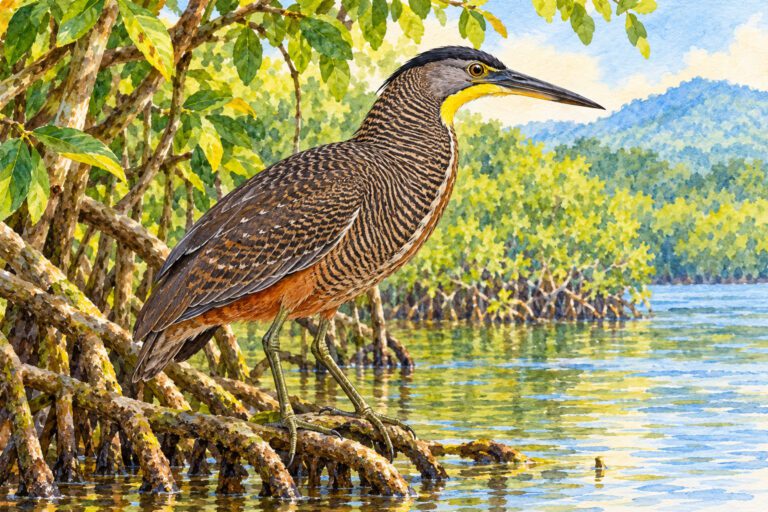
Bare-throated Tiger-Heron

Spanish name
Garza tigre cuellinuda
Scientific name
Tigrisoma mexicanum

What Do Pico & Tati Think?

Pico wonders where the tiger is hiding. Tati points to the fine patterns on a very watchful heron.

Identification

Key Features of the Bare-throated Tiger-Heron

  • Bare yellow throat patch

  • Adult finely barred neck and body

  • Gray cheeks and greenish legs

  • Young birds have bold brown bands

Habitat & range

Scan shallow water, quiet mangrove channels and vegetated wetland margins from an established viewpoint. Follow a local guide’s directions around estuaries.

Conservation & care

Give feeding and resting birds space. If a bird stops feeding, repeatedly looks at you or moves away, increase your distance. Keep dogs away from flocks, avoid playback and feeding, and leave nests and natural shoreline debris undisturbed.

View full profile →

Nature Field Guide

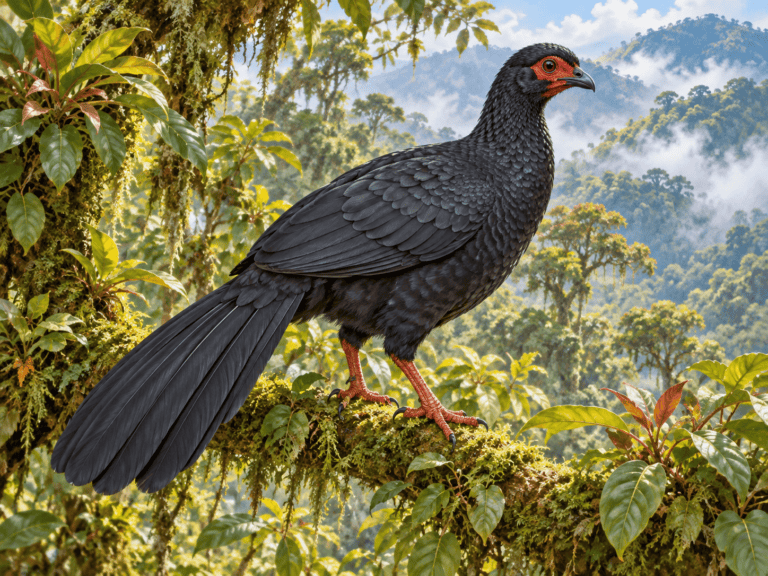
Black Guan

Spanish name
Pava negra
Scientific name
Chamaepetes unicolor

What Do Pico & Tati Think?

Pico: “A big bird is moving through the branches!”

Tati: “Look for its face and legs as well as its feathers.”

What does Least Concern mean?

In the linked conservation assessment, this species does not qualify as threatened or near threatened with extinction. It still needs care: local populations and habitats can face problems even when the species has a lower extinction risk overall.

This label describes conservation status. It does not tell us whether a plant is safe for children or pets. Select the status button to read the assessment.

Identification

Key Features of the Black Guan

  • Black body without a curassow’s curled crest.

  • Blue bare skin around a red eye.

  • Reddish legs.

Habitat & range

Montane forest, generally from about 1000 m to the upper forest limit. South Pacific refers to high Talamanca slopes, not coastal lowlands.

Seasonal Calendar

Resident presence

Costa Rica; suitable highland forest

Year-round

Resident nationally; presence and detectability vary among local sites.

Event source ↗

Conservation & care

Stay on authorized trails or viewing routes. Give birds space, keep voices low and leave nests undisturbed. Observe without bait, feeding or recorded calls.

Threats & pressures

Dependence on forest makes clearing and fragmentation relevant pressures despite the global Least Concern category.

Conservation assessment

BirdLife gives Least Concern, last assessment 2021. Source checked 7 October 2026. This is a global species category, not a count of birds in the tagged towns.

View full profile →

Nature Field Guide

Black Vulture

Spanish name
Zopilote negro
Scientific name
Coragyps atratus

What Do Pico & Tati Think?

Pico: “Which vulture is that one?”

Tati: “Look for the short tail and pale patches just at the wingtips.”

Identification

Key Features of the Black Vulture

  • Bare dark head

  • Short rounded tail

  • White patches at outer wingtips

Habitat & range

Widespread over towns and open landscapes from the coast into the mountains, becoming less frequent above about 2000 m. A regional tag does not identify a nesting site.

Conservation & care

Observe quietly from trails or established viewing areas. Give nests, roosts and feeding birds space. Do not handle, chase or lure birds with playback. Keep pets away from wildlife.

Threats & pressures

Protect native vegetation, reduce collision hazards around glass and keep cats away from birds. These are practical prevention priorities, not a claim of a measured decline at a specific Costa Rican site.

View full profile →

Nature Field Guide

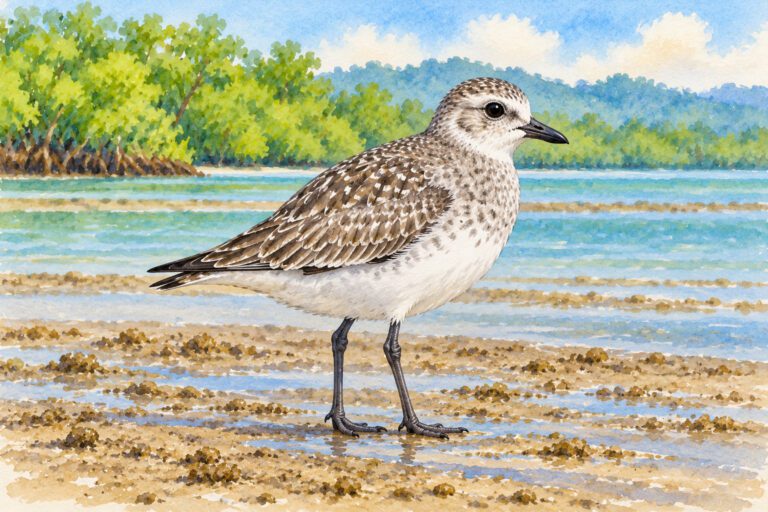
Black-bellied Plover

Spanish name
Chorlito gris
Scientific name
Pluvialis squatarola

What Do Pico & Tati Think?

Pico expects a black belly. Tati’s winter bird has a pale belly and a very different outfit.

Identification

Key Features of the Black-bellied Plover

  • Large round-headed plover

  • Short stout dark bill

  • Gray upperparts and pale nonbreeding belly

  • Dark armpit patch visible in natural flight

Habitat & range

Scan exposed shoreline feeding areas and nearby resting places with binoculars. The tide changes which flats are available; remain on a safe established route.

Conservation & care

Give feeding and resting birds space. If a bird stops feeding, repeatedly looks at you or moves away, increase your distance. Keep dogs away from flocks, avoid playback and feeding, and leave nests and natural shoreline debris undisturbed.

View full profile →

Nature Field Guide

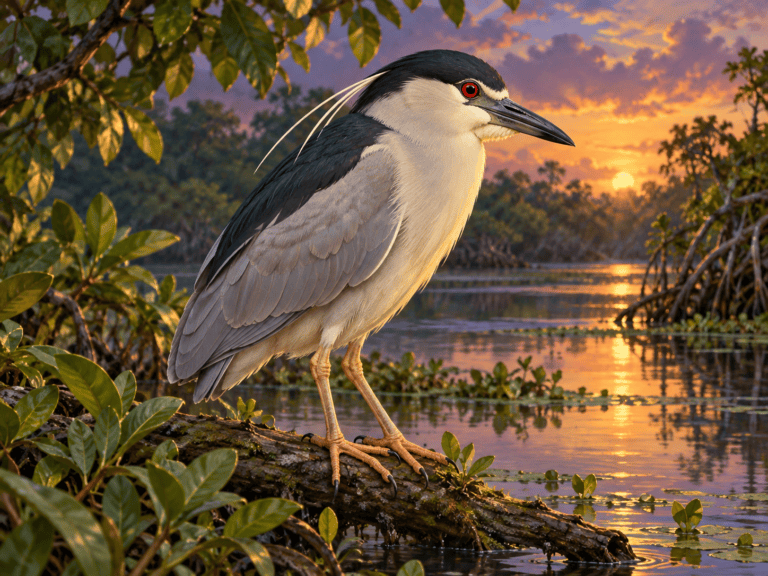
Black-crowned Night-Heron

Spanish name
Martinete coroninegro
Scientific name
Nycticorax nycticorax

What Do Pico & Tati Think?

Pico: “This heron looks shorter and rounder than the others!”

Tati: “It may be resting now and feeding later.”

Identification

Key Features of the Black-crowned Night-Heron

  • Stocky body and short-looking neck.

  • Adult: black crown and back, gray wings.

  • Young: brown plumage with pale spots.

Habitat & range

Wetland and mangrove populations include the Tempisque and Gulf of Nicoya landscape and local Caribbean lowlands. Resident birds and seasonal visitors both occur.

Conservation & care

Stay on authorized trails or viewing routes. Give birds space, keep voices low and leave nests undisturbed. Observe without bait, feeding or recorded calls.

Threats & pressures

Wetland drainage, development and contaminated runoff can degrade habitat and water quality.

View full profile →

Nature Field Guide

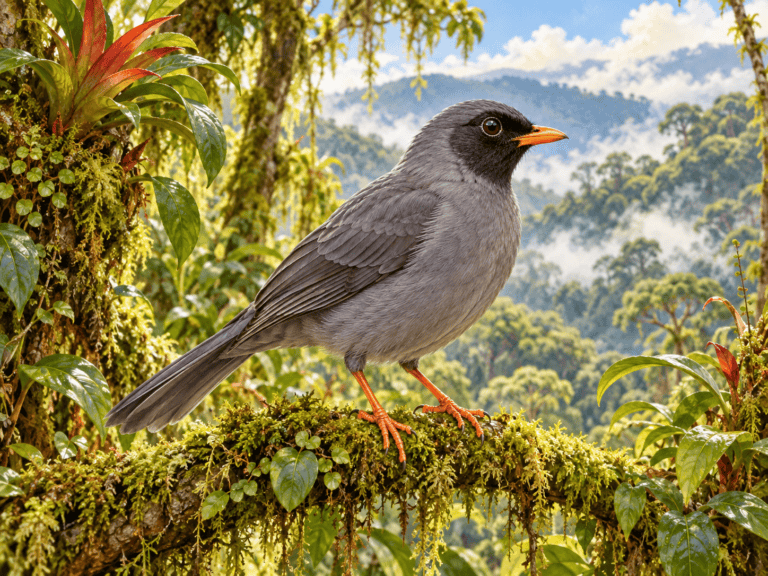
Black-faced Solitaire

Spanish name
Jilguero / Solitario carinegro
Scientific name
Myadestes melanops

What Do Pico & Tati Think?

Pico: “The song seems to be coming from a different place now!”

Tati: “Listening is a discovery, even without a photograph.”

Identification

Key Features of the Black-faced Solitaire

  • Slate-gray body and dark face.

  • A distinctive, varied mountain-forest song.

  • Singer may stay low and move within vegetation.

Habitat & range

Humid mountain forest on both slopes; after breeding some birds descend into Caribbean foothills and lowlands. Broad lowland tags represent seasonal forest habitat, not general abundance.

Conservation & care

Stay on authorized trails or viewing routes. Give birds space, keep voices low and leave nests undisturbed. Observe without bait, feeding or recorded calls.

View full profile →

Nature Field Guide

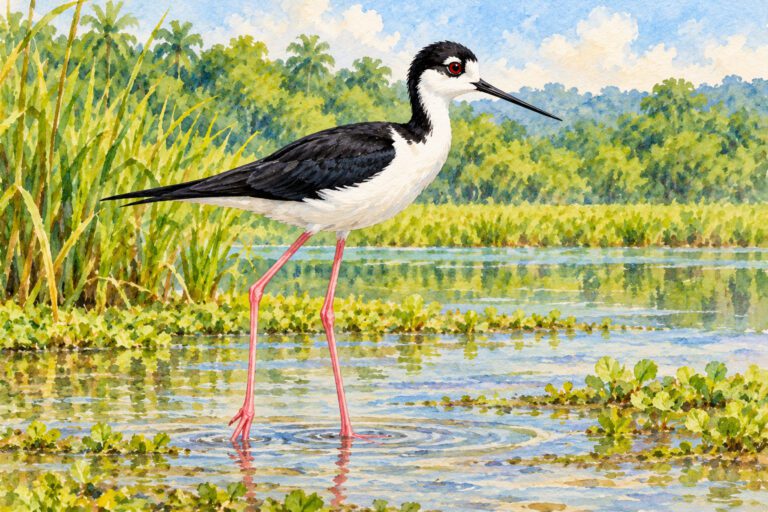
Black-necked Stilt

Spanish name
Cigüeñuela cuellinegra
Scientific name
Himantopus mexicanus

What Do Pico & Tati Think?

Those pink legs look almost too long for Pico’s page. Tati turns the journal upright to draw the whole bird.

Identification

Key Features of the Black-necked Stilt

  • Very long pink legs

  • Thin straight black bill

  • White underparts with dark back and hindneck

Habitat & range

Scan exposed shoreline feeding areas and nearby resting places with binoculars. The tide changes which flats are available; remain on a safe established route.

Conservation & care

Give feeding and resting birds space. If a bird stops feeding, repeatedly looks at you or moves away, increase your distance. Keep dogs away from flocks, avoid playback and feeding, and leave nests and natural shoreline debris undisturbed.

View full profile →

Nature Field Guide

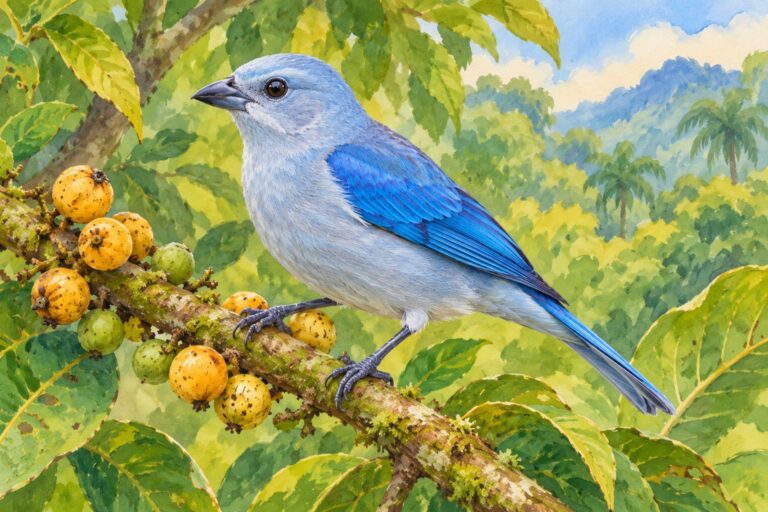
Blue-gray Tanager

Spanish name
Tangara azuleja
Scientific name
Thraupis episcopus

What Do Pico & Tati Think?

Pico: “It looks like a piece of the sky!”

Tati: “Let’s see where the blue is pale and where it is brighter.”

Identification

Key Features of the Blue-gray Tanager

  • Powder blue-gray body

  • Brighter blue wings and shoulder

  • Dark eye and stout bill

Habitat & range

Widespread in gardens, towns and semi-open wooded areas, mainly below about 2000 m. In the dry northwest it is less frequent and associated with moister sites near homes.

Conservation & care

Observe quietly from trails or established viewing areas. Give nests, roosts and feeding birds space. Do not handle, chase or lure birds with playback. Keep pets away from wildlife.

Threats & pressures

Protect native vegetation, reduce collision hazards around glass and keep cats away from birds. These are practical prevention priorities, not a claim of a measured decline at a specific Costa Rican site.

View full profile →

Nature Field Guide

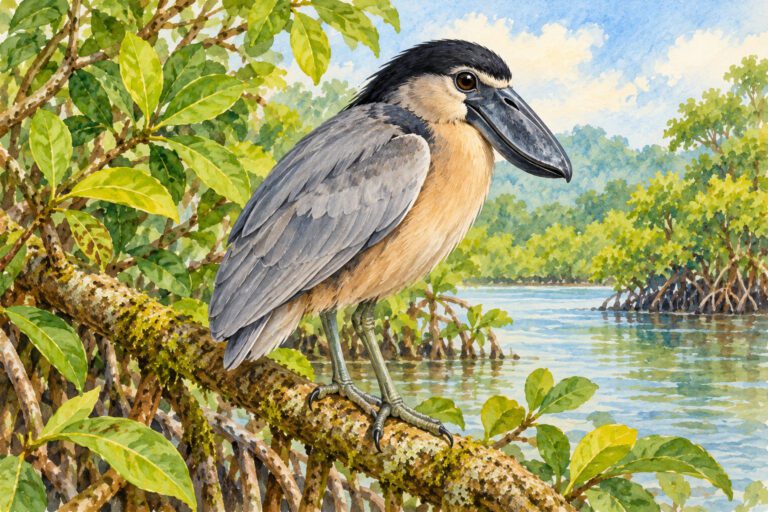
Boat-billed Heron

Spanish name
Chocuaco o picocuchara
Scientific name
Cochlearius cochlearius

What Do Pico & Tati Think?

That broad bill looks unlike the pointed bills Pico has drawn. Tati adds a new shape to the explorer journal.

Identification

Key Features of the Boat-billed Heron

  • Very broad boat-shaped bill

  • Large dark eyes and black crown

  • Stocky body with gray back

Habitat & range

Scan shallow water, quiet mangrove channels and vegetated wetland margins from an established viewpoint. Follow a local guide’s directions around estuaries.

Conservation & care

Give feeding and resting birds space. If a bird stops feeding, repeatedly looks at you or moves away, increase your distance. Keep dogs away from flocks, avoid playback and feeding, and leave nests and natural shoreline debris undisturbed.

View full profile →

Nature Field Guide

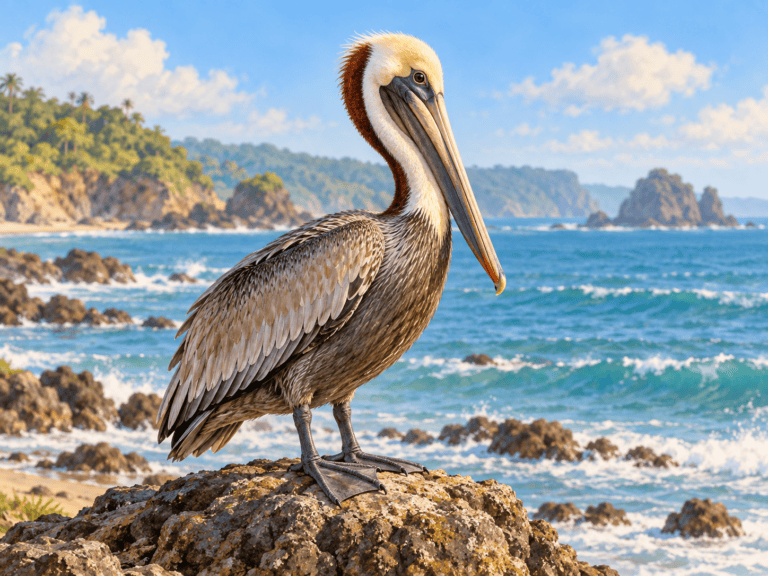
Brown Pelican

Spanish name
Pelícano pardo
Scientific name
Pelecanus occidentalis

What Do Pico & Tati Think?

Pico: “Look at that enormous bill!”

Tati: “Let’s compare its shape with the other birds by the water.”

Identification

Key Features of the Brown Pelican

  • A long bill with a pouch beneath the lower jaw.

  • A large gray-brown body and broad wings.

  • Head and neck colors change with age and breeding condition.

Habitat & range

Coastal waters along the Pacific, with less frequent nonbreeding visitors on the Caribbean coast. Regional tags refer to coastal habitat, not inland towns.

Seasonal Calendar

Resident presence

Isla San Lucas, Costa Rica

Year-round

SINAC lists Brown Pelican as a resident at Isla San Lucas on Costa Rica’s Pacific coast. This regional pattern does not guarantee a Tamarindo sighting or establish a local breeding calendar.

Event source ↗

Conservation & care

Do not feed birds or approach resting groups. Dispose of fishing line responsibly and leave nests undisturbed.

View full profile →

Nature Field Guide

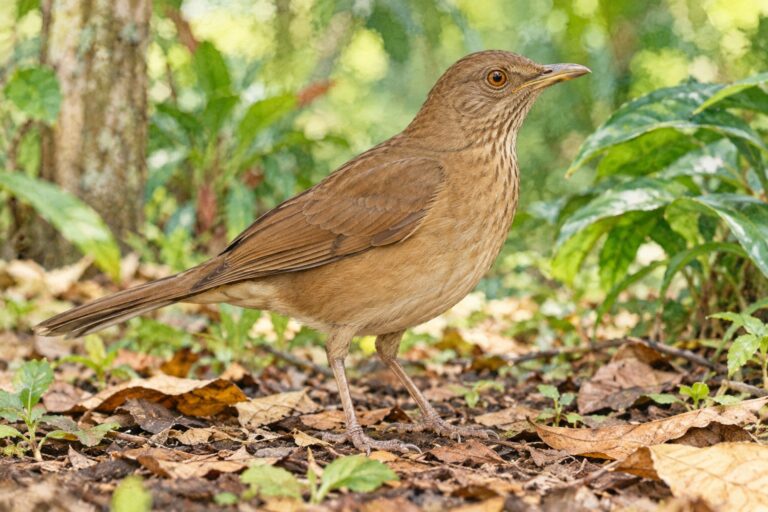
Clay-colored Thrush

Spanish name
Mirlo pardo / Yigüirro
Scientific name
Turdus grayi

What Do Pico & Tati Think?

Pico: “That brown bird has a beautiful song!”

Tati: “That is the yigüirro. We can learn its voice as well as its colors.”

Identification

Key Features of the Clay-colored Thrush

  • Warm brown plumage

  • Yellowish bill

  • Fine throat streaks and orange-brown eye

Habitat & range

Widespread across Costa Rica from lowlands to about 2450 m, in gardens, farms, secondary growth and wooded urban areas. Less numerous in the dry northwest and higher mountains.

Conservation & care

Observe quietly from trails or established viewing areas. Give nests, roosts and feeding birds space. Do not handle, chase or lure birds with playback. Keep pets away from wildlife.

Threats & pressures

Protect native vegetation, reduce collision hazards around glass and keep cats away from birds. These are practical prevention priorities, not a claim of a measured decline at a specific Costa Rican site.

View full profile →

Nature Field Guide

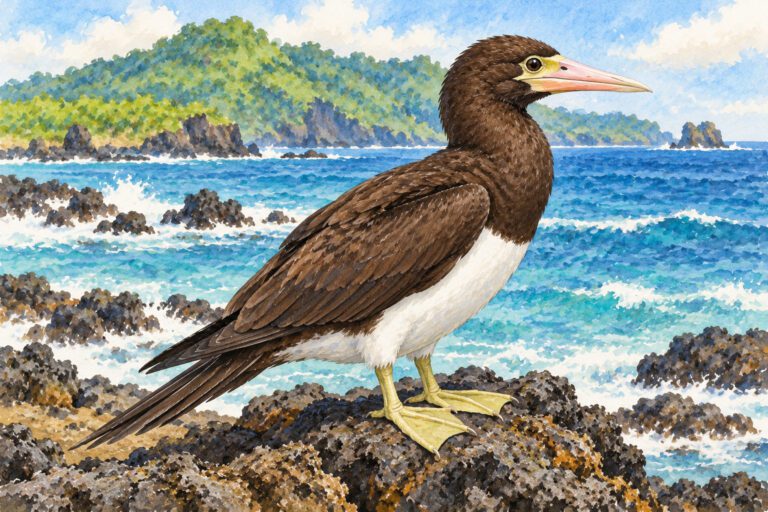
Cocos Booby

Spanish name
Piquero de Cocos
Scientific name
Sula brewsteri

What Do Pico & Tati Think?

Pico meets a familiar-looking seabird with a newer name. Tati keeps the scientific name beside the illustration.

Identification

Key Features of the Cocos Booby

  • Brown adult upperparts and white belly

  • Strong pointed pale bill

  • Short legs and broad webbed feet

  • Identification may require close expert comparison

Habitat & range

Scan Pacific coastal waters and offshore rocks from a safe viewpoint or responsible boat trip. Do not approach seabird colonies or land on nesting islands.

Conservation & care

Give feeding and resting birds space. If a bird stops feeding, repeatedly looks at you or moves away, increase your distance. Keep dogs away from flocks, avoid playback and feeding, and leave nests and natural shoreline debris undisturbed.

View full profile →

Nature Field Guide

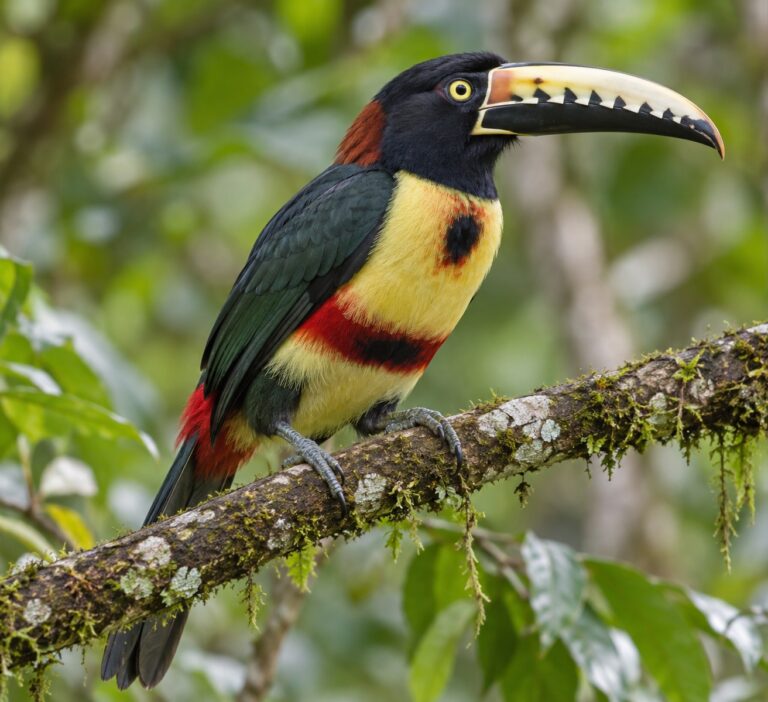
Collared Aracari

Spanish name
Tucancillo collarejo
Scientific name
Pteroglossus torquatus

What Do Pico & Tati Think?

Pico: “Is that a little toucan?”

Tati: “An aracari belongs to the toucan family. Its shape and bill give us clues.”

Identification

Key Features of the Collared Aracari

  • Dark head and throat

  • Yellow chest with red and black marks

  • Patterned pale upper bill

Habitat & range

Commoner in Caribbean lowlands and foothills; also occurs locally in the northern Pacific, including Nicoya woodland and lower Guanacaste slopes. Central Valley records are exceptional rather than a core range.

Conservation & care

Observe quietly from trails or established viewing areas. Give nests, roosts and feeding birds space. Do not handle, chase or lure birds with playback. Keep pets away from wildlife.

Threats & pressures

Protect native vegetation, reduce collision hazards around glass and keep cats away from birds. These are practical prevention priorities, not a claim of a measured decline at a specific Costa Rican site.

View full profile →

Nature Field Guide

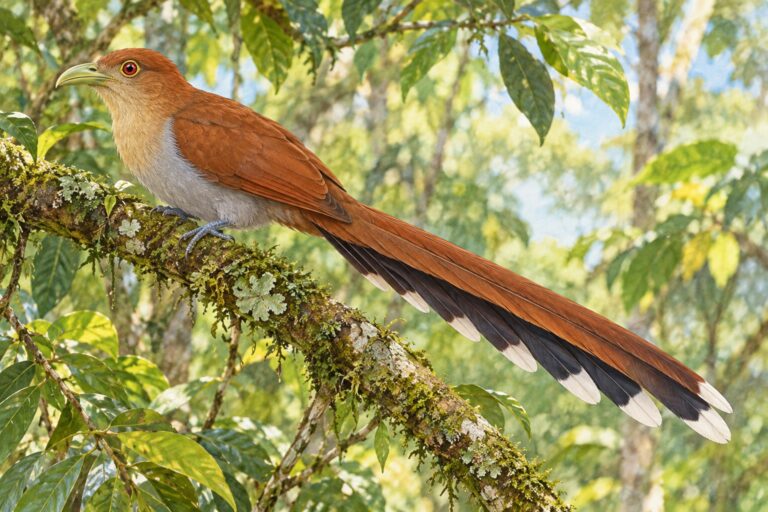
Common Squirrel-Cuckoo

Spanish name
Cuco ardilla
Scientific name
Piaya cayana

What Do Pico & Tati Think?

Pico: “That tail is longer than I expected!”

Tati: “Follow its movement through the branches without chasing it.”

Identification

Key Features of the Common Squirrel-Cuckoo

  • Rusty upperparts

  • Very long graduated white-tipped tail

  • Greenish-yellow bill

Habitat & range

Widespread in wooded habitats on both slopes, including forest canopy, secondary growth, plantations and tree-rich gardens. It can occur well above the lowlands where trees remain.

Conservation & care

Observe quietly from trails or established viewing areas. Give nests, roosts and feeding birds space. Do not handle, chase or lure birds with playback. Keep pets away from wildlife.

Threats & pressures

Protect native vegetation, reduce collision hazards around glass and keep cats away from birds. These are practical prevention priorities, not a claim of a measured decline at a specific Costa Rican site.

View full profile →

Nature Field Guide

Coppery-headed Emerald

Spanish name
Esmeralda de coronilla cobriza
Scientific name
Microchera cupreiceps

What Do Pico & Tati Think?

Pico: “Does this tiny bird live only in Costa Rica?”

Tati: “Yes. Endemic means its natural range is limited to one place.”

Identification

Key Features of the Coppery-headed Emerald

  • Male coppery crown

  • White outer tail feathers

  • Small size and slightly curved bill

Habitat & range

Costa Rican endemic of humid northern and central mountain slopes, from the Guanacaste range toward the northern Reventazon valley. Seasonal descent occurs; dry coastal Guanacaste is unsuitable.

Conservation & care

Observe quietly from trails or established viewing areas. Give nests, roosts and feeding birds space. Do not handle, chase or lure birds with playback. Keep pets away from wildlife.

Threats & pressures

Protect native vegetation, reduce collision hazards around glass and keep cats away from birds. These are practical prevention priorities, not a claim of a measured decline at a specific Costa Rican site.

View full profile →

Nature Field Guide

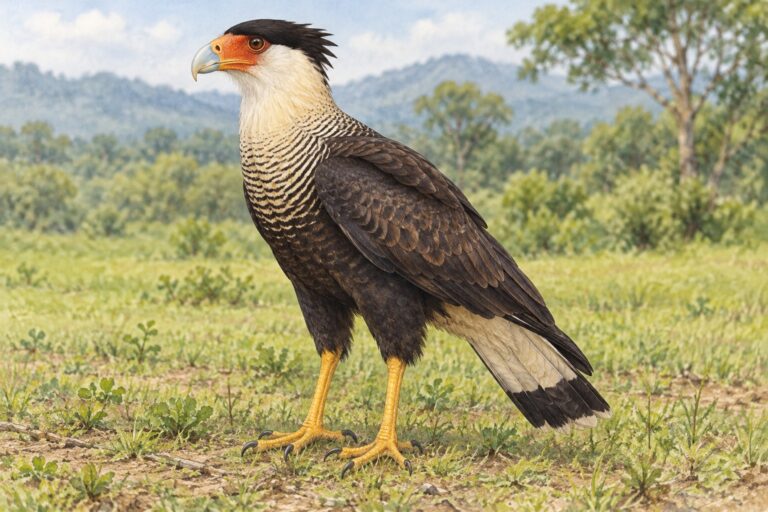
Crested Caracara

Spanish name
Caracara cargahuesos
Scientific name
Caracara plancus

What Do Pico & Tati Think?

Pico: “That bird of prey is walking!”

Tati: “Caracaras often search on foot. Look at those long legs.”

Identification

Key Features of the Crested Caracara

  • Dark cap and pale neck

  • Orange-red bare face

  • Long legs and hooked bill

Habitat & range

Open northwestern landscapes, pasture, farmland and beaches, with local occurrence around Rio Frio and occasional movement into San Carlos. This conservative set omits occasional Central Valley wanderers.

Conservation & care

Observe quietly from trails or established viewing areas. Give nests, roosts and feeding birds space. Do not handle, chase or lure birds with playback. Keep pets away from wildlife.

Threats & pressures

Protect native vegetation, reduce collision hazards around glass and keep cats away from birds. These are practical prevention priorities, not a claim of a measured decline at a specific Costa Rican site.

View full profile →

Nature Field Guide

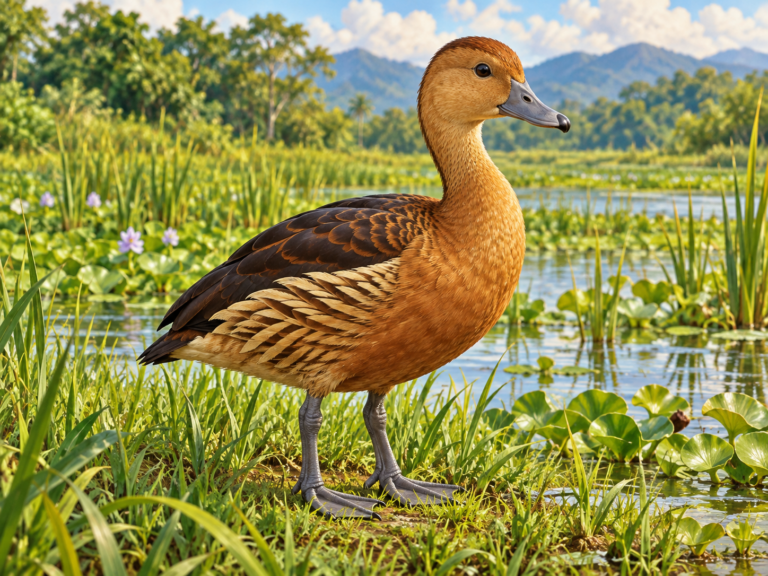
Fulvous Whistling-Duck

Spanish name
Pijije canelo
Scientific name
Dendrocygna bicolor

What Do Pico & Tati Think?

Pico: “That duck has such a long neck!”

Tati: “Let’s compare its colors with the other ducks.”

Identification

Key Features of the Fulvous Whistling-Duck

  • Warm caramel-brown neck and underparts.

  • Dark bill, long neck and long legs.

  • Pale flank markings on a darker body.

Habitat & range

Documented in the Tempisque and Palo Verde wetland landscape. Freshwater marshes, shallow flooded areas and rice-growing wetlands are relevant habitats.

Conservation & care

Stay on authorized trails or viewing routes. Give birds space, keep voices low and leave nests undisturbed. Observe without bait, feeding or recorded calls.

View full profile →

Nature Field Guide

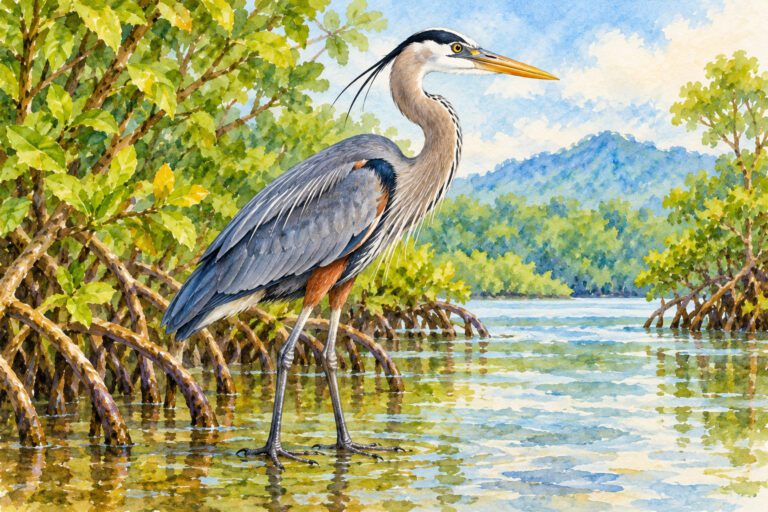
Great Blue Heron

Spanish name
Garzón azulado
Scientific name
Ardea herodias

What Do Pico & Tati Think?

A tall, patient hunter can make the whole shoreline feel still. Pico counts its slow steps while Tati watches its folded neck.

Identification

Key Features of the Great Blue Heron

  • Large blue-gray body

  • Long legs and a heavy yellowish bill

  • Pale head with a dark stripe above the eye

Habitat & range

Scan shallow water, quiet mangrove channels and vegetated wetland margins from an established viewpoint. Follow a local guide’s directions around estuaries.

Conservation & care

Give feeding and resting birds space. If a bird stops feeding, repeatedly looks at you or moves away, increase your distance. Keep dogs away from flocks, avoid playback and feeding, and leave nests and natural shoreline debris undisturbed.

View full profile →

Nature Field Guide

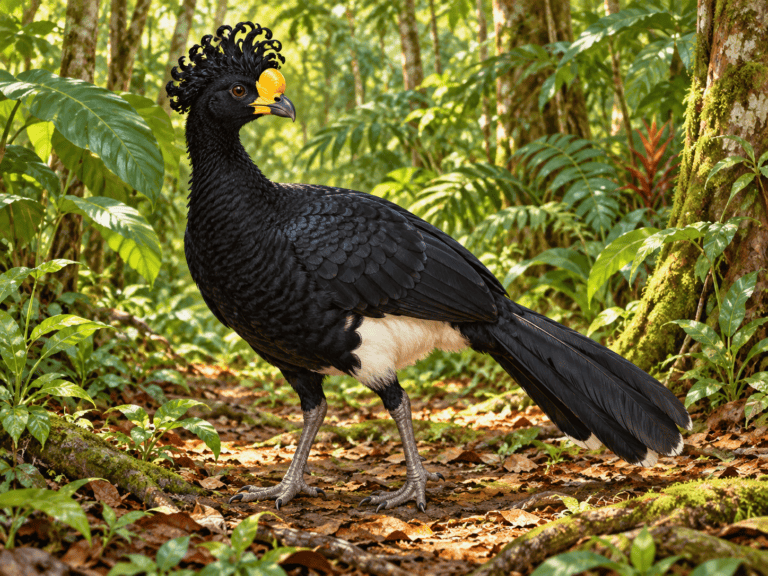
Great Curassow

Spanish name
Pavón
Scientific name
Crax rubra

What Do Pico & Tati Think?

Pico: “Those head feathers curl forward!”

Tati: “Let’s stay still while it searches the forest floor.”

Identification

Key Features of the Great Curassow

  • Curled feathers form a forward-facing crest.

  • Male: black body, white belly and yellow bill swelling.

  • Female plumage varies; no yellow bill swelling.

Habitat & range

Local surviving forest populations include Santa Rosa, Rincon de la Vieja, Braulio Carrillo and Corcovado. Present distribution is patchy; historical lowland range is not a promise of local occurrence.

Seasonal Calendar

Nesting

ACG / Costa Rican lowland forest

Mar, Apr, May

Legacy natural-history account reports egg laying; local dates and other regions can differ.

Event source ↗

Conservation & care

Stay on authorized trails or viewing routes. Give birds space, keep voices low and leave nests undisturbed. Observe without bait, feeding or recorded calls.

Threats & pressures

La Amistad’s management plan identifies hunting and forest pressures on the Pacific boundary. These are habitat-level concerns; no local curassow decline percentage is assigned.

Conservation assessment

ACG describes the species as Vulnerable; this is not a local population estimate. Source checked 7 October 2026. This is a global species category, not a count of birds in the tagged towns.

View full profile →

Nature Field Guide

Great Egret

Spanish name
Garceta grande
Scientific name
Ardea alba

What Do Pico & Tati Think?

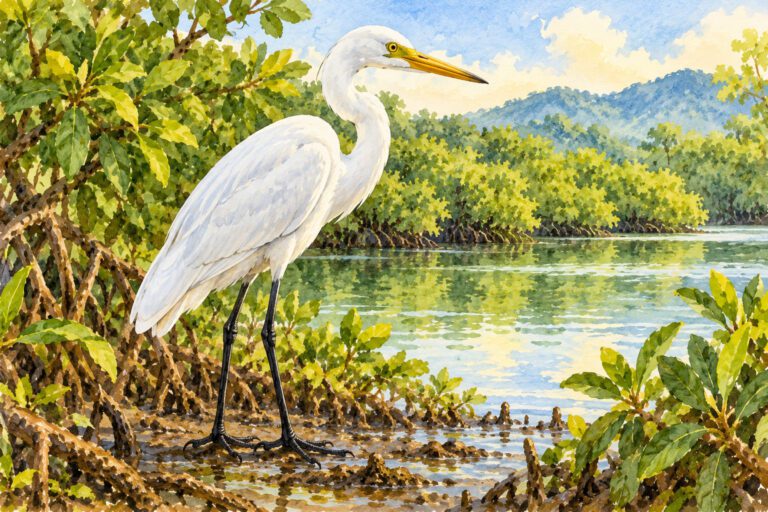
Pico calls it a bright white shape in the green. Tati checks the bill and feet before giving it a name.

Identification

Key Features of the Great Egret

  • White plumage and long slender neck

  • Yellow bill

  • Black legs and dark feet

Habitat & range

Scan shallow water, quiet mangrove channels and vegetated wetland margins from an established viewpoint. Follow a local guide’s directions around estuaries.

Conservation & care

Give feeding and resting birds space. If a bird stops feeding, repeatedly looks at you or moves away, increase your distance. Keep dogs away from flocks, avoid playback and feeding, and leave nests and natural shoreline debris undisturbed.

View full profile →

Nature Field Guide

Great Green Macaw

Spanish name
Lapa verde
Scientific name
Ara ambiguus

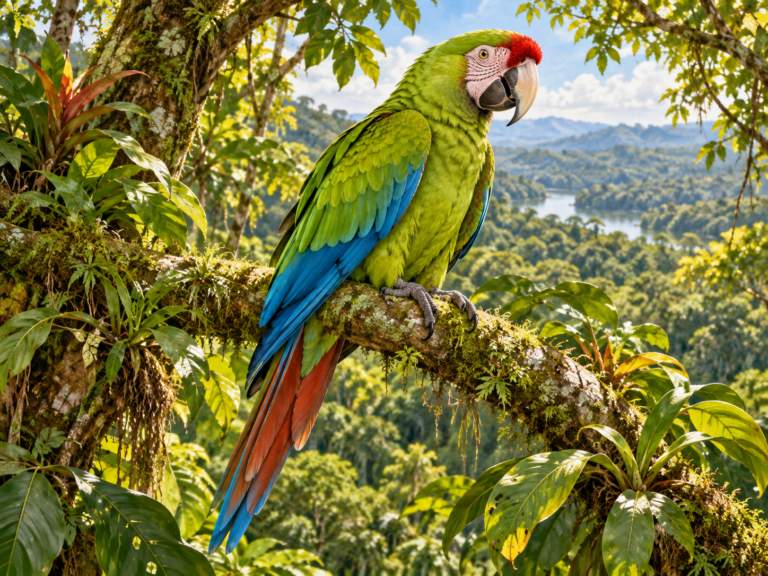
What Do Pico & Tati Think?

Pico: “That green bird almost matches the treetops!”

Tati: “Its forest needs room for feeding and nesting.”

Identification

Key Features of the Great Green Macaw

  • Mainly green plumage with a reddish forehead.

  • Blue in the wings and a long tail.

  • Large, powerful bill.

Habitat & range

Humid northern and Caribbean lowland forest. Birds move with food availability. Northern Plains and Caribbean are broad browsing areas, not claims of continuous occupation.

Seasonal Calendar

Breeding

Costa Rica; broad national window

Jan, Feb, Mar, Apr, Dec

Costa Rican dry-season breeding window; individual sites vary.

Event source ↗

Conservation & care

Stay on authorized trails or viewing routes. Give birds space, keep voices low and leave nests undisturbed. Observe without bait, feeding or recorded calls.

Threats & pressures

Habitat disturbance, logging of important nesting trees and illegal capture threaten this species.

Documented impact

BirdLife’s 2021 Red List update reported a 99% decline over three generations for Nicaragua/Costa Rica. This historical regional estimate is not a 2026 local census.

Protection & recovery

World Parrot Trust reports 50 chicks fledged from artificial nests in the Ara Manzanillo project in 2022, and more than 60 in 2023. These are project breeding outcomes, not the total wild population.

Conservation assessment

World Parrot Trust reports IUCN Critically Endangered. Source checked 7 October 2026. This is a global species category, not a count of birds in the tagged towns.

View full profile →

Nature Field Guide

Great Kiskadee

Spanish name
Bienteveo grande
Scientific name
Pitangus sulphuratus

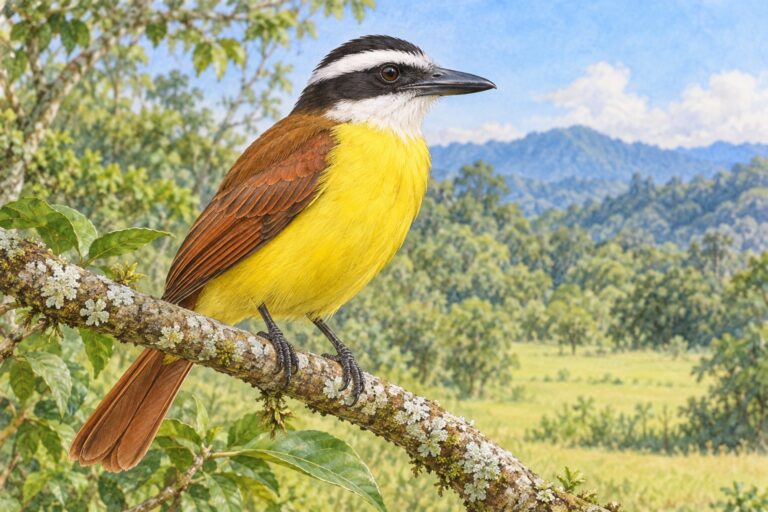
What Do Pico & Tati Think?

Pico: “It sounds like it is calling its own name!”

Tati: “Let’s also check its bold eyebrow and strong bill.”

Identification

Key Features of the Great Kiskadee

  • Black-and-white head pattern

  • Bright yellow belly

  • Heavy bill and reddish-brown wings

Habitat & range

Open wooded country and settled areas, often near water, on both slopes, mainly below about 1500 m. Less frequent in some southern Pacific areas; not a high-mountain specialist.

Conservation & care

Observe quietly from trails or established viewing areas. Give nests, roosts and feeding birds space. Do not handle, chase or lure birds with playback. Keep pets away from wildlife.

Threats & pressures

Protect native vegetation, reduce collision hazards around glass and keep cats away from birds. These are practical prevention priorities, not a claim of a measured decline at a specific Costa Rican site.

View full profile →

Nature Field Guide

Great Tinamou

Spanish name
Tinamú grande / Gallina de monte
Scientific name
Tinamus major

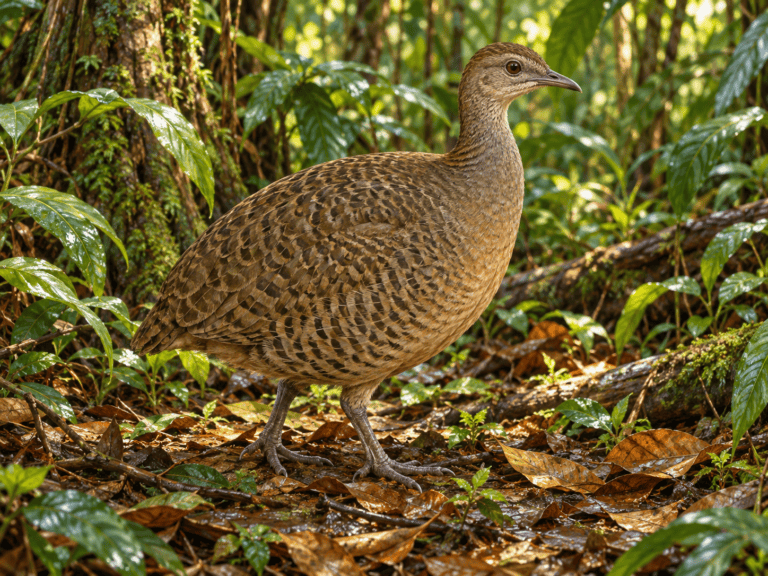
What Do Pico & Tati Think?

Pico: “I can hear a whistle, but the leaves hide the bird!”

Tati: “We can listen without leaving the trail.”

Identification

Key Features of the Great Tinamou

  • Rounded body with almost no visible tail.

  • Gray-brown, dark-barred plumage.

  • A clear whistle from the forest floor.

Habitat & range

Humid lowland and foothill forest on the Caribbean slope and southern Pacific, north toward Carara. Guanacaste refers to humid forest sectors, including documented ACG rainforest, not dry coastal forest.

Conservation & care

Stay on authorized trails or viewing routes. Give birds space, keep voices low and leave nests undisturbed. Observe without bait, feeding or recorded calls.

View full profile →

Nature Field Guide

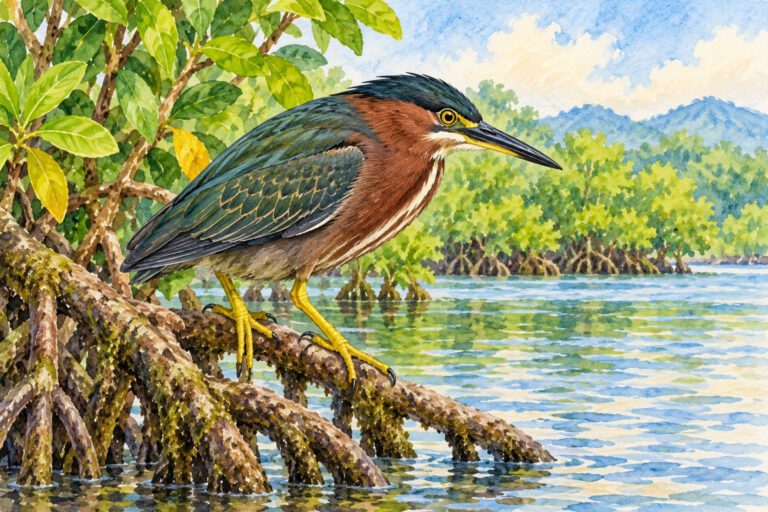
Green Heron

Spanish name
Garcilla verde
Scientific name
Butorides virescens

What Do Pico & Tati Think?

A small hunched shape almost disappears among the roots. Pico and Tati learn that patient looking beats noisy searching.

Identification

Key Features of the Green Heron

  • Small hunched silhouette

  • Greenish back and chestnut neck

  • Straight pointed bill and yellowish legs

Habitat & range

Scan shallow water, quiet mangrove channels and vegetated wetland margins from an established viewpoint. Follow a local guide’s directions around estuaries.

Conservation & care

Give feeding and resting birds space. If a bird stops feeding, repeatedly looks at you or moves away, increase your distance. Keep dogs away from flocks, avoid playback and feeding, and leave nests and natural shoreline debris undisturbed.

View full profile →

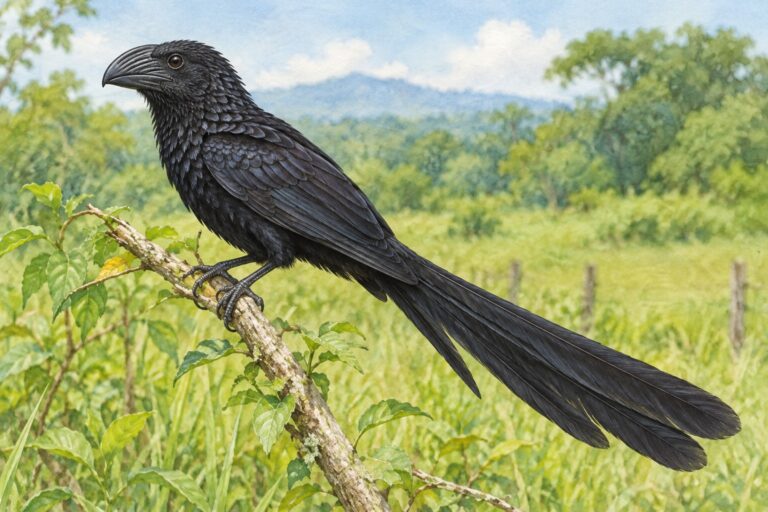
Nature Field Guide

Groove-billed Ani

Spanish name
Garrapatero piquiestriado / Tijo
Scientific name
Crotophaga sulcirostris

What Do Pico & Tati Think?

Pico: “Its beak has tiny lines!”

Tati: “Those grooves are helpful, but we need a clear view.”

Identification

Key Features of the Groove-billed Ani

  • All-black plumage

  • Long loosely held tail

  • Heavy upper bill with grooves

Habitat & range

Open and shrubby country, pasture margins and settled areas across Costa Rica, reaching middle elevations. It is less frequent in much of the southern Pacific, where Smooth-billed Ani predominates.

Conservation & care

Observe quietly from trails or established viewing areas. Give nests, roosts and feeding birds space. Do not handle, chase or lure birds with playback. Keep pets away from wildlife.

Threats & pressures

Protect native vegetation, reduce collision hazards around glass and keep cats away from birds. These are practical prevention priorities, not a claim of a measured decline at a specific Costa Rican site.

View full profile →

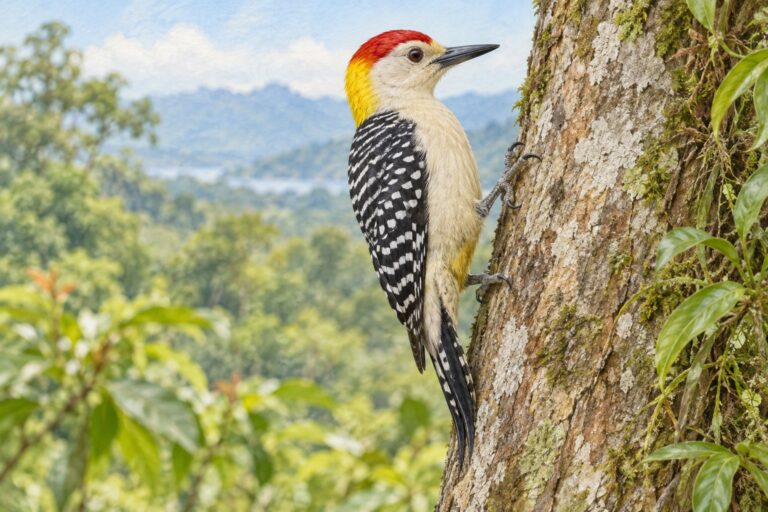
Nature Field Guide

Hoffmann’s Woodpecker

Spanish name
Carpintero de Hoffmann
Scientific name
Melanerpes hoffmannii

What Do Pico & Tati Think?

Pico: “Its back looks like a striped pattern!”

Tati: “Look at the crown too. Males and females differ there.”

Identification

Key Features of the Hoffmann’s Woodpecker

  • Black-and-white barred back

  • Yellow nape

  • Male has a red crown

Habitat & range

Strongest in the northern Pacific and Central Valley, extending south toward Tarcoles and locally into Rio Frio. Occurs along parts of the Reventazon corridor; avoid treating all Caribbean rainforest as typical habitat.

Conservation & care

Observe quietly from trails or established viewing areas. Give nests, roosts and feeding birds space. Do not handle, chase or lure birds with playback. Keep pets away from wildlife.

Threats & pressures

Protect native vegetation, reduce collision hazards around glass and keep cats away from birds. These are practical prevention priorities, not a claim of a measured decline at a specific Costa Rican site.

View full profile →

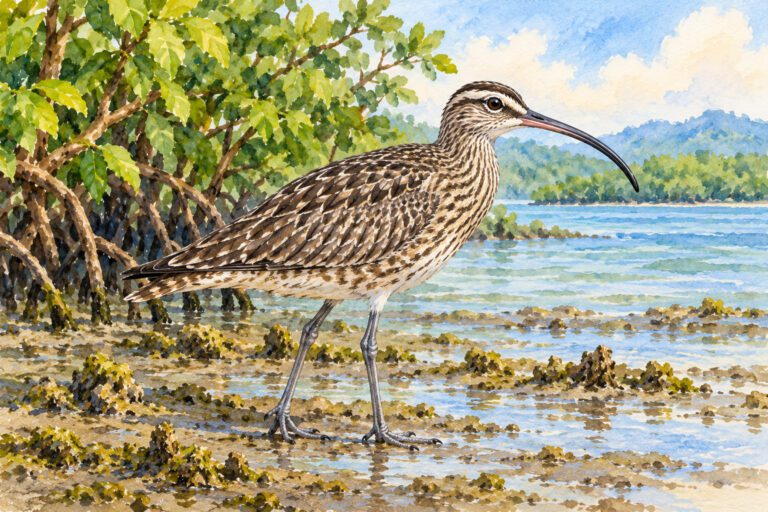
Nature Field Guide

Hudsonian Whimbrel

Spanish name
Zarapito trinador
Scientific name
Numenius hudsonicus

What Do Pico & Tati Think?

Pico curves his pencil line to match the bill. Tati checks the striped head for another clue.

Identification

Key Features of the Hudsonian Whimbrel

  • Long downward-curved bill

  • Striped brown head with a pale central crown stripe

  • Brown patterned body and long legs

Habitat & range

Scan exposed shoreline feeding areas and nearby resting places with binoculars. The tide changes which flats are available; remain on a safe established route.

Conservation & care

Give feeding and resting birds space. If a bird stops feeding, repeatedly looks at you or moves away, increase your distance. Keep dogs away from flocks, avoid playback and feeding, and leave nests and natural shoreline debris undisturbed.

View full profile →

Nature Field Guide

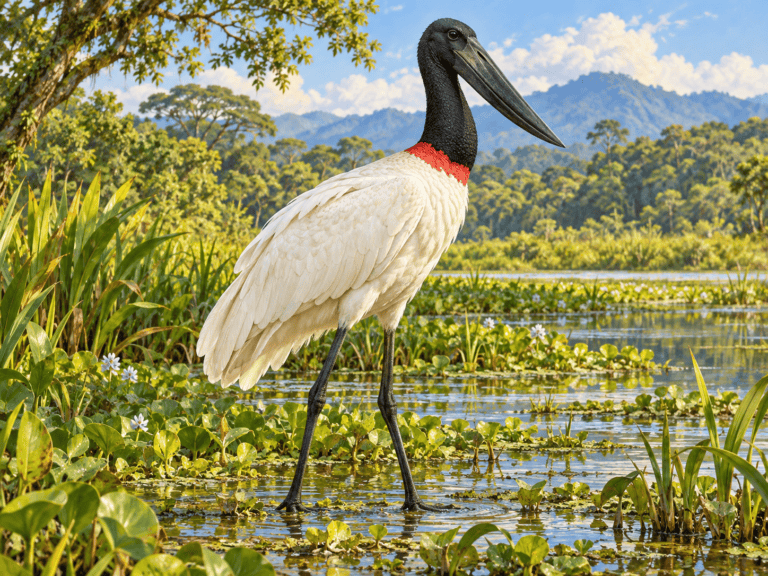
Jabiru

Spanish name
Jabirú / Galán sin ventura
Scientific name
Jabiru mycteria

What Do Pico & Tati Think?

Pico: “That bird is standing so tall in the wetland!”

Tati: “Its shape tells us more than size alone.”

Identification

Key Features of the Jabiru

  • Large white body with black bare head and neck.

  • Red band at the lower neck.

  • Massive dark bill and very long legs.

Habitat & range

The Tempisque basin is the principal nesting landscape. Cano Negro and Rio Frio receive seasonal visitors; not all wetlands in either region support Jabirus.

Conservation & care

Stay on authorized trails or viewing routes. Give birds space, keep voices low and leave nests undisturbed. Observe without bait, feeding or recorded calls.

View full profile →

Nature Field Guide

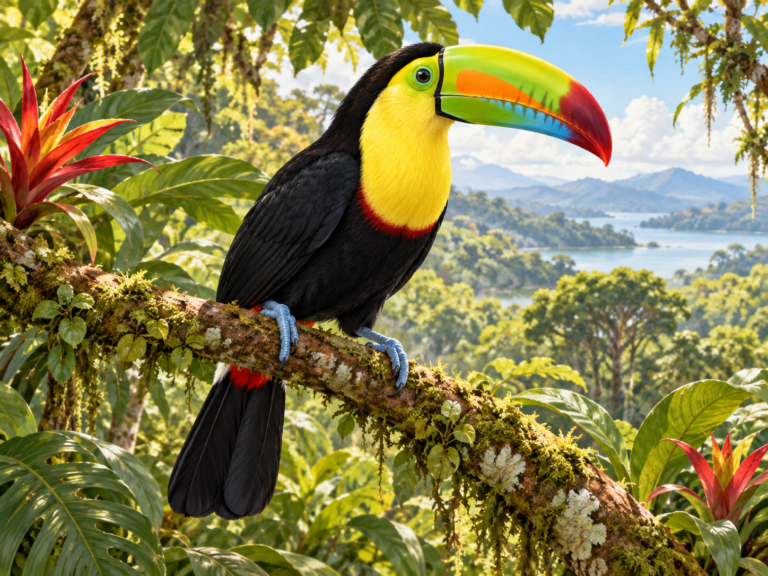
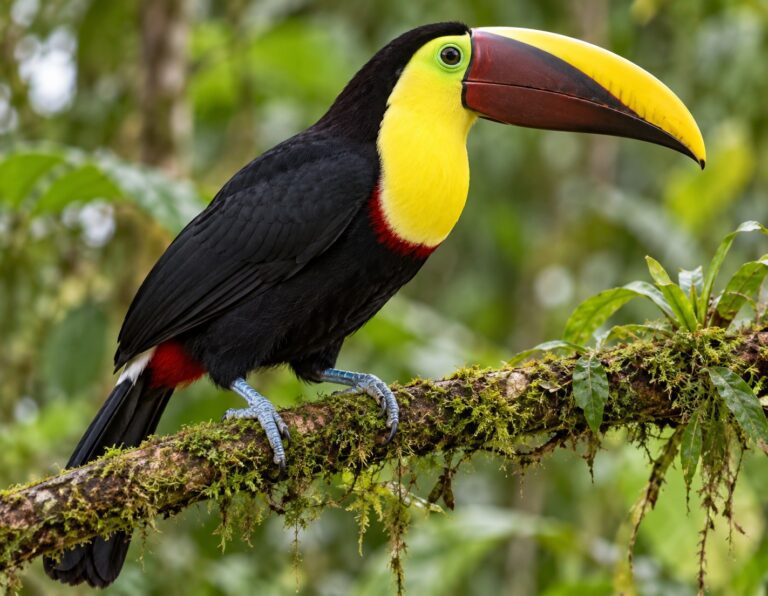
Keel-billed Toucan

Spanish name
Tucán pico arco iris / Pico canoa
Scientific name
Ramphastos sulfuratus

What Do Pico & Tati Think?

Pico: “Its bill has so many colors!”

Tati: “Let’s look at the throat and body too.”

Identification

Key Features of the Keel-billed Toucan

  • Large bill with several bright colors.

  • Yellow throat and dark body.

  • Compare the entire silhouette with other toucans.

Habitat & range

Most frequent in wooded Caribbean lowlands. Also occurs in suitable northern Pacific woodland, Nicoya hills, foothills and parts of the Central Valley; generally less frequent there.

Conservation & care

Stay on authorized trails or viewing routes. Give birds space, keep voices low and leave nests undisturbed. Observe without bait, feeding or recorded calls.

Conservation assessment

Costa Rica’s government wildlife guide reports IUCN Near Threatened and a decreasing trend; the page does not supply the assessment year. Source checked 7 October 2026. This is a global species category, not a count of birds in the tagged towns.

View full profile →

Nature Field Guide

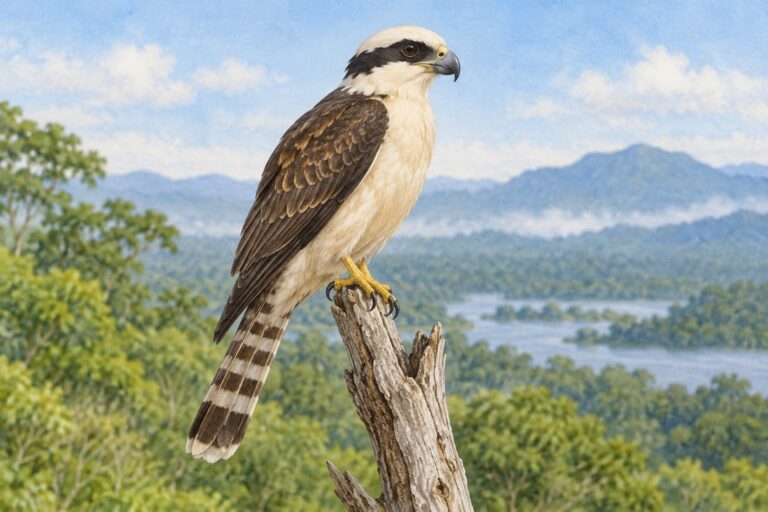
Laughing Falcon

Spanish name
Guaco
Scientific name
Herpetotheres cachinnans

What Do Pico & Tati Think?

Pico: “It sounds like a laugh!”

Tati: “That call explains its name. Its wide eye mask helps us recognize it too.”

Identification

Key Features of the Laughing Falcon

  • Creamy head and underparts

  • Broad black eye mask

  • Dark upperparts

Habitat & range

Lowland forest edges, secondary woodland and partly open country on both slopes. Occasional higher-elevation records do not make high mountain forest core habitat.

Conservation & care

Observe quietly from trails or established viewing areas. Give nests, roosts and feeding birds space. Do not handle, chase or lure birds with playback. Keep pets away from wildlife.

Threats & pressures

Protect native vegetation, reduce collision hazards around glass and keep cats away from birds. These are practical prevention priorities, not a claim of a measured decline at a specific Costa Rican site.

View full profile →

Nature Field Guide

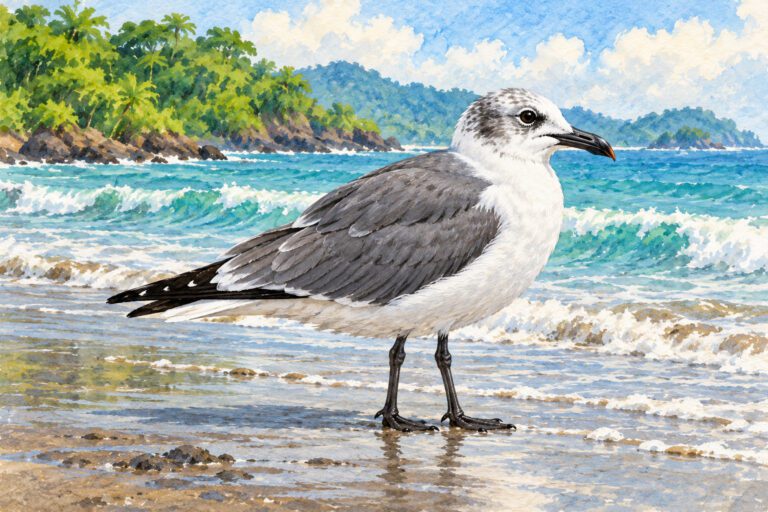
Laughing Gull

Spanish name
Gaviota reidora
Scientific name
Leucophaeus atricilla

What Do Pico & Tati Think?

Pico hears a call that sounds like laughter. Tati checks the season before expecting a black hood.

Identification

Key Features of the Laughing Gull

  • Dark gray back and pale body

  • Blackish wingtips

  • Breeding adults have a dark hood

  • Winter head is paler with gray smudges

Habitat & range

Scan coastal waters and undisturbed shoreline resting places from a safe public viewpoint. Keep boats and people away from nesting or resting colonies.

Conservation & care

Give feeding and resting birds space. If a bird stops feeding, repeatedly looks at you or moves away, increase your distance. Keep dogs away from flocks, avoid playback and feeding, and leave nests and natural shoreline debris undisturbed.

View full profile →

Nature Field Guide

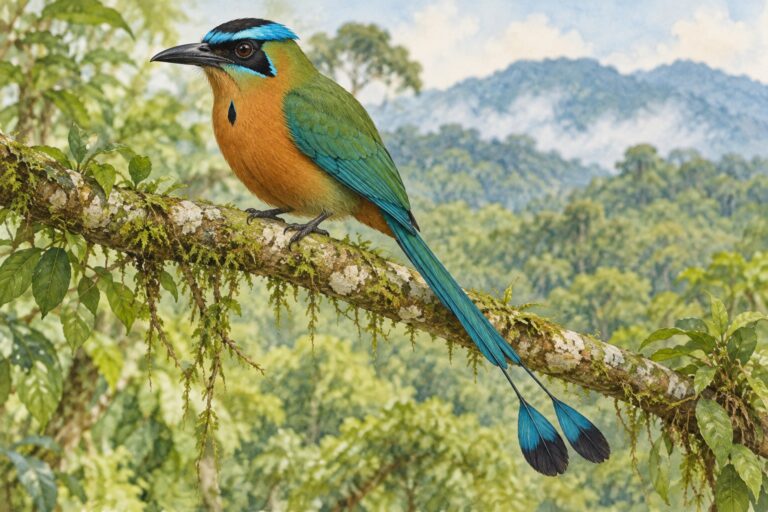
Lesson’s Motmot

Spanish name
Momoto coroniazul
Scientific name
Momotus lessonii

What Do Pico & Tati Think?

Pico: “Its tail has tiny paddles!”

Tati: “They are feather tips. Let’s compare the crown with our other motmot.”

Identification

Key Features of the Lesson’s Motmot

  • Blue crown with dark center

  • Dark eye mask

  • Long central tail feathers with racket tips

Habitat & range

Pacific lowlands and middle elevations, the Central Valley and locally northern areas. In the dry northwest it is associated especially with gallery forest. Most Caribbean lowlands are outside its usual range.

Conservation & care

Observe quietly from trails or established viewing areas. Give nests, roosts and feeding birds space. Do not handle, chase or lure birds with playback. Keep pets away from wildlife.

Threats & pressures

Protect native vegetation, reduce collision hazards around glass and keep cats away from birds. These are practical prevention priorities, not a claim of a measured decline at a specific Costa Rican site.

View full profile →

Nature Field Guide

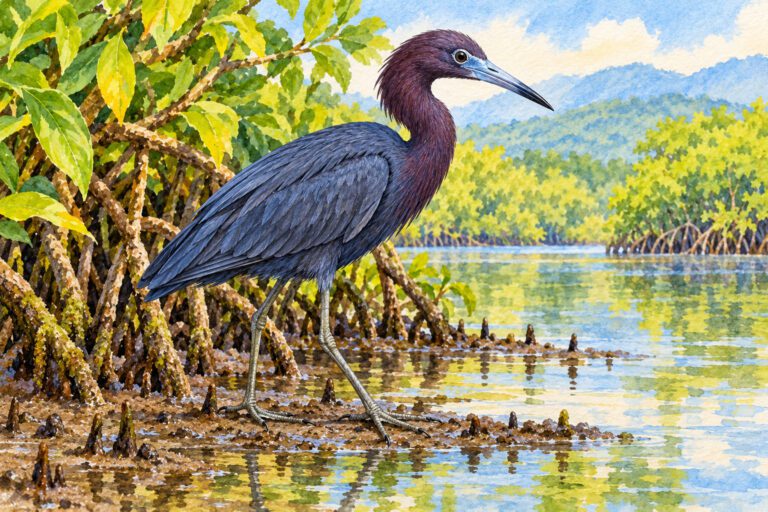
Little Blue Heron

Spanish name
Garceta azul
Scientific name
Egretta caerulea

What Do Pico & Tati Think?

Pico expects every Little Blue Heron to be blue. Tati discovers that young birds tell a different color story.

Identification

Key Features of the Little Blue Heron

  • Adult slate-blue body and purplish neck

  • Two-toned bill with a dark tip

  • Juveniles are white, unlike the illustrated adult

Habitat & range

Scan shallow water, quiet mangrove channels and vegetated wetland margins from an established viewpoint. Follow a local guide’s directions around estuaries.

Conservation & care

Give feeding and resting birds space. If a bird stops feeding, repeatedly looks at you or moves away, increase your distance. Keep dogs away from flocks, avoid playback and feeding, and leave nests and natural shoreline debris undisturbed.

View full profile →

Nature Field Guide

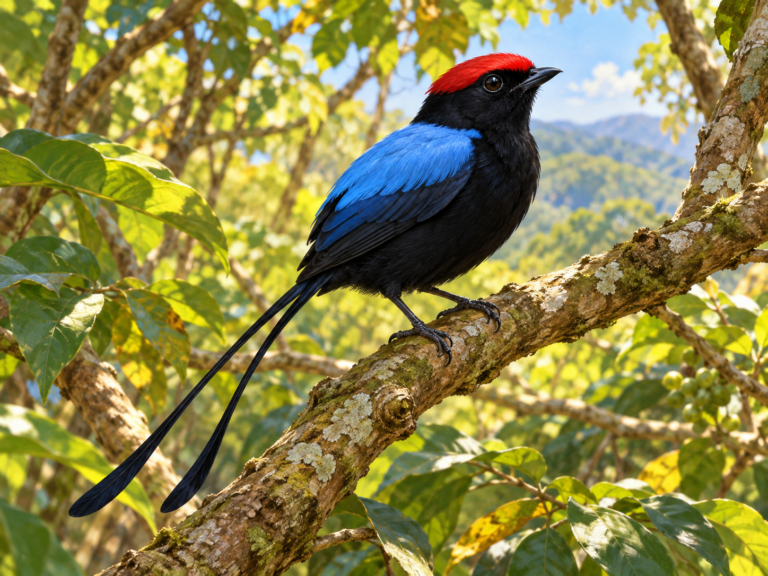
Long-tailed Manakin

Spanish name
Saltarín toledo
Scientific name
Chiroxiphia linearis

What Do Pico & Tati Think?

Pico: “Two birds are moving together on the branches!”

Tati: “We can watch the rhythm without interrupting.”

Identification

Key Features of the Long-tailed Manakin

  • Adult male: black body, blue back and red crown.

  • Long central tail feathers in males.

  • Female: less conspicuous greenish plumage.

Habitat & range

Gallery forest, mature secondary woodland and mangrove edges in the northern Pacific, extending toward Carara, the Central Valley and suitable Dota slopes. Shaded woodland is essential.

Conservation & care

Stay on authorized trails or viewing routes. Give birds space, keep voices low and leave nests undisturbed. Observe without bait, feeding or recorded calls.

View full profile →

Nature Field Guide

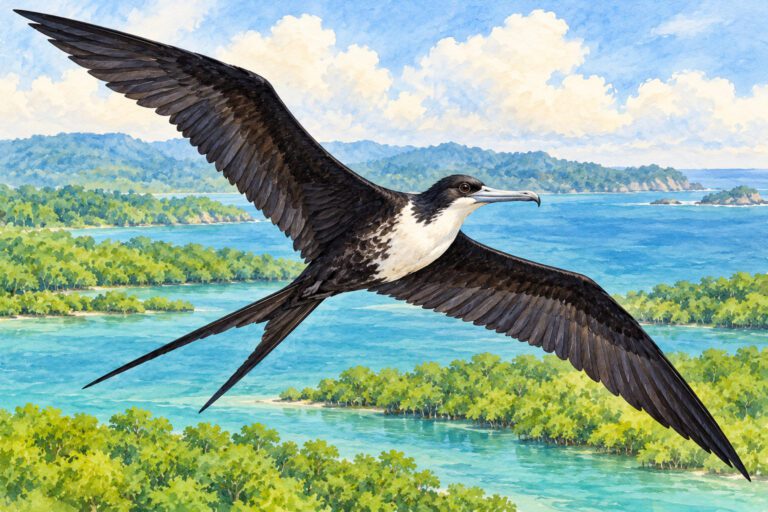
Magnificent Frigatebird

Spanish name
Rabihorcado magnífico
Scientific name
Fregata magnificens

What Do Pico & Tati Think?

Pico draws a bird that barely seems to flap. Tati adds a deeply forked tail to finish its sky silhouette.

Identification

Key Features of the Magnificent Frigatebird

  • Very long angular wings

  • Deeply forked tail

  • Adult male dark with red throat skin

  • Adult female has a white chest

Habitat & range

Scan coastal waters and undisturbed shoreline resting places from a safe public viewpoint. Keep boats and people away from nesting or resting colonies.

Conservation & care

Give feeding and resting birds space. If a bird stops feeding, repeatedly looks at you or moves away, increase your distance. Keep dogs away from flocks, avoid playback and feeding, and leave nests and natural shoreline debris undisturbed.

View full profile →

Nature Field Guide

Montezuma Oropendola

Spanish name
Oropéndola de Moctezuma
Scientific name
Psarocolius montezuma

What Do Pico & Tati Think?

Pico: “Those nests hang like long baskets!”

Tati: “We can admire their shape from a distance and leave the colony quiet.”

Identification

Key Features of the Montezuma Oropendola

  • Black head and chestnut body

  • Yellow outer tail feathers

  • Large patterned bill and bare cheek area

Habitat & range

Most frequent in Caribbean lowlands, with distribution through the Reventazon basin and parts of the Central Valley. Local in the northwest, especially near mountain bases; not uniformly common across Guanacaste.

Conservation & care

Observe quietly from trails or established viewing areas. Give nests, roosts and feeding birds space. Do not handle, chase or lure birds with playback. Keep pets away from wildlife.

Threats & pressures

Protect native vegetation, reduce collision hazards around glass and keep cats away from birds. These are practical prevention priorities, not a claim of a measured decline at a specific Costa Rican site.

View full profile →

Nature Field Guide

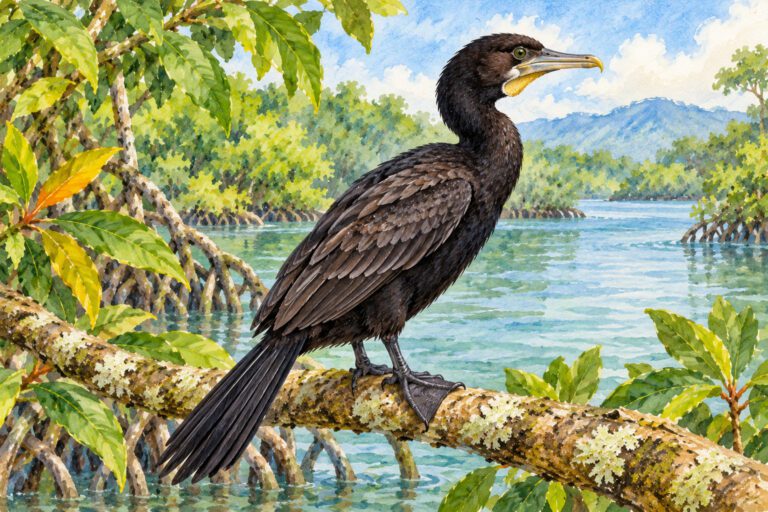
Neotropic Cormorant

Spanish name
Cormorán neotropical
Scientific name
Nannopterum brasilianum

What Do Pico & Tati Think?

Pico watches a dark swimmer vanish below the surface. Tati looks for its hooked bill when it returns.

Identification

Key Features of the Neotropic Cormorant

  • Dark body and long tail

  • Slender neck

  • Bill with a hooked tip

  • Often dives from the water surface

Habitat & range

Look across sheltered wetlands, lagoons and river margins from permitted trails or a responsible guided boat trip.

Conservation & care

Give feeding and resting birds space. If a bird stops feeding, repeatedly looks at you or moves away, increase your distance. Keep dogs away from flocks, avoid playback and feeding, and leave nests and natural shoreline debris undisturbed.

View full profile →

Nature Field Guide

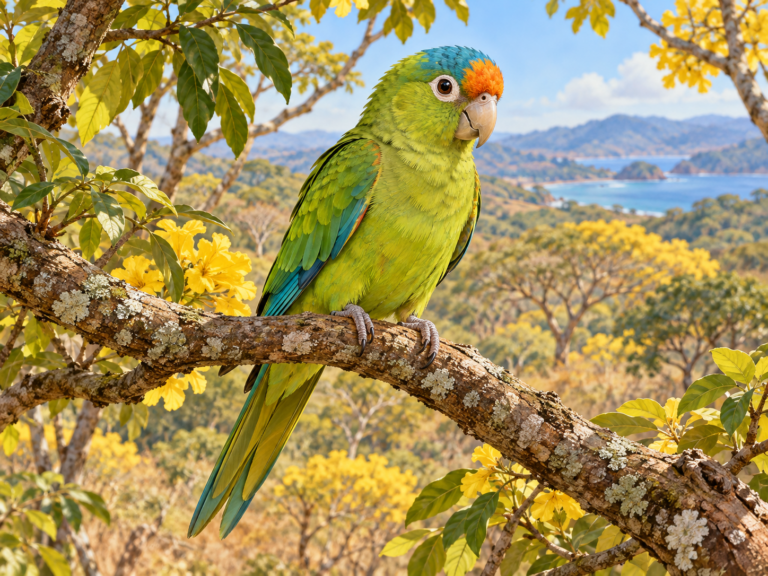
Orange-fronted Parakeet

Spanish name
Perico frentinaranja / Catano
Scientific name
Eupsittula canicularis

What Do Pico & Tati Think?

Pico: “That little flock turns so quickly!”

Tati: “Let’s look for orange above the bill when one lands.”

Identification

Key Features of the Orange-fronted Parakeet

  • Orange forehead above the bill.

  • Pale yellow eye ring and green body.

  • Long pointed tail; agile flock flight.

Habitat & range

Northern Pacific lowlands, Tilaran and Nicoya hills. Occurs locally in the western Central Valley. Regional tags do not imply abundance in every town.

Seasonal Calendar

Year-round presence

Santa Rosa, ACG

Year-round

Source describes presence in nearly any season; La Cruz is the gateway, not the observation site.

Event source ↗

Fledgling family activity

Santa Rosa / lowland ACG

May, Jun

Source describes begging fledglings in May and June; not a fixed date for every nest.

Event source ↗

Conservation & care

Stay on authorized trails or viewing routes. Give birds space, keep voices low and leave nests undisturbed. Observe without bait, feeding or recorded calls.

Threats & pressures

ACG documents capture of nestlings for the pet trade outside the protected area. Habitat and safe nesting sites also matter.

View full profile →

Nature Field Guide

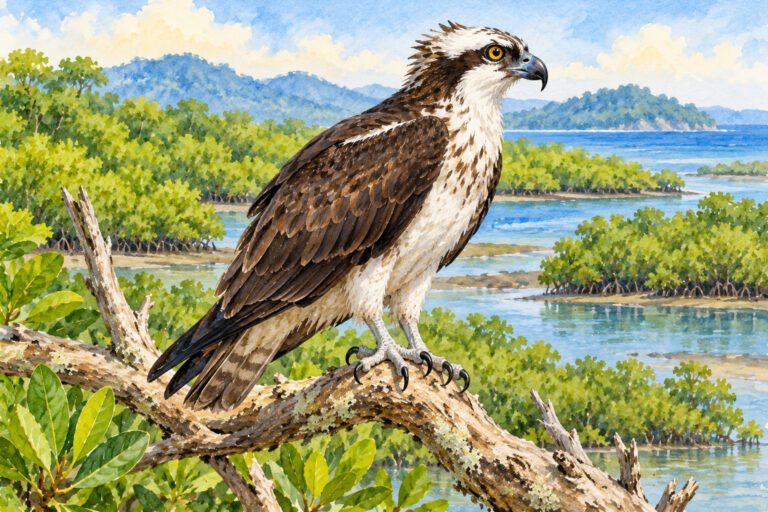
Osprey

Spanish name
Águila pescadora
Scientific name
Pandion haliaetus

What Do Pico & Tati Think?

Pico sees a fish hunter high above the water. Tati follows its shape with binoculars while keeping both feet on the trail.

Identification

Key Features of the Osprey

  • White head with broad dark eye stripe

  • Brown back and pale underparts

  • Hooked bill and powerful feet

  • Long angled wings in flight

Habitat & range

Scan exposed branches and the sky above fish-bearing rivers, estuaries and coastal water. Watch from a safe shore viewpoint.

Conservation & care

Give feeding and resting birds space. If a bird stops feeding, repeatedly looks at you or moves away, increase your distance. Keep dogs away from flocks, avoid playback and feeding, and leave nests and natural shoreline debris undisturbed.

View full profile →

Nature Field Guide

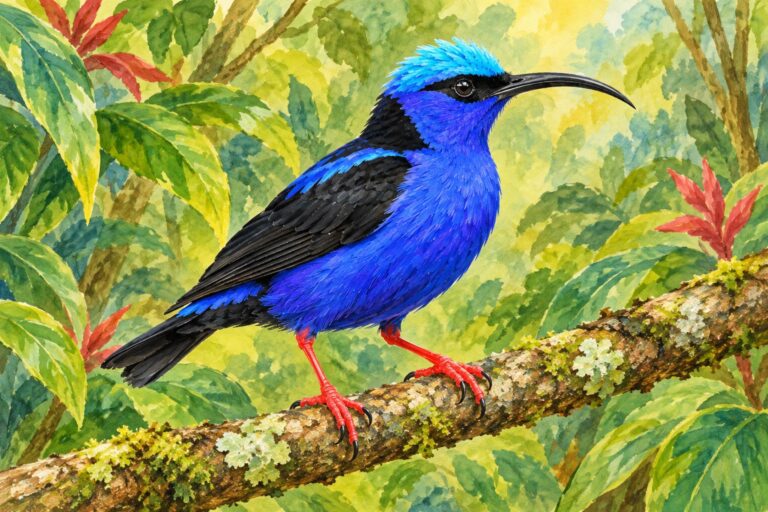
Red-legged Honeycreeper

Spanish name
Mielero patirrojo
Scientific name
Cyanerpes cyaneus

What Do Pico & Tati Think?

Pico: “Why are its feet so red?”

Tati: “Those red legs help us identify it, even when the body colors differ.”

Identification

Key Features of the Red-legged Honeycreeper

  • Bright red legs

  • Slender decurved bill

  • Breeding male blue with turquoise crown

Habitat & range

Wooded lowlands, forest edges, gardens and plantations. Common in northern Pacific areas and parts of Rio Frio; elsewhere on the Caribbean slope it is more local. Also occurs in the southern Pacific.

Conservation & care

Observe quietly from trails or established viewing areas. Give nests, roosts and feeding birds space. Do not handle, chase or lure birds with playback. Keep pets away from wildlife.

Threats & pressures

Protect native vegetation, reduce collision hazards around glass and keep cats away from birds. These are practical prevention priorities, not a claim of a measured decline at a specific Costa Rican site.

View full profile →

Nature Field Guide

Resplendent Quetzal

Spanish name
Quetzal
Scientific name
Pharomachrus mocinno

What Do Pico & Tati Think?

Pico: “Can you find green feathers among the green leaves?”

Tati: “Let’s watch the fruiting trees quietly.”

Identification

Key Features of the Resplendent Quetzal

  • Shimmering green upperparts and a red belly.

  • Adult males have very long upper-tail feathers.

  • Look in forest trees, especially where fruit is available.

Habitat & range

Forested mountains from the Tilaran range south through the Central and Talamanca ranges, principally cloud forest at suitable elevations. Lower-elevation seasonal movements need site-specific treatment.

Conservation & care

Stay on authorized trails or viewing routes. Give birds space, keep voices low and leave nests undisturbed. Observe without bait, feeding or recorded calls.

Threats & pressures

Forest loss and fragmentation can remove nesting cavities and interrupt access to seasonal feeding habitat.

Conservation assessment

American Bird Conservancy reports Near Threatened and a decreasing population trend. Source checked 7 October 2026. This is a global species category, not a count of birds in the tagged towns.

View full profile →

Nature Field Guide

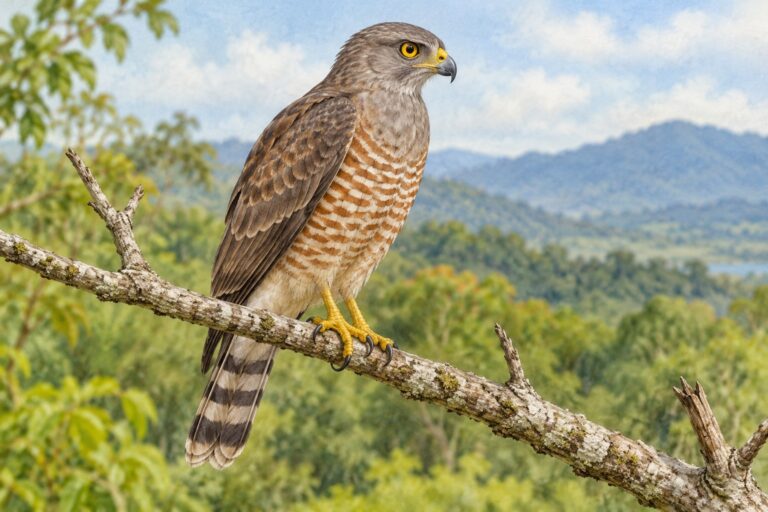
Roadside Hawk

Spanish name
Gavilán chapulinero
Scientific name
Rupornis magnirostris

What Do Pico & Tati Think?

Pico: “I can see stripes across its belly!”

Tati: “Those bars and its yellow eye help us check the identification.”

Identification

Key Features of the Roadside Hawk

  • Yellow eye

  • Rufous-and-white barred belly

  • Broad dark tail bands

Habitat & range

Lowland woodland edges, second growth and open country with trees on both slopes. More frequent in northern Pacific lowlands; local in the Central Valley and other areas.

Conservation & care

Observe quietly from trails or established viewing areas. Give nests, roosts and feeding birds space. Do not handle, chase or lure birds with playback. Keep pets away from wildlife.

Threats & pressures

Protect native vegetation, reduce collision hazards around glass and keep cats away from birds. These are practical prevention priorities, not a claim of a measured decline at a specific Costa Rican site.

View full profile →

Nature Field Guide

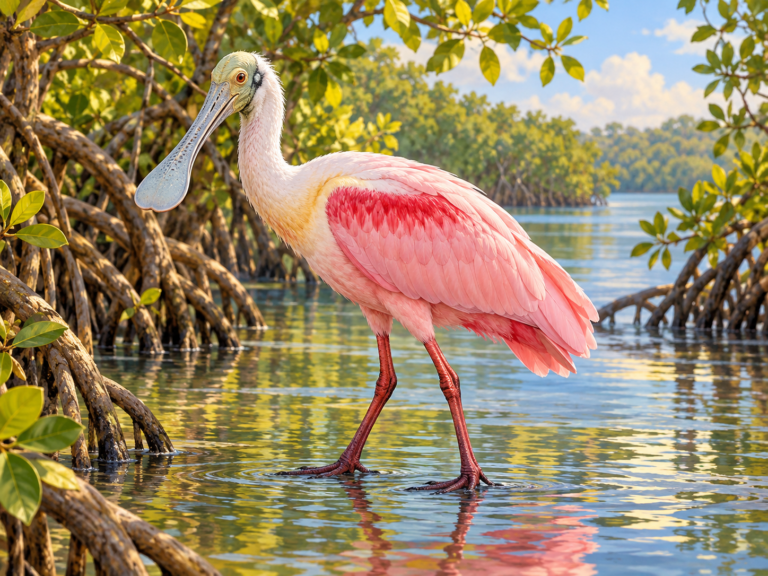
Roseate Spoonbill

Spanish name
Espátula rosada
Scientific name
Platalea ajaja

What Do Pico & Tati Think?

Pico: “Why does its bill widen at the end?”

Tati: “Let’s watch how it moves through the water.”

Identification

Key Features of the Roseate Spoonbill

  • Pink plumage, often paler in young birds.

  • Long bill with a broad, flattened spoon tip.

  • Side-to-side bill sweeping in shallow water.

Habitat & range

Shallow wetlands around Tempisque, Rio Frio and the Gulf of Nicoya, with smaller numbers elsewhere along the Pacific coast. Rare inland or Caribbean records are not used as core regional tags.

Conservation & care

Stay on authorized trails or viewing routes. Give birds space, keep voices low and leave nests undisturbed. Observe without bait, feeding or recorded calls.

Threats & pressures

Altered wetland water conditions can affect feeding habitat. Disturbance at nesting colonies can cause abandonment; keep boats and observers at a respectful distance.

View full profile →

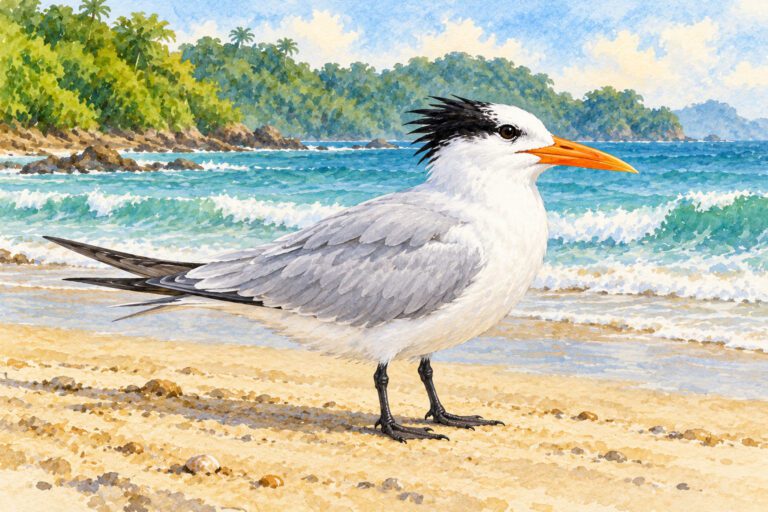
Nature Field Guide

Royal Tern

Spanish name
Pagaza real
Scientific name
Thalasseus maximus

What Do Pico & Tati Think?

Pico notices an orange bill above the tideline. Tati sketches the crest before the tern returns to fishing.

Identification

Key Features of the Royal Tern

  • Large orange pointed bill

  • Pale gray back and white body

  • Black legs

  • Dark rear crest, with a white forehead outside breeding

Habitat & range

Scan coastal waters and undisturbed shoreline resting places from a safe public viewpoint. Keep boats and people away from nesting or resting colonies.

Conservation & care

Give feeding and resting birds space. If a bird stops feeding, repeatedly looks at you or moves away, increase your distance. Keep dogs away from flocks, avoid playback and feeding, and leave nests and natural shoreline debris undisturbed.

View full profile →

Nature Field Guide

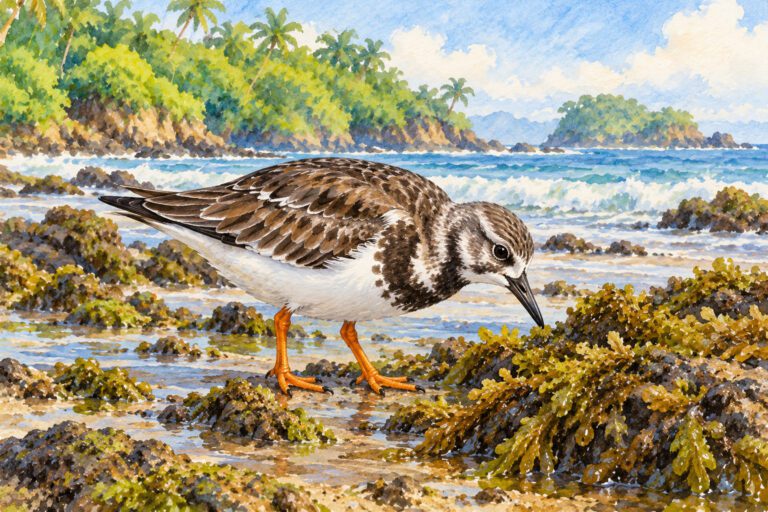
Ruddy Turnstone

Spanish name
Vuelvepiedras rojizo
Scientific name
Arenaria interpres

What Do Pico & Tati Think?

Pico watches a little bird investigate beach debris. Tati leaves the shells exactly where they belong.

Identification

Key Features of the Ruddy Turnstone

  • Short stout slightly upturned bill

  • Orange legs

  • Stocky body and dark breast patches

  • Nonbreeding back is brown rather than bright rusty

Habitat & range

Scan exposed shoreline feeding areas and nearby resting places with binoculars. The tide changes which flats are available; remain on a safe established route.

Conservation & care

Give feeding and resting birds space. If a bird stops feeding, repeatedly looks at you or moves away, increase your distance. Keep dogs away from flocks, avoid playback and feeding, and leave nests and natural shoreline debris undisturbed.

View full profile →

Nature Field Guide

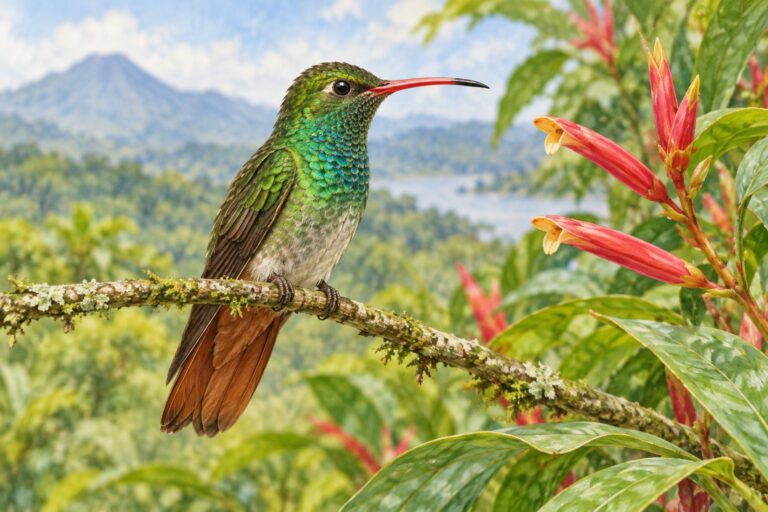
Rufous-tailed Hummingbird

Spanish name
Colibrí rabirrufo
Scientific name
Amazilia tzacatl

What Do Pico & Tati Think?

Pico: “That hummingbird has a rusty tail!”

Tati: “Let’s check its bill and belly too.”

Identification

Key Features of the Rufous-tailed Hummingbird

  • Rusty rufous tail

  • Green head and chest

  • Reddish bill with dark tip

Habitat & range

Widespread on both slopes from sea level locally to about 1850 m. Flowering gardens, secondary growth and river corridors are useful habitat; occurrence is more local in the dry northwest.

Conservation & care

Observe quietly from trails or established viewing areas. Give nests, roosts and feeding birds space. Do not handle, chase or lure birds with playback. Keep pets away from wildlife.

Threats & pressures

Protect native vegetation, reduce collision hazards around glass and keep cats away from birds. These are practical prevention priorities, not a claim of a measured decline at a specific Costa Rican site.

View full profile →

Nature Field Guide

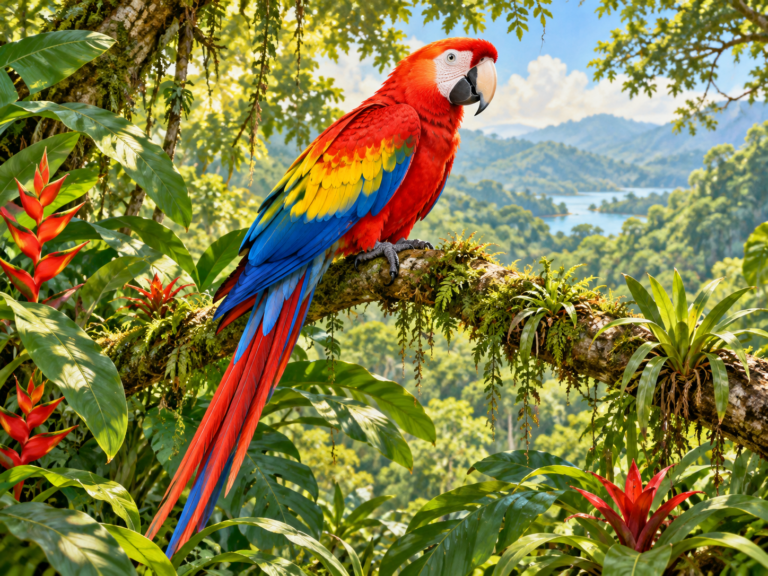
Scarlet Macaw

Spanish name
Lapa roja
Scientific name
Ara macao

What Do Pico & Tati Think?

Pico: “Those wings have three colors to discover!”

Tati: “Let’s listen, look up and give the pair room to fly.”

What does Least Concern mean?

In the linked conservation assessment, this species does not qualify as threatened or near threatened with extinction. It still needs care: local populations and habitats can face problems even when the species has a lower extinction risk overall.

This label describes conservation status. It does not tell us whether a plant is safe for children or pets. Select the status button to read the assessment.

Identification

Key Features of the Scarlet Macaw

  • Red body with yellow and blue wing feathers.

  • Long pointed tail and large pale upper bill.

  • Loud calls; birds may fly in pairs.

Habitat & range

Important populations occur around Carara and the Osa Peninsula. Guanacaste includes restored populations around Punta Islita; this does not imply occurrence throughout the region.

Seasonal Calendar

Breeding

Costa Rica; broad national window

Jan, Feb, Mar, Apr, Oct, Nov, Dec

Broad reported window, not a dated Carara nesting forecast.

Event source ↗

Conservation & care

Stay on authorized trails or viewing routes. Give birds space, keep voices low and leave nests undisturbed. Observe without bait, feeding or recorded calls.

Threats & pressures

Forest loss removes feeding and nesting trees. Capture for the pet trade also affects populations; global status does not describe every local population.

Conservation assessment

World Parrot Trust reports IUCN Least Concern; local declines are still documented. Source checked 7 October 2026. This is a global species category, not a count of birds in the tagged towns.

View full profile →

Nature Field Guide

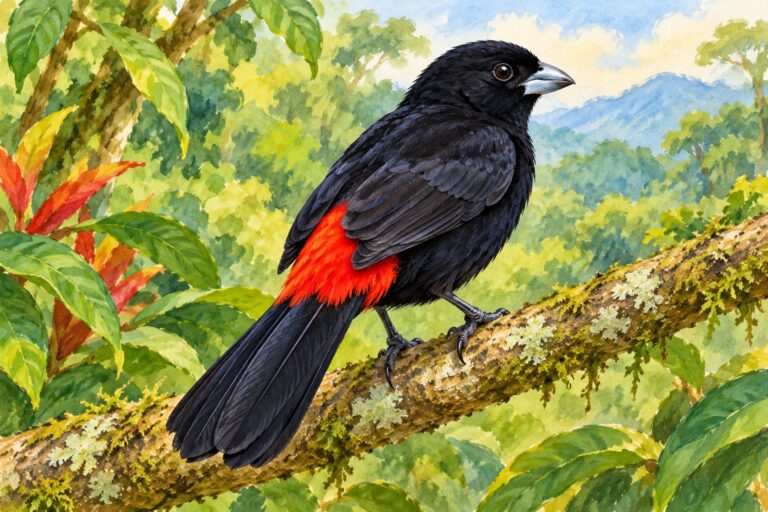
Scarlet-rumped Tanager

Spanish name
Tangara de Passerini
Scientific name
Ramphocelus passerinii

What Do Pico & Tati Think?

Pico: “I saw a bright red flash near its tail!”

Tati: “That rump patch is the clue. The male’s head stays black.”

Identification

Key Features of the Scarlet-rumped Tanager

  • Male black with scarlet rump

  • Pale silvery bill

  • Female plumage differs strongly

Habitat & range

Humid lowlands and foothills, secondary growth and wooded gardens on the Caribbean and Pacific slopes. This profile follows the current Costa Rican checklist's combined Scarlet-rumped Tanager treatment, including the southern Pacific form formerly called Cherrie's Tanager.

Conservation & care

Observe quietly from trails or established viewing areas. Give nests, roosts and feeding birds space. Do not handle, chase or lure birds with playback. Keep pets away from wildlife.

Threats & pressures

Protect native vegetation, reduce collision hazards around glass and keep cats away from birds. These are practical prevention priorities, not a claim of a measured decline at a specific Costa Rican site.

View full profile →

Nature Field Guide

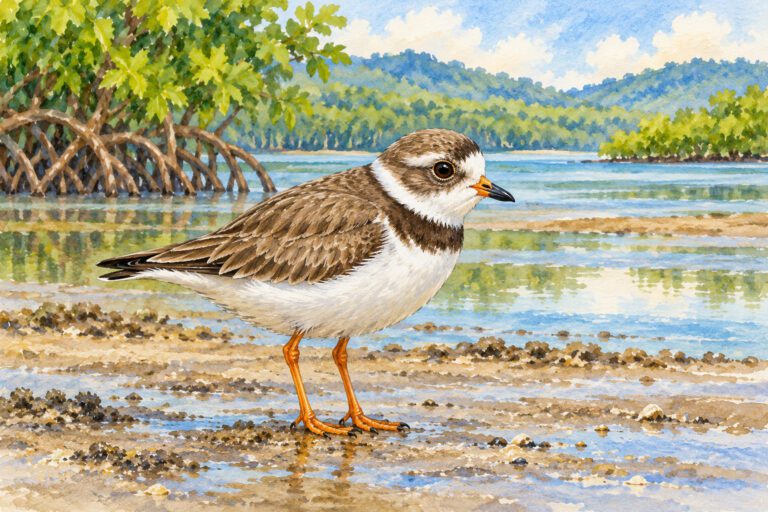
Semipalmated Plover

Spanish name
Chorlitejo semipalmado
Scientific name
Charadrius semipalmatus

What Do Pico & Tati Think?

Pico follows a run, then a stop. Tati notices one breast band on a small round shorebird.

Identification

Key Features of the Semipalmated Plover

  • Small compact brown-and-white body

  • One dark breast band

  • Short bill and orange legs

  • Run-and-pause feeding

Habitat & range

Scan exposed shoreline feeding areas and nearby resting places with binoculars. The tide changes which flats are available; remain on a safe established route.

Conservation & care

Give feeding and resting birds space. If a bird stops feeding, repeatedly looks at you or moves away, increase your distance. Keep dogs away from flocks, avoid playback and feeding, and leave nests and natural shoreline debris undisturbed.

View full profile →

Nature Field Guide

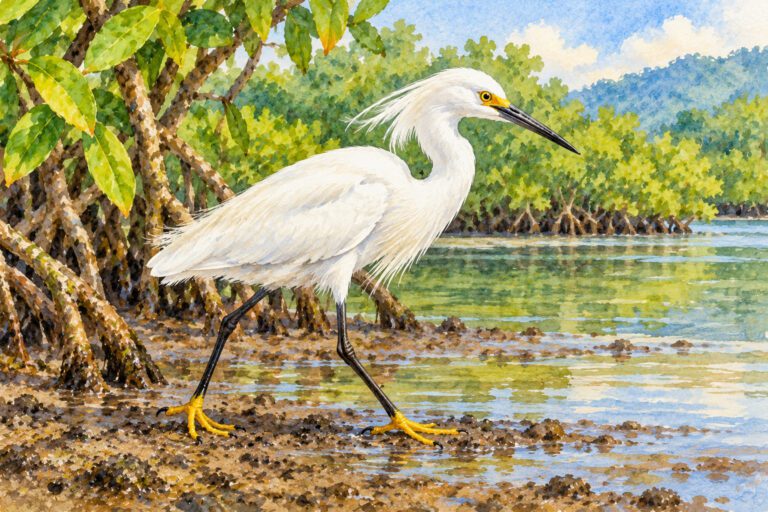
Snowy Egret

Spanish name
Garceta patiamarilla
Scientific name
Egretta thula

What Do Pico & Tati Think?

Those yellow feet catch Pico’s attention. Tati waits to see whether the bird uses them while feeding.

Identification

Key Features of the Snowy Egret

  • White body and slim black bill

  • Black legs with yellow feet

  • Often active in shallow water

Habitat & range

Scan shallow water, quiet mangrove channels and vegetated wetland margins from an established viewpoint. Follow a local guide’s directions around estuaries.

Conservation & care

Give feeding and resting birds space. If a bird stops feeding, repeatedly looks at you or moves away, increase your distance. Keep dogs away from flocks, avoid playback and feeding, and leave nests and natural shoreline debris undisturbed.

View full profile →

Nature Field Guide

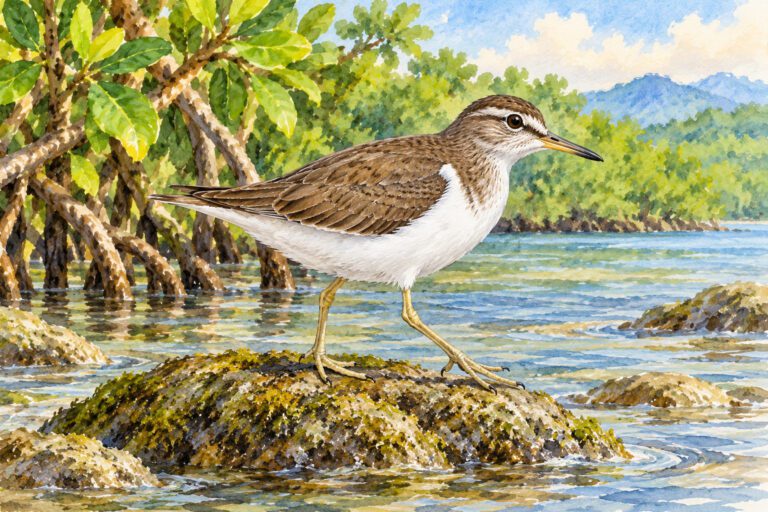
Spotted Sandpiper

Spanish name
Andarríos maculado
Scientific name
Actitis macularius

What Do Pico & Tati Think?

Pico looks for spots but finds a plain white belly. Tati learns that the name does not describe every season.

Identification

Key Features of the Spotted Sandpiper

  • Brown back and white underparts

  • Frequent tail bobbing

  • Short straight bill

  • Belly spots may be absent outside breeding

Habitat & range

Scan exposed shoreline feeding areas and nearby resting places with binoculars. The tide changes which flats are available; remain on a safe established route.

Conservation & care

Give feeding and resting birds space. If a bird stops feeding, repeatedly looks at you or moves away, increase your distance. Keep dogs away from flocks, avoid playback and feeding, and leave nests and natural shoreline debris undisturbed.

View full profile →

Nature Field Guide

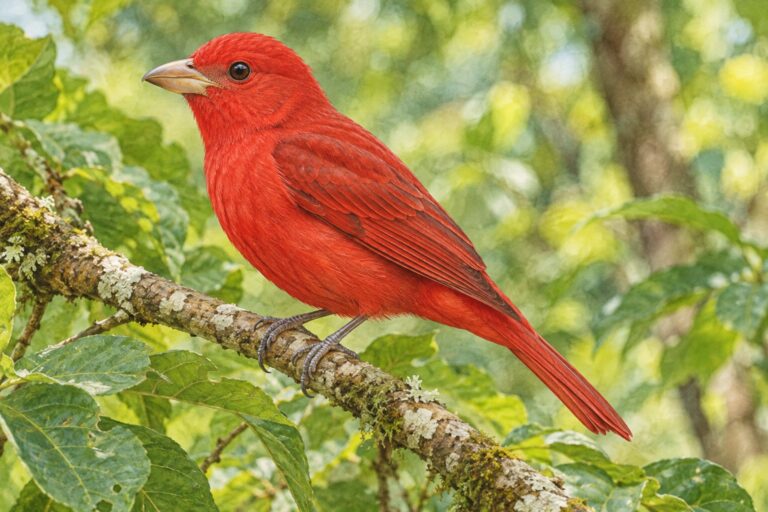
Summer Tanager

Spanish name
Tangara veranera
Scientific name
Piranga rubra

What Do Pico & Tati Think?

Pico: “Even its wings are red!”

Tati: “That helps us compare it with the scarlet tanager.”

Identification

Key Features of the Summer Tanager

  • Adult male entirely red

  • Hefty pale bill

  • Female yellowish and young males patchy

Habitat & range

A migrant and nonbreeding visitor, generally mid-September through April. Uses forest, edges and wooded gardens on both slopes, with fewer birds at higher elevations.

Conservation & care

Observe quietly from trails or established viewing areas. Give nests, roosts and feeding birds space. Do not handle, chase or lure birds with playback. Keep pets away from wildlife.

Threats & pressures

Migrants depend on suitable habitat across their full annual journey. Protect native vegetation, reduce collision hazards around glass and keep cats away from birds. These are practical prevention priorities, not a claim of a measured decline at a specific Costa Rican site.

View full profile →

Nature Field Guide

Sunbittern

Spanish name
Garza del sol
Scientific name
Eurypyga helias

What Do Pico & Tati Think?

Pico: “Its folded wings look so different from its open wings!”

Tati: “We will wait for natural movement instead of startling it.”

Identification

Key Features of the Sunbittern

  • Dark head with white stripes.

  • Long bill and slender neck.

  • Orange-chestnut wing pattern visible in a natural display.

Habitat & range

Wooded streams in Caribbean foothills and adjoining lowlands and the southern Pacific. Usually around 100–1200 m, locally higher in Coto Brus.

Conservation & care

Stay on authorized trails or viewing routes. Give birds space, keep voices low and leave nests undisturbed. Observe without bait, feeding or recorded calls.

Threats & pressures

Smithsonian identifies habitat loss as a pressure on Sunbittern populations.

View full profile →

Nature Field Guide

Three-wattled Bellbird

Spanish name
Pájaro campana
Scientific name
Procnias tricarunculatus

What Do Pico & Tati Think?

Pico: “That call sounds like a forest bell!”

Tati: “Let’s look high in the trees without calling it closer.”

Identification

Key Features of the Three-wattled Bellbird

  • Adult male: white head, chestnut body and three hanging wattles.

  • Females lack the male’s conspicuous wattles.

  • A loud, distinctive call from high forest perches.

Habitat & range

Breeds in mountain forest and moves downslope seasonally. Guanacaste includes mountain habitats; South Pacific includes Talamanca slopes and the General Valley. Not a year-round lowland bird throughout these regions.

Seasonal Calendar

Seasonal presence

Monteverde / Tilarán mountains

Mar, Apr, May, Jun, Jul, Aug

Reported upland presence; not a guarantee of calling, nesting or sightings throughout each month.

Event source ↗

Breeding

Caribbean slope of the Tilarán mountains, east of Monteverde

Feb, Mar, Apr, May

Reported for the Monteverde population; a different area from its later Pacific-slope feeding habitat.

Event source ↗

Post-breeding feeding movement

Pacific slope around Monteverde

Jun, Jul, Aug

Reported movement into fruiting forest; some birds remain into September.

Event source ↗

Conservation & care

Stay on authorized trails or viewing routes. Give birds space, keep voices low and leave nests undisturbed. Observe without bait, feeding or recorded calls.

Threats & pressures

Loss of mature forest and breaks in habitat along seasonal movement routes can reduce feeding and breeding opportunities.

Conservation assessment

American Bird Conservancy reports Vulnerable. Source checked 7 October 2026. This is a global species category, not a count of birds in the tagged towns.

View full profile →

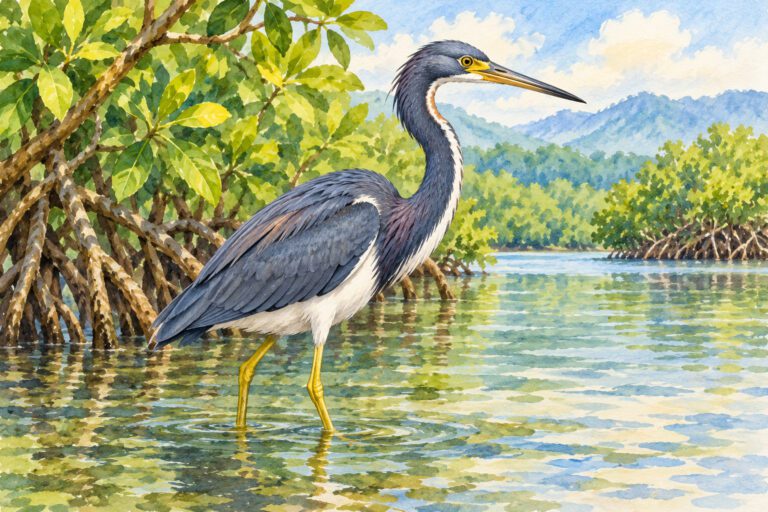
Nature Field Guide

Tricolored Heron

Spanish name
Garceta tricolor
Scientific name
Egretta tricolor

What Do Pico & Tati Think?

Pico follows a quick turn in the shallows. Tati notices the white belly beneath the darker neck.

Identification

Key Features of the Tricolored Heron

  • Dark blue-gray upperparts

  • White belly and pale front-neck stripe

  • Long slim bill and lively feeding movements

Habitat & range

Scan shallow water, quiet mangrove channels and vegetated wetland margins from an established viewpoint. Follow a local guide’s directions around estuaries.

Conservation & care

Give feeding and resting birds space. If a bird stops feeding, repeatedly looks at you or moves away, increase your distance. Keep dogs away from flocks, avoid playback and feeding, and leave nests and natural shoreline debris undisturbed.

View full profile →

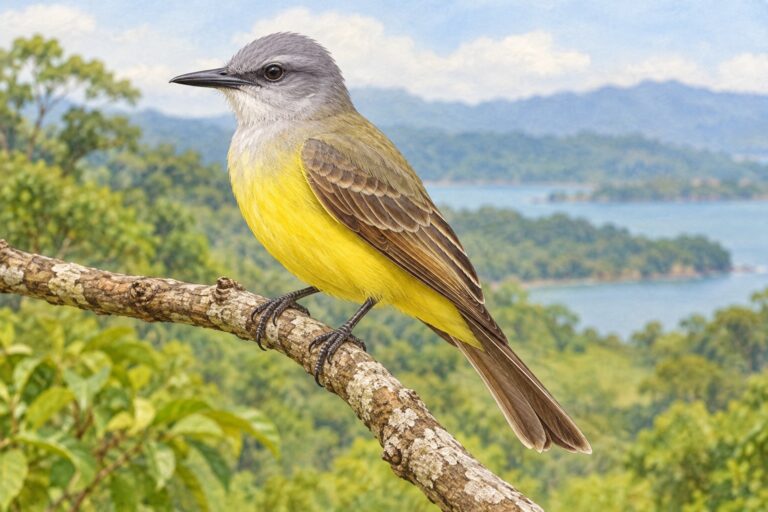
Nature Field Guide

Tropical Kingbird

Spanish name
Tirano tropical
Scientific name
Tyrannus melancholicus

What Do Pico & Tati Think?

Pico: “That bird keeps returning to the same branch!”

Tati: “A perch gives a flycatcher a place to watch for food.”

Identification

Key Features of the Tropical Kingbird

  • Gray head without bold white eyebrow

  • Yellow underparts

  • Long dark bill and brown tail

Habitat & range

Widespread in open country, farms, towns and forest clearings, mainly below about 1850 m and less commonly higher. Regional tags apply only where suitable open habitat exists.

Conservation & care

Observe quietly from trails or established viewing areas. Give nests, roosts and feeding birds space. Do not handle, chase or lure birds with playback. Keep pets away from wildlife.

Threats & pressures

Protect native vegetation, reduce collision hazards around glass and keep cats away from birds. These are practical prevention priorities, not a claim of a measured decline at a specific Costa Rican site.

View full profile →

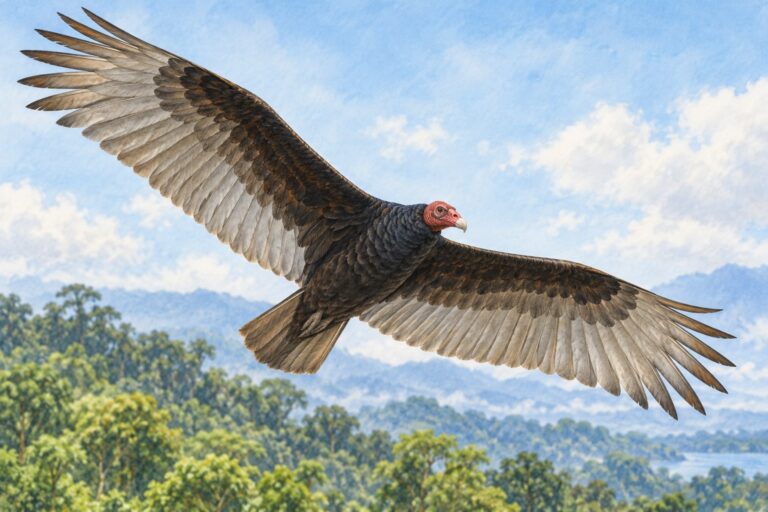
Nature Field Guide

Turkey Vulture

Spanish name
Zopilote cabecirrojo
Scientific name
Cathartes aura

What Do Pico & Tati Think?

Pico: “Its wings look like a gentle V!”

Tati: “That posture and the pale flight feathers give us clues.”

Identification

Key Features of the Turkey Vulture

  • Red head in adults

  • Pale flight feathers beneath dark wings

  • Longer tail and shallow V in flight

Habitat & range

Widespread over open and wooded landscapes, less numerous at high elevations. Resident birds are joined by migrants, with especially conspicuous passage along Caribbean lowlands.

Conservation & care

Observe quietly from trails or established viewing areas. Give nests, roosts and feeding birds space. Do not handle, chase or lure birds with playback. Keep pets away from wildlife.

Threats & pressures

Protect native vegetation, reduce collision hazards around glass and keep cats away from birds. These are practical prevention priorities, not a claim of a measured decline at a specific Costa Rican site.

View full profile →

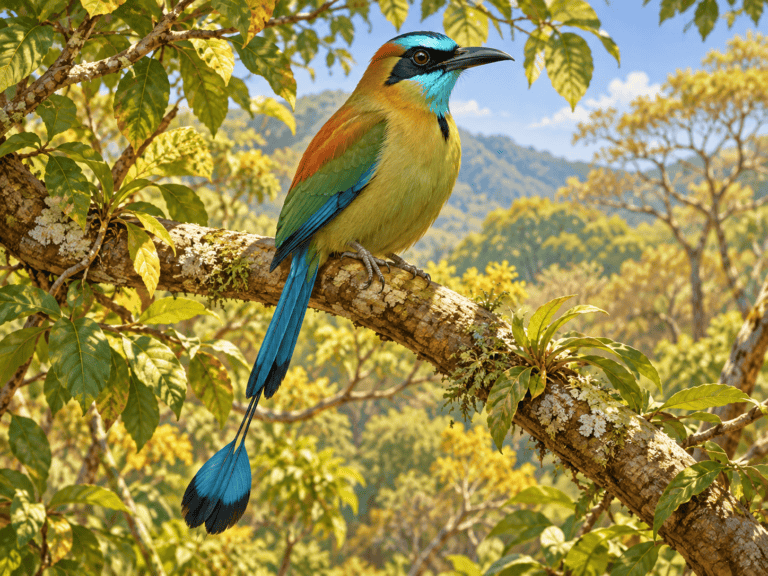
Nature Field Guide

Turquoise-browed Motmot

Spanish name
Momoto cejiceleste / Bobo
Scientific name
Eumomota superciliosa

What Do Pico & Tati Think?

Pico: “The end of its tail looks like two tiny paddles!”

Tati: “The blue eyebrow gives us another clue.”

Identification

Key Features of the Turquoise-browed Motmot

  • Bright turquoise eyebrow above a dark mask.

  • Long central tail shafts with broad racket tips.

  • Compare head pattern and tail together.

Habitat & range

Dry and gallery woodland in the northern Pacific, south regularly toward Tarcoles. Rare Central Valley occurrences are not used as a core regional tag.

Conservation & care

Stay on authorized trails or viewing routes. Give birds space, keep voices low and leave nests undisturbed. Observe without bait, feeding or recorded calls.

View full profile →

Nature Field Guide

Violet Sabrewing

Spanish name
Ala de sable violáceo
Scientific name
Campylopterus hemileucurus

What Do Pico & Tati Think?

Pico: “It looked dark until it turned!”

Tati: “Iridescent feathers can change appearance as the light changes.”

Identification

Key Features of the Violet Sabrewing

  • Large hummingbird shape

  • Thick curved bill

  • White outer tail corners

Habitat & range

Humid mountain forest and forest edges on both slopes. Breeding is mainly at middle elevations, with seasonal descent into foothills. Guanacaste means humid mountain habitat, not dry beaches.

Conservation & care

Observe quietly from trails or established viewing areas. Give nests, roosts and feeding birds space. Do not handle, chase or lure birds with playback. Keep pets away from wildlife.

Threats & pressures

Protect native vegetation, reduce collision hazards around glass and keep cats away from birds. These are practical prevention priorities, not a claim of a measured decline at a specific Costa Rican site.

View full profile →

Nature Field Guide

Western Sandpiper

Spanish name
Correlimos occidental
Scientific name
Calidris mauri

What Do Pico & Tati Think?

A tiny gray bird makes Pico slow down. Tati learns that some identifications deserve a question mark.

Identification

Key Features of the Western Sandpiper

  • Very small gray-and-white nonbreeding bird

  • Fine dark bill often slightly downcurved

  • Dark legs

  • Compare carefully with other small sandpipers

Habitat & range

Scan exposed shoreline feeding areas and nearby resting places with binoculars. The tide changes which flats are available; remain on a safe established route.

Conservation & care

Give feeding and resting birds space. If a bird stops feeding, repeatedly looks at you or moves away, increase your distance. Keep dogs away from flocks, avoid playback and feeding, and leave nests and natural shoreline debris undisturbed.

View full profile →

Nature Field Guide

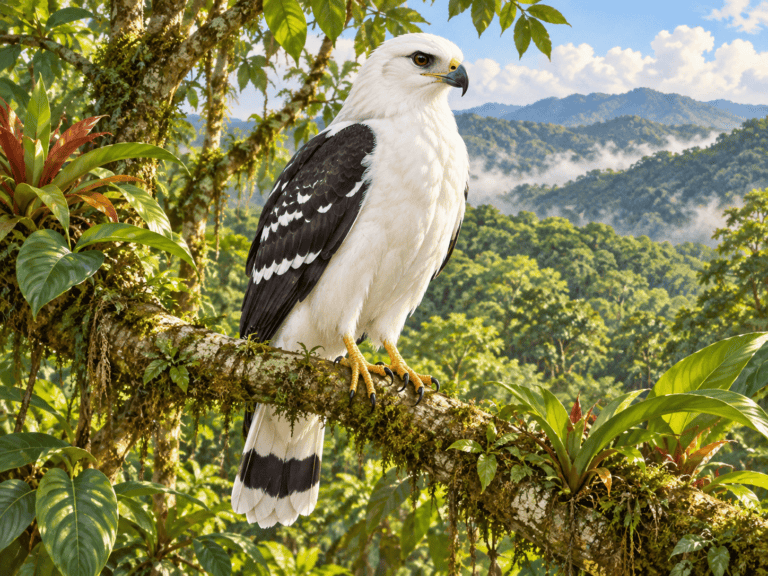
White Hawk

Spanish name
Gavilán blanco
Scientific name
Pseudastur albicollis

What Do Pico & Tati Think?

Pico: “A white shape is circling above the forest!”

Tati: “Let’s compare its wings and tail before naming it.”

Identification

Key Features of the White Hawk

  • Mostly white plumage, with black wing and tail markings.

  • Broad wings while soaring.

  • Patient perching near forest gaps.

Habitat & range

Forested foothills and uneven terrain on the Caribbean side and southern Pacific, locally to about 1400 m. Dry northwestern lowlands are unsuitable.

Conservation & care

Stay on authorized trails or viewing routes. Give birds space, keep voices low and leave nests undisturbed. Observe without bait, feeding or recorded calls.

Threats & pressures

The Peregrine Fund reports declines where forest is cleared for agriculture and livestock.

View full profile →

Nature Field Guide

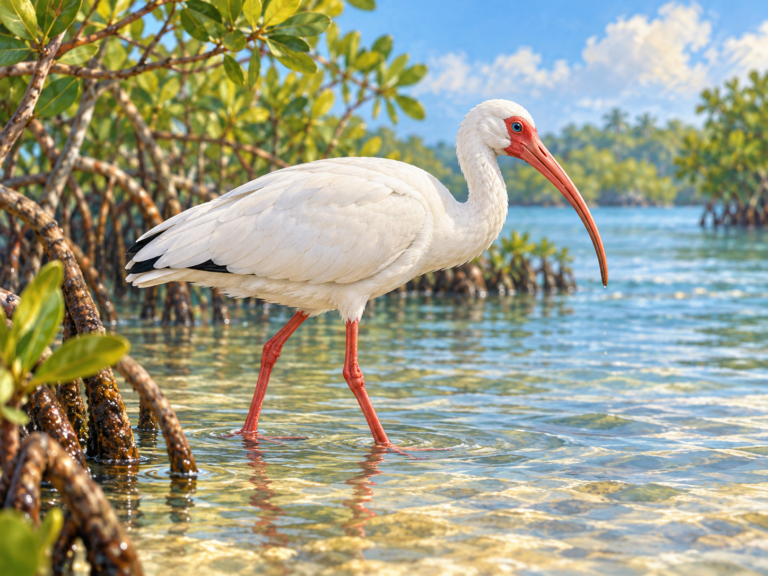
White Ibis

Spanish name
Ibis blanco
Scientific name
Eudocimus albus

What Do Pico & Tati Think?

Pico: “Its bill curves down like a little hook.”

Tati: “I wonder what we can learn by watching how it searches for food.”

Identification

Key Features of the White Ibis

  • A long, downward-curving bill.

  • Adults have white plumage with black wing tips.

  • Reddish legs and bill on adults; younger birds are brown and white.

Habitat & range

Strongest around the Tempisque basin and Gulf of Nicoya, with seasonal occurrence in Rio Frio and local Pacific wetlands. Rare scattered records elsewhere are not used to populate every region.

Conservation & care

Keep enough distance that birds continue their natural activity. Stay out of nesting and roosting areas.

View full profile →

Nature Field Guide

White-necked Jacobin

Spanish name
Jacobino nuquiblanco
Scientific name
Florisuga mellivora

What Do Pico & Tati Think?

Pico: “Its tail opened like a little white fan!”

Tati: “The white tail and blue hood are useful clues in a male.”

Identification

Key Features of the White-necked Jacobin

  • Male has blue hood

  • White belly and tail in males

  • Green back and white nape collar

Habitat & range

Humid lowlands and lower slopes of the Caribbean and southern Pacific, especially forest canopy, clearings and flowering edges. It is not a general dry-northwest garden hummingbird.

Conservation & care

Observe quietly from trails or established viewing areas. Give nests, roosts and feeding birds space. Do not handle, chase or lure birds with playback. Keep pets away from wildlife.

Threats & pressures

Protect native vegetation, reduce collision hazards around glass and keep cats away from birds. These are practical prevention priorities, not a claim of a measured decline at a specific Costa Rican site.

View full profile →

Nature Field Guide

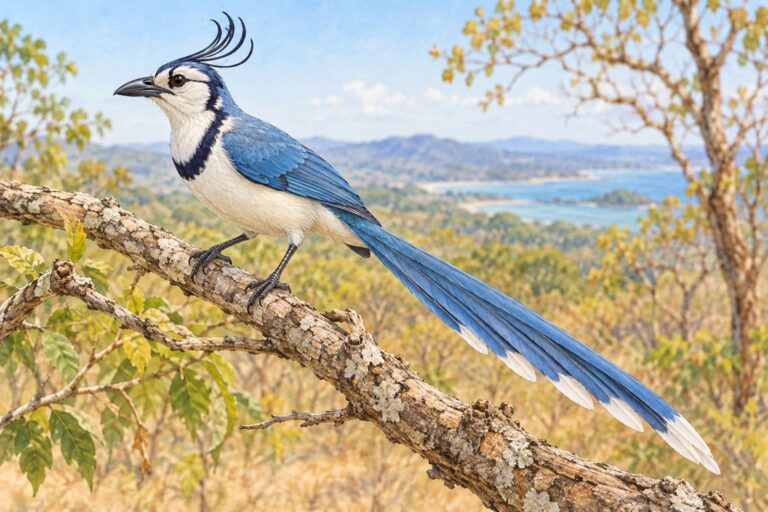
White-throated Magpie-Jay

Spanish name
Urraca copetona
Scientific name
Cyanocorax formosa

What Do Pico & Tati Think?

Pico: “Its crest curls like a little ribbon!”

Tati: “The blue tail and white throat are other good clues.”

Identification

Key Features of the White-throated Magpie-Jay

  • Long blue tail with pale tips

  • Tall curled crest

  • White throat with dark neck markings

Habitat & range

Northern Pacific dry and gallery woodland, extending toward Orotina and San Mateo. A documented Tamarindo photograph supports that local connection. The public scientific name is corrected to Cyanocorax formosa; the permanent import ID stays unchanged.

Conservation & care

Observe quietly from trails or established viewing areas. Give nests, roosts and feeding birds space. Do not handle, chase or lure birds with playback. Keep pets away from wildlife.

Threats & pressures

Protect native vegetation, reduce collision hazards around glass and keep cats away from birds. These are practical prevention priorities, not a claim of a measured decline at a specific Costa Rican site.

View full profile →

Nature Field Guide

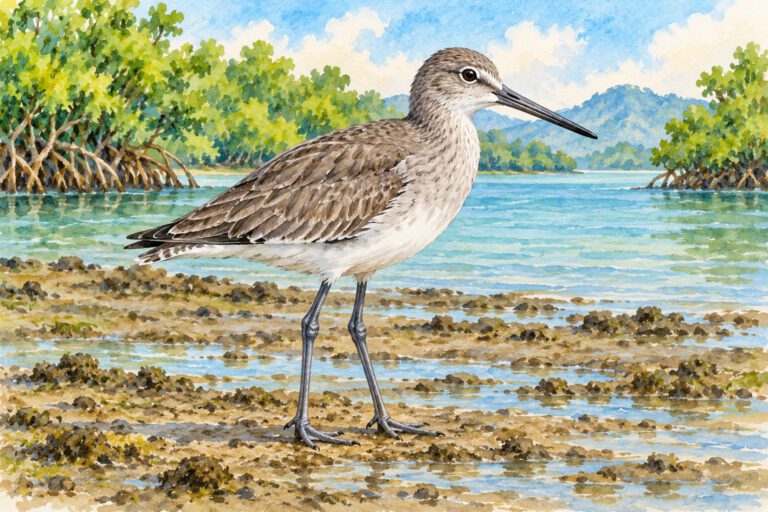
Willet

Spanish name
Pigüilo o playero aliblanco
Scientific name
Tringa semipalmata

What Do Pico & Tati Think?

Pico sees a plain gray shorebird. Tati learns that a bird can reveal a surprising pattern when it takes flight on its own.

Identification

Key Features of the Willet

  • Sturdy long straight bill

  • Long grayish legs

  • Plain gray nonbreeding body

  • Bold black-and-white wings in natural flight

Habitat & range

Scan exposed shoreline feeding areas and nearby resting places with binoculars. The tide changes which flats are available; remain on a safe established route.

Conservation & care

Give feeding and resting birds space. If a bird stops feeding, repeatedly looks at you or moves away, increase your distance. Keep dogs away from flocks, avoid playback and feeding, and leave nests and natural shoreline debris undisturbed.

View full profile →

Nature Field Guide

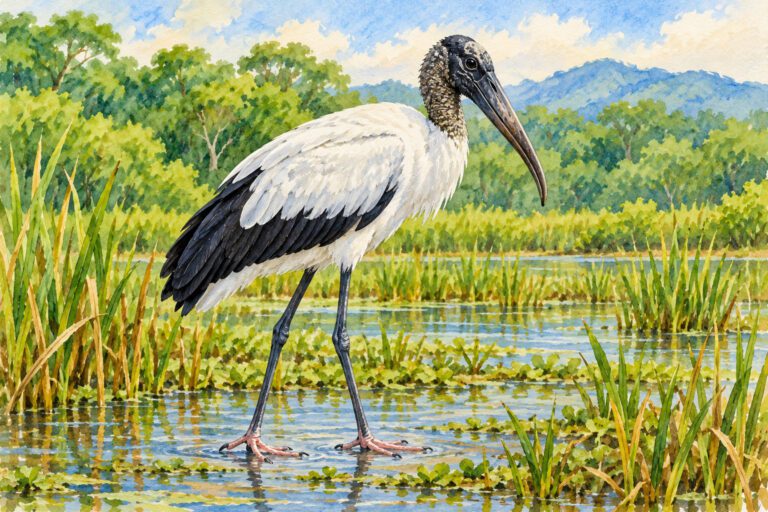
Wood Stork

Spanish name
Cigüeñón
Scientific name
Mycteria americana

What Do Pico & Tati Think?

Pico spots a tall white bird with a very different head. Tati checks its heavy bill before comparing it with the egrets.

Identification

Key Features of the Wood Stork

  • White body with black flight feathers

  • Bare dark adult head

  • Heavy slightly curved bill

  • Long legs

Habitat & range

Look across sheltered wetlands, lagoons and river margins from permitted trails or a responsible guided boat trip.

Conservation & care

Give feeding and resting birds space. If a bird stops feeding, repeatedly looks at you or moves away, increase your distance. Keep dogs away from flocks, avoid playback and feeding, and leave nests and natural shoreline debris undisturbed.

View full profile →

Nature Field Guide

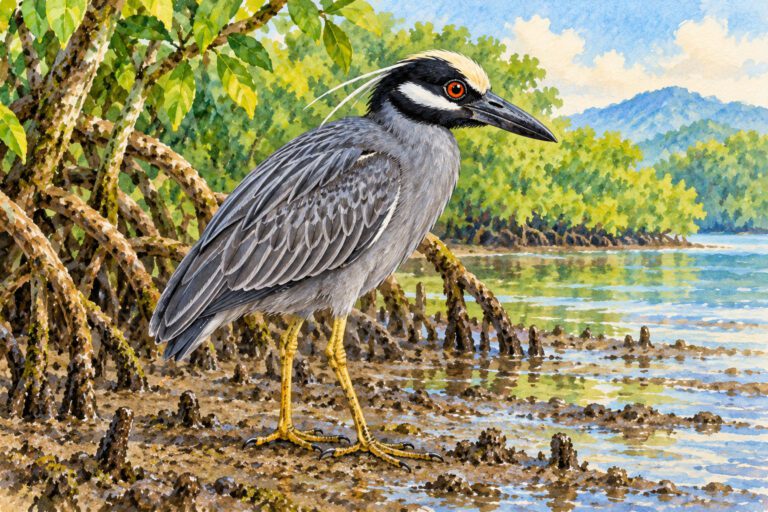
Yellow-crowned Night-Heron

Spanish name
Martinete cabecipinto
Scientific name
Nyctanassa violacea

What Do Pico & Tati Think?

Pico reads the word night and expects an invisible bird. Tati learns that feeding can also happen in daylight.

Identification

Key Features of the Yellow-crowned Night-Heron

  • Adult gray body

  • Dark face with pale cheek and crown

  • Heavy dark bill

  • Juveniles are brown and spotted

Habitat & range

Scan shallow water, quiet mangrove channels and vegetated wetland margins from an established viewpoint. Follow a local guide’s directions around estuaries.

Conservation & care

Give feeding and resting birds space. If a bird stops feeding, repeatedly looks at you or moves away, increase your distance. Keep dogs away from flocks, avoid playback and feeding, and leave nests and natural shoreline debris undisturbed.

View full profile →

Nature Field Guide

Yellow-throated Toucan

Spanish name
Tucán pico castaño
Scientific name
Ramphastos ambiguus

What Do Pico & Tati Think?

Pico: “That bill is enormous!”

Tati: “Its yellow and chestnut areas help us compare it with the keel-billed toucan.”

Identification

Key Features of the Yellow-throated Toucan

  • Large yellow-and-chestnut bill

  • Yellow throat and upper chest

  • Mostly dark body

Habitat & range

Humid Caribbean lowlands and foothills and the southern Pacific, north toward Carara. Suitable Talamanca forest extends to middle elevations; dry Guanacaste is not core habitat.

Conservation & care

Observe quietly from trails or established viewing areas. Give nests, roosts and feeding birds space. Do not handle, chase or lure birds with playback. Keep pets away from wildlife.

Threats & pressures

Protect native vegetation, reduce collision hazards around glass and keep cats away from birds. These are practical prevention priorities, not a claim of a measured decline at a specific Costa Rican site.

View full profile →

My Tico Explorer Experience

Save nature, towns, discoveries and learning adventures for your next experience.

Your list stays in this browser on this device.