

Nature Field Guide
Green Heron
- Spanish name
- Garcilla verde
- Scientific name
- Butorides virescens
What Do Pico & Tati Think?
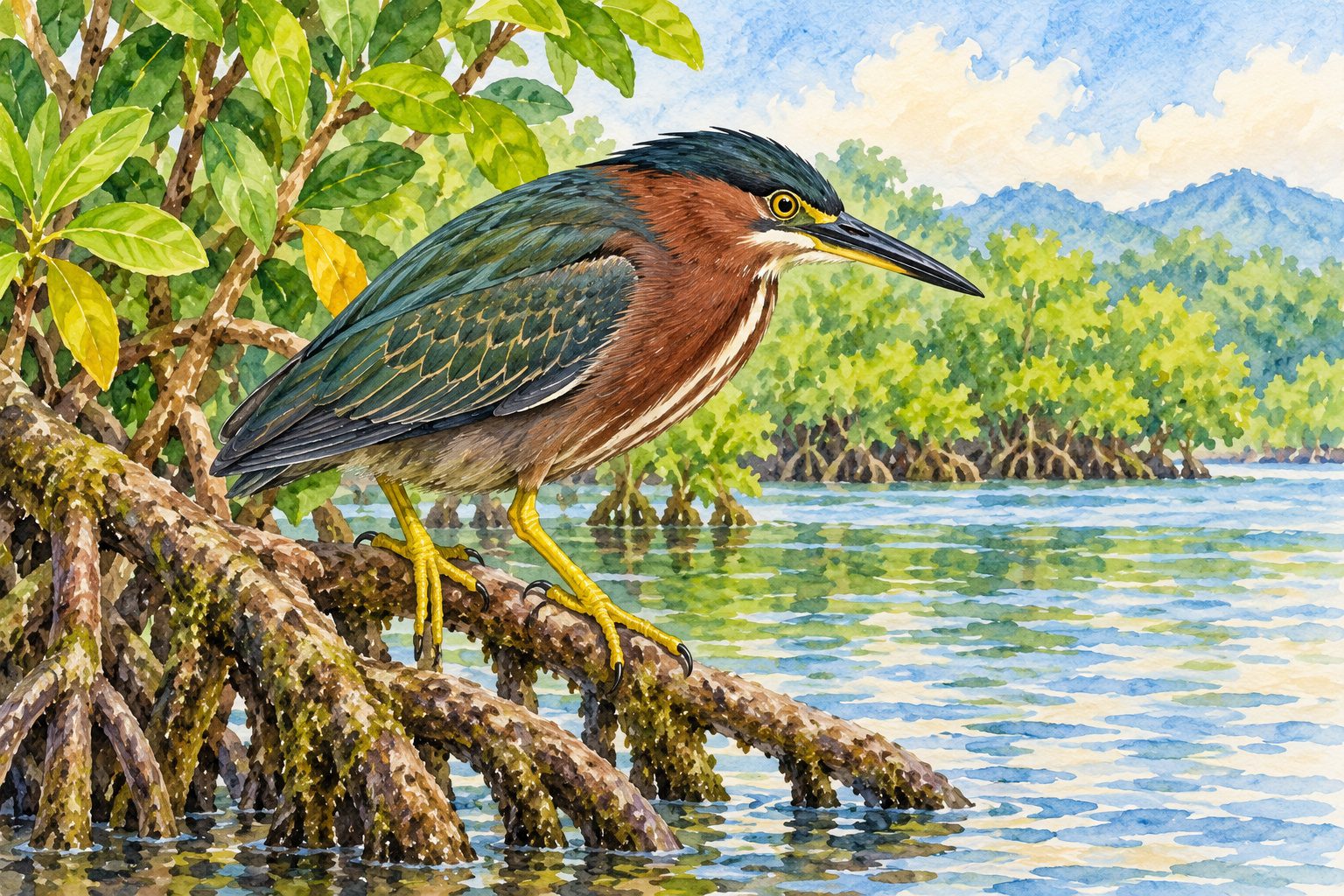
A small hunched shape almost disappears among the roots. Pico and Tati learn that patient looking beats noisy searching.
Species overview
About the Green Heron
The Green Heron is a compact hunter with a dark greenish back, chestnut neck and a short crest. It often waits on roots or low branches, extending its neck to catch prey. Some individuals use small objects as bait. That is a behavior to learn about, not a reason to throw food or objects into a wild bird’s feeding place.
Identification
Key Features of the Green Heron
Small hunched silhouette
Greenish back and chestnut neck
Straight pointed bill and yellowish legs
Habitat & range
Scan shallow water, quiet mangrove channels and vegetated wetland margins from an established viewpoint. Follow a local guide’s directions around estuaries.
Local observations
Widespread near vegetated water from the coast to about 1850 m. Central Highlands means suitable foothill and middle-elevation waterways, not high mountain forest everywhere. Resident and migrant birds overlap. Oceanic Pacific: rare visitor in the official Isla del Coco checklist, rather than ordinary year-round habitat.
When to observe
Resident populations occur in suitable habitat. Look during permitted daylight visiting hours; feeding, resting and visibility depend on the site, weather and water levels.
Conservation & care
Give feeding and resting birds space. If a bird stops feeding, repeatedly looks at you or moves away, increase your distance. Keep dogs away from flocks, avoid playback and feeding, and leave nests and natural shoreline debris undisturbed.
Observation activity
Draw the same bird with its neck tucked and extended. Ask how posture changes its apparent size.
Explore by location
Caribbean · Central Highlands · Central Pacific · Central Valley · Guanacaste · Northern Plains · Oceanic Pacific · Puntarenas & the Gulf Islands · South Pacific