

Nature Field Guide
Snowy Egret
- Spanish name
- Garceta patiamarilla
- Scientific name
- Egretta thula
What Do Pico & Tati Think?
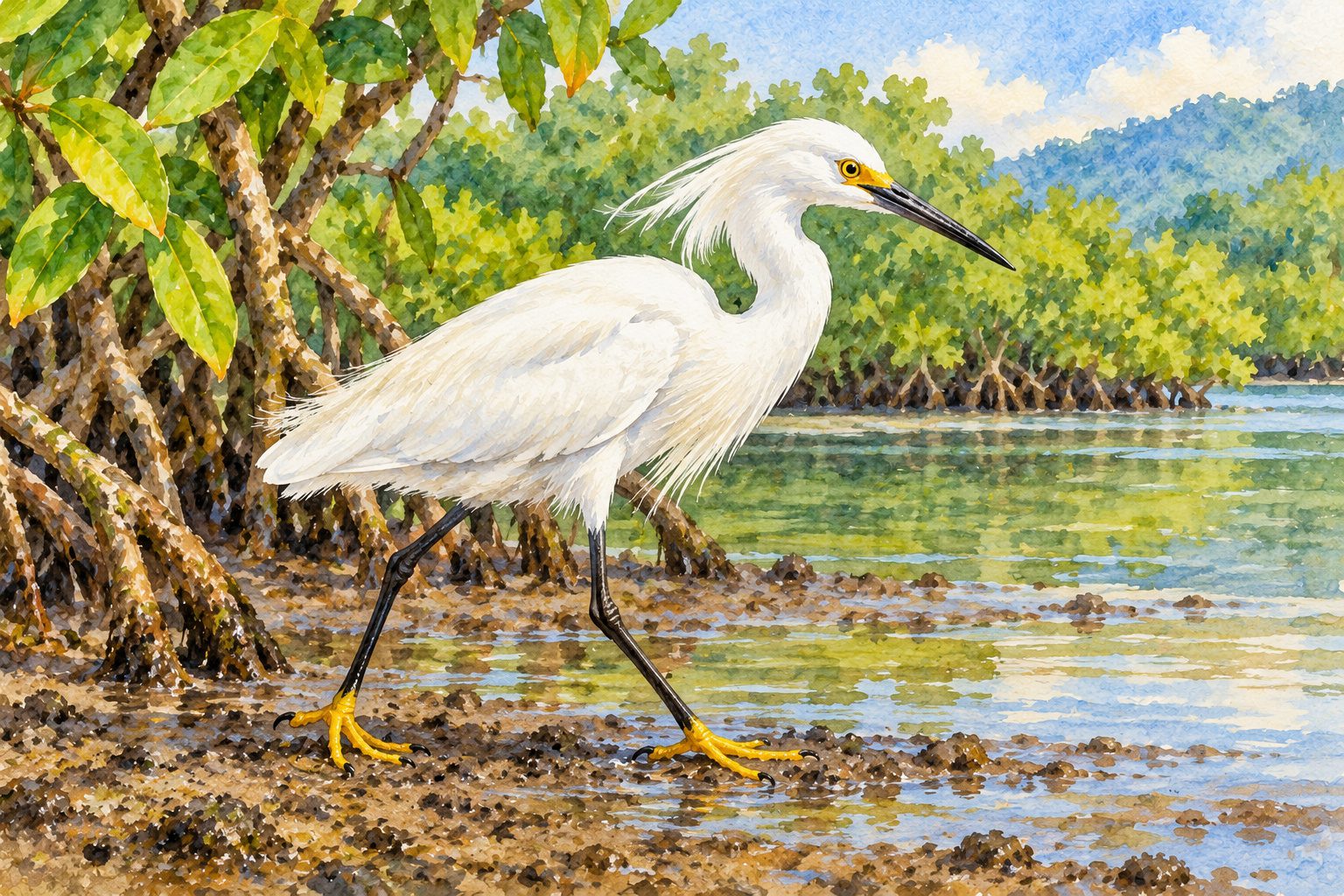
Those yellow feet catch Pico’s attention. Tati waits to see whether the bird uses them while feeding.
Species overview
About the Snowy Egret
This slender white egret often feeds actively in shallow coastal water. Its dark legs end in contrasting yellow feet, which it may move to stir small prey. A slim black bill offers another useful clue. During breeding, fine ornamental plumes become more conspicuous. Several white herons look alike, so check more than feather color.
Identification
Key Features of the Snowy Egret
White body and slim black bill
Black legs with yellow feet
Often active in shallow water
Habitat & range
Scan shallow water, quiet mangrove channels and vegetated wetland margins from an established viewpoint. Follow a local guide’s directions around estuaries.
Local observations
Coastal and inland lowland wetlands on both slopes, with migratory and small breeding populations. Higher-elevation appearances are occasional and do not establish a broad Central Highlands range. Oceanic Pacific: rare visitor in the official Isla del Coco checklist, rather than ordinary year-round habitat.
When to observe
Numbers and locations can change with water levels, feeding opportunities and seasonal movement. Check recent local observations; a regional record does not promise a bird on a particular visit.
Conservation & care
Give feeding and resting birds space. If a bird stops feeding, repeatedly looks at you or moves away, increase your distance. Keep dogs away from flocks, avoid playback and feeding, and leave nests and natural shoreline debris undisturbed.
Observation activity
Make a three-color identification key: white body, dark bill and legs, yellow feet. Observe without making it move.
Explore by location
Caribbean · Central Pacific · Guanacaste · Northern Plains · Oceanic Pacific · Puntarenas & the Gulf Islands · South Pacific