

Nature Field Guide
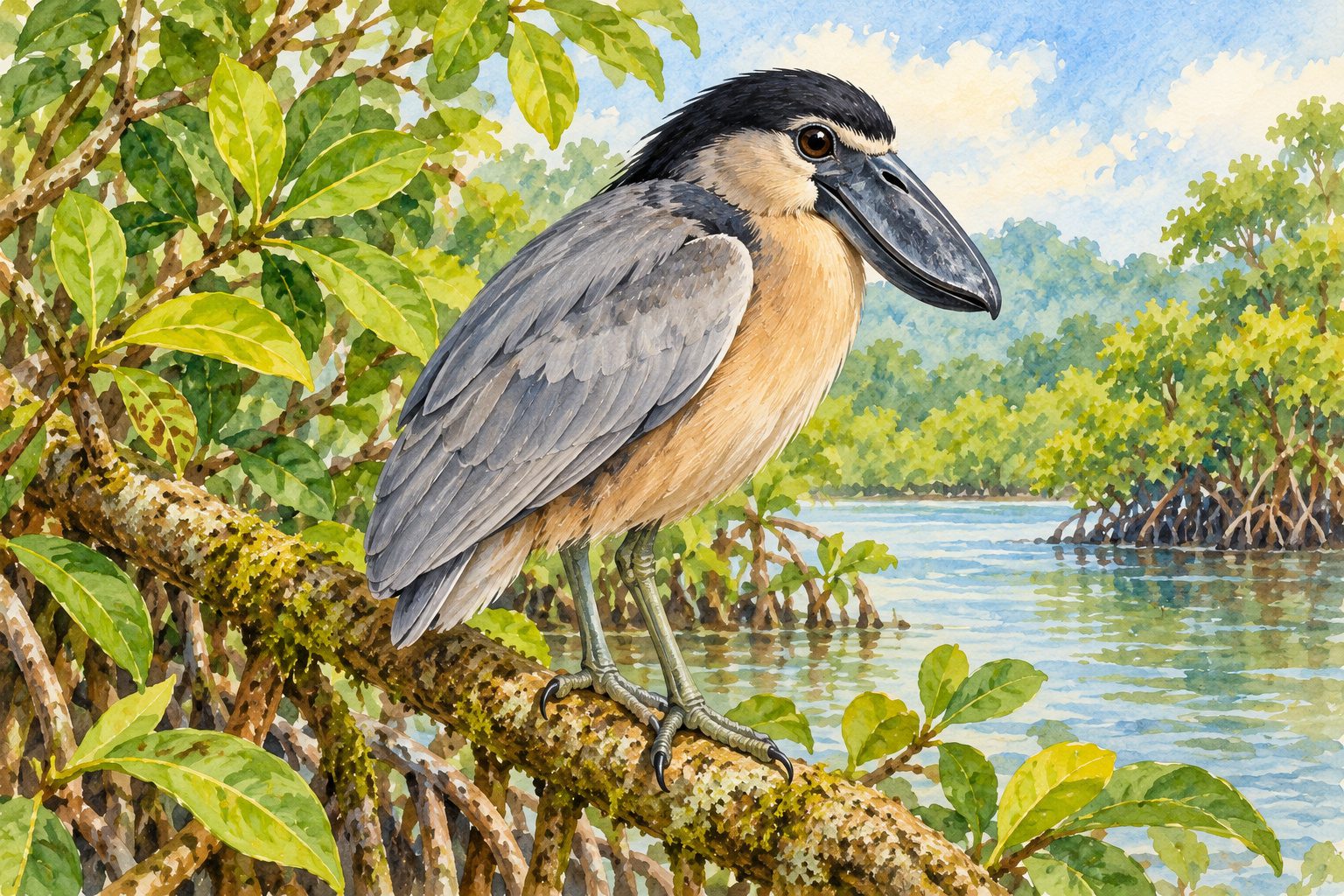
Boat-billed Heron
- Spanish name
- Chocuaco o picocuchara
- Scientific name
- Cochlearius cochlearius
What Do Pico & Tati Think?
That broad bill looks unlike the pointed bills Pico has drawn. Tati adds a new shape to the explorer journal.
Species overview
About the Boat-billed Heron
The Boat-billed Heron has an unusually wide flattened bill and large dark eyes. Adults combine a dark crown with gray upperparts and warm pale underparts. It feeds mainly at night and often rests in shaded vegetation during the day. Quiet observation protects resting birds and avoids interrupting the hours when they recover between feeding trips.
Identification
Key Features of the Boat-billed Heron
Very broad boat-shaped bill
Large dark eyes and black crown
Stocky body with gray back
Habitat & range
Scan shallow water, quiet mangrove channels and vegetated wetland margins from an established viewpoint. Follow a local guide’s directions around estuaries.
Local observations
Lowland river margins, swamps and mangroves on both slopes, principally below about 300 m. Important areas include Tortuguero, Rio Frio and the Tempisque-Bebedero basin.
When to observe
Often active near dusk or at night, although daytime observations occur. Respect park opening hours and observe resting birds quietly; do not use flash, playback or a night search to disturb them.
Conservation & care
Give feeding and resting birds space. If a bird stops feeding, repeatedly looks at you or moves away, increase your distance. Keep dogs away from flocks, avoid playback and feeding, and leave nests and natural shoreline debris undisturbed.
Observation activity
Compare a boat-bill outline with a Great Egret’s pointed bill. Write one question about how shape relates to feeding.
Explore by location
Caribbean · Central Pacific · Guanacaste · Northern Plains · Puntarenas & the Gulf Islands · South Pacific