

Nature Field Guide
Cocos Booby
- Spanish name
- Piquero de Cocos
- Scientific name
- Sula brewsteri
What Do Pico & Tati Think?
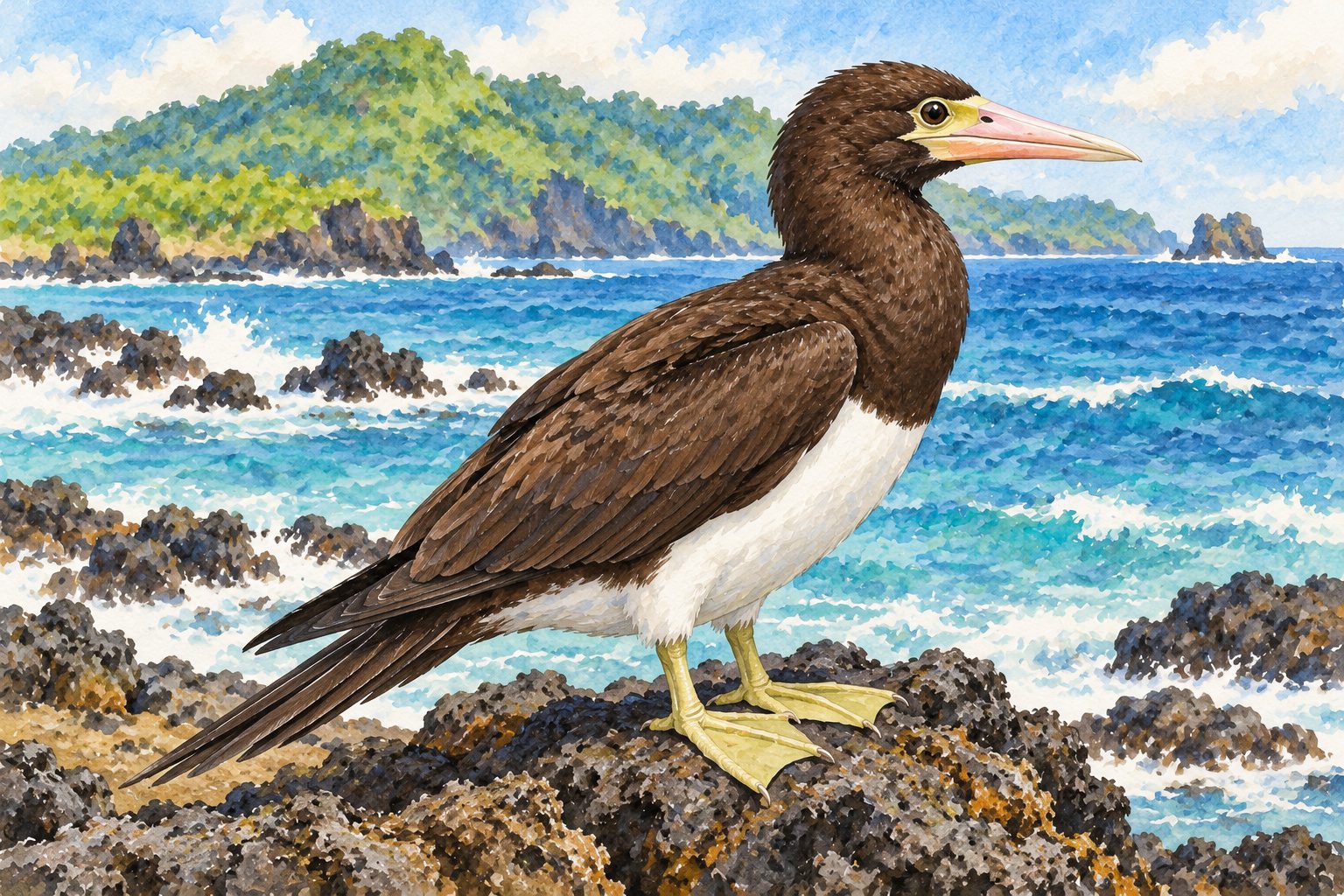
Pico meets a familiar-looking seabird with a newer name. Tati keeps the scientific name beside the illustration.
Species overview
About the Cocos Booby
Cocos Boobies are eastern Pacific seabirds formerly included with Brown Booby. Adults have brown upperparts and a sharply contrasting white belly. They hunt fish by diving from the air and rest on rocks or islands. Males and females differ, and distinguishing distant boobies can be difficult. Older Guanacaste lists use Sula leucogaster; this card follows the split recognizing Sula brewsteri.
Identification
Key Features of the Cocos Booby
Brown adult upperparts and white belly
Strong pointed pale bill
Short legs and broad webbed feet
Identification may require close expert comparison
Habitat & range
Scan Pacific coastal waters and offshore rocks from a safe viewpoint or responsible boat trip. Do not approach seabird colonies or land on nesting islands.
Local observations
Pacific coastal waters and islands, plus Isla del Coco and its offshore waters. This is Cocos Booby under the current split. Caribbean records in older combined Brown Booby accounts are not assigned to this species; they generally refer to Sula leucogaster. Gulf-region tags describe occurrence, not a claim of nesting in the Gulf of Nicoya.
When to observe
Resident populations occur in suitable habitat. Look during permitted daylight visiting hours; feeding, resting and visibility depend on the site, weather and water levels.
Conservation & care
Give feeding and resting birds space. If a bird stops feeding, repeatedly looks at you or moves away, increase your distance. Keep dogs away from flocks, avoid playback and feeding, and leave nests and natural shoreline debris undisturbed.
Observation activity
Compare the current name with an older field guide. Write why names can change as scientists learn more.
Explore by location
Central Pacific · Guanacaste · Oceanic Pacific · Puntarenas & the Gulf Islands · South Pacific