

Nature Field Guide
Anhinga
- Spanish name
- Aninga o pato aguja
- Scientific name
- Anhinga anhinga
What Do Pico & Tati Think?
A long neck rises above the water like a question mark. Pico waits while Tati looks for the rest of the bird.
Species overview
About the Anhinga
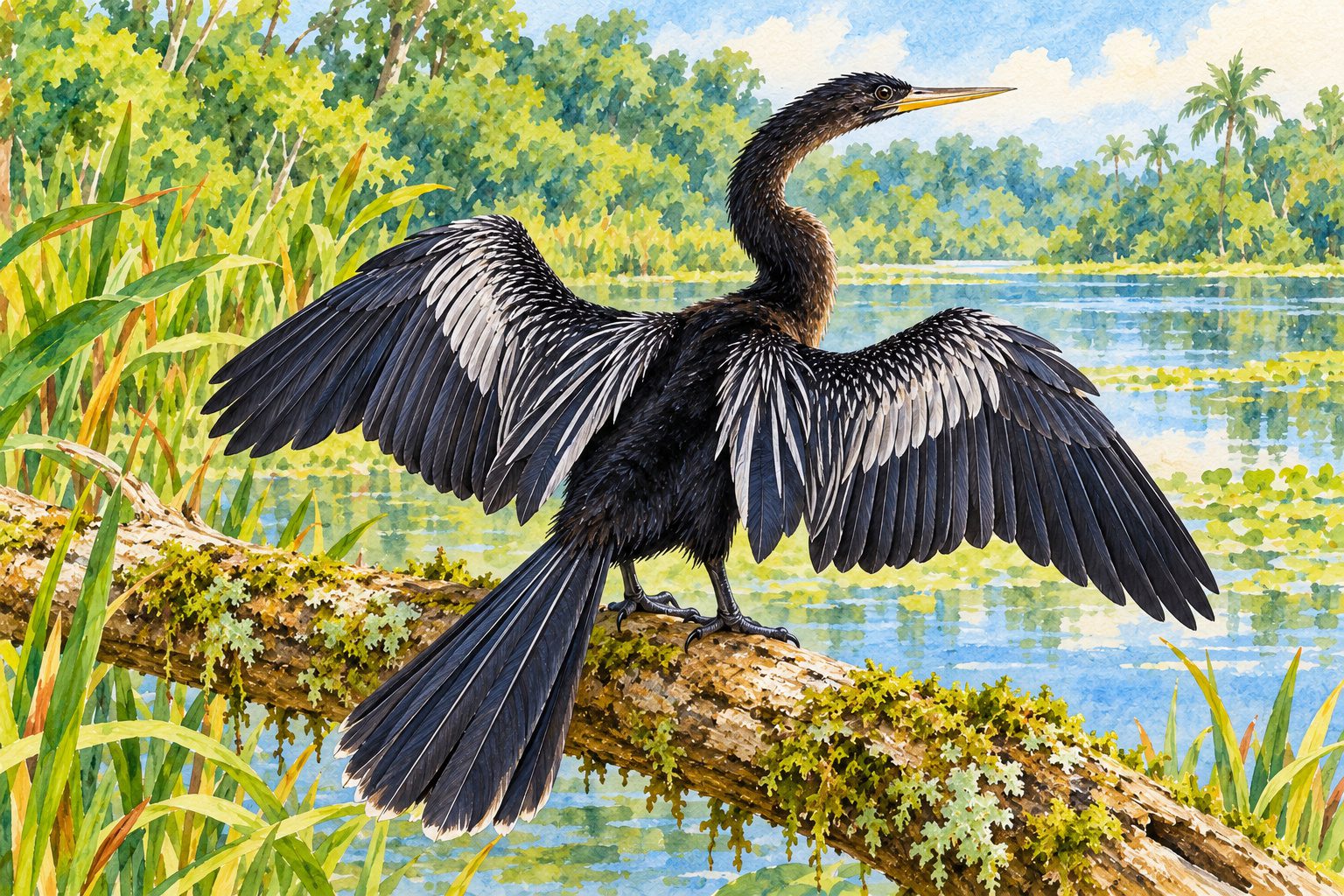
Anhingas swim underwater after fish and use straight pointed bills to seize prey. A swimming bird may show little more than its head and long neck. On branches, it often spreads its wings after a dive. Males are mostly dark with pale wing markings; females have a warmer tan head and neck. A straight bill distinguishes it from a cormorant’s hooked tip.
Identification
Key Features of the Anhinga
Very long slender neck
Straight pointed bill
Long tail and pale wing markings
Often rests with wings spread
Habitat & range
Scan sheltered freshwater wetlands and wooded lagoon margins for swimming birds or a resting bird on a branch. Observe from a permitted viewpoint.
Local observations
Mainly lowland waters on both slopes, with concentrations around Tempisque-Bebedero and Rio Frio-Caño Negro. A documented Heredia/InBio Parque record supports a local Central Valley match; that region is not core habitat throughout.
When to observe
Numbers and locations can change with water levels, feeding opportunities and seasonal movement. Check recent local observations; a regional record does not promise a bird on a particular visit.
Conservation & care
Give feeding and resting birds space. If a bird stops feeding, repeatedly looks at you or moves away, increase your distance. Keep dogs away from flocks, avoid playback and feeding, and leave nests and natural shoreline debris undisturbed.
Observation activity
Compare the bill tips on the Anhinga and cormorant cards. Make a straight-versus-hooked shape chart.
Explore by location
Caribbean · Central Pacific · Central Valley · Guanacaste · Northern Plains · Puntarenas & the Gulf Islands · South Pacific