

Nature Field Guide
Yellowfin Tuna
- Spanish name
- Atún aleta amarilla
- Scientific name
- Thunnus albacares
What Do Pico & Tati Think?
Pico: “Its fins are bright yellow!”
Tati: “Its streamlined shape gives us a clue about life in open water.”
Species overview
About the Yellowfin Tuna
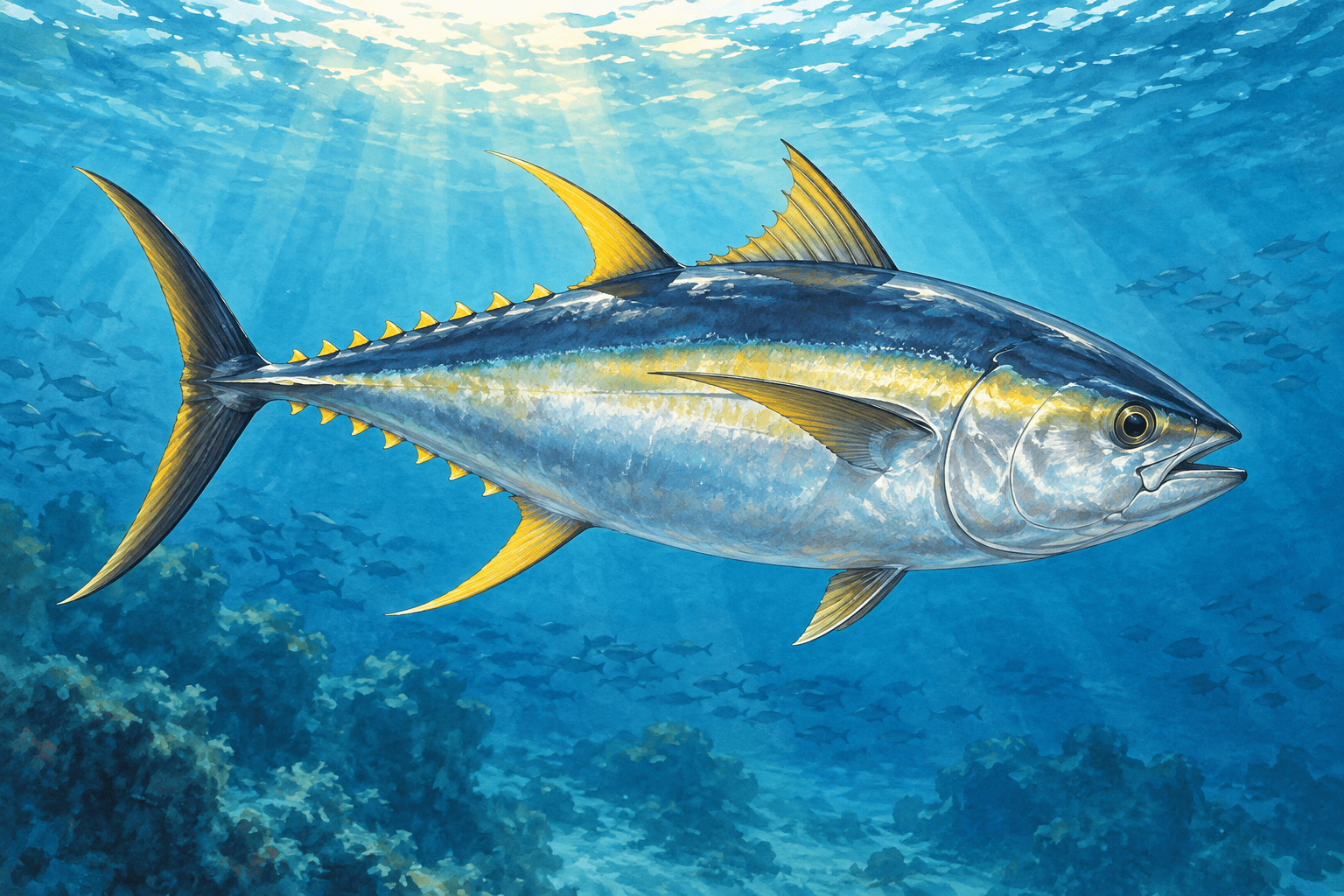
Yellowfin tuna is an open-water fish with a torpedo-shaped body. The back is metallic dark blue, while the lower body becomes lighter. Yellow dorsal and anal fins and small yellow finlets help explain its common name.
Adults eat fish, squid and crustaceans, and the species undertakes substantial movements through warm waters. Young and adult fish can use different parts of the water column.
SINAC records yellowfin tuna in the waters around Isla del Coco. Its presence connects the protected island with a much wider ocean system. A regional fishery assessment describes a stock over a broad area; it cannot be interpreted as the number of fish living around the island.
Identification
Key Features of the Yellowfin Tuna
A streamlined, torpedo-shaped body.
Metallic dark blue upper body with a lighter underside.
Bright yellow fins and finlets; larger adults may have elongated dorsal and anal fins.
Habitat & range
Tropical and subtropical open-ocean waters. The offshore Costa Rican connection is supported by SINAC’s Isla del Coco information.
Local observations
SINAC includes yellowfin tuna in the marine fauna around Isla del Coco. This supports occurrence without identifying a resident school or fixed viewing point.
When to observe
Observations depend on route, visibility, currents and animal movements. No fixed viewing season or guaranteed sighting is established by this profile.
Seasonal Calendar
Regional presence
Costa Rican pelagic waters
Year-round
FECOP’s good-practice guide reports year-round presence in Costa Rican pelagic waters. Migratory schools move between areas; regional presence does not imply residence of one school.
Event source ↗Conservation & care
Follow park rules and qualified guides. Do not feed, touch, chase or collect marine wildlife. Maintain distance and avoid contact with reef habitat.
Protection & recovery
NOAA summarizes the Eastern Pacific stock as not overfished and not subject to overfishing based on a 2023 stock assessment. This describes a regional fishery stock, not a Costa Rican endangered-species designation or proof of local recovery.
Observation activity
Use a verified identification image to sketch three distinguishing features. During any guided observation, record the place, date and behavior without moving closer to the animal.