

Nature Field Guide
Starry Grouper
- Spanish name
- Cabrilla pinta
- Scientific name
- Epinephelus labriformis
What Do Pico & Tati Think?
Pico: “It looks covered in stars!”
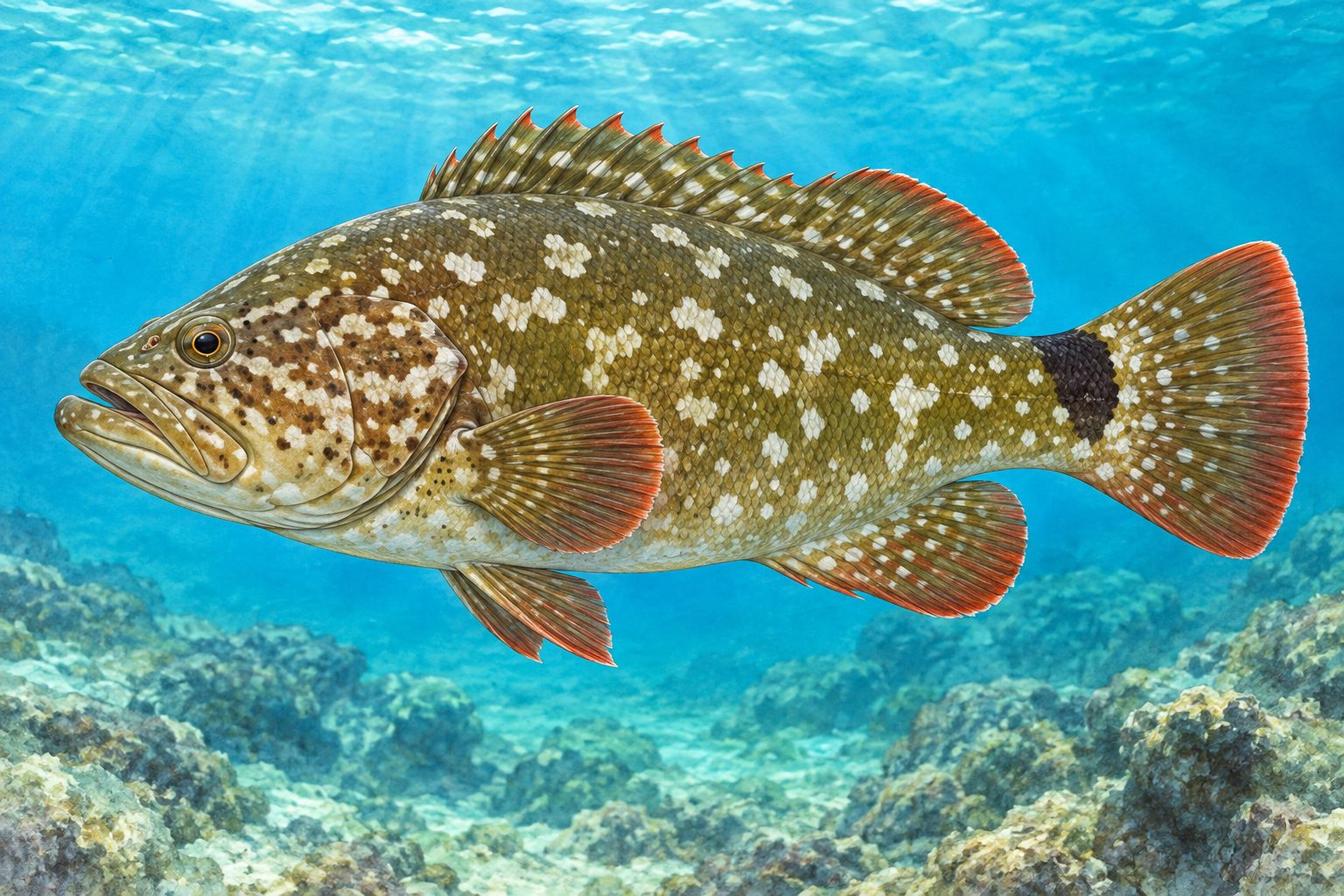
Tati: “The white patches and dark tail-base saddle help identify it.”
Species overview
About the Starry Grouper
White spots and patches break up an olive-green body. A dark saddle sits on the upper tail base, while reddish tones can appear around fin margins and the head.
This robust reef predator eats fish and other animals, including crustaceans. Its broad mouth, rounded tail and broken pattern offer useful clues near rocky shelter.
Identification
Key Features of the Starry Grouper
Olive body with white marks
Black saddle on upper tail base
Rounded tail and broad mouth
Habitat & range
Pacific rocky reefs and nearby coastal marine habitats. Check the linked species reference for its wider range.
Local observations
Recorded at Cabo Blanco.
When to observe
Visibility depends on water clarity, currents, depth and conditions. No fixed local viewing or migration season is assigned.
Conservation & care
Observe with a qualified guide. Do not feed, chase or handle fish. Keep fins off the reef and take all litter home.
Threats & pressures
Habitat damage and degraded water quality are pressures to prevent in coastal fish habitats. This profile does not quantify a local decline.
Observation activity
Locate the dark tail-base saddle in a photograph. Add it to a sketch before the white spots.
Explore by location
Guanacaste · Puntarenas & the Gulf Islands · South Pacific · Ocean & Coastal Life