

Nature Field Guide
Spinner Dolphin
- Spanish name
- Delfín tornillo
- Scientific name
- Stenella longirostris
What Do Pico & Tati Think?
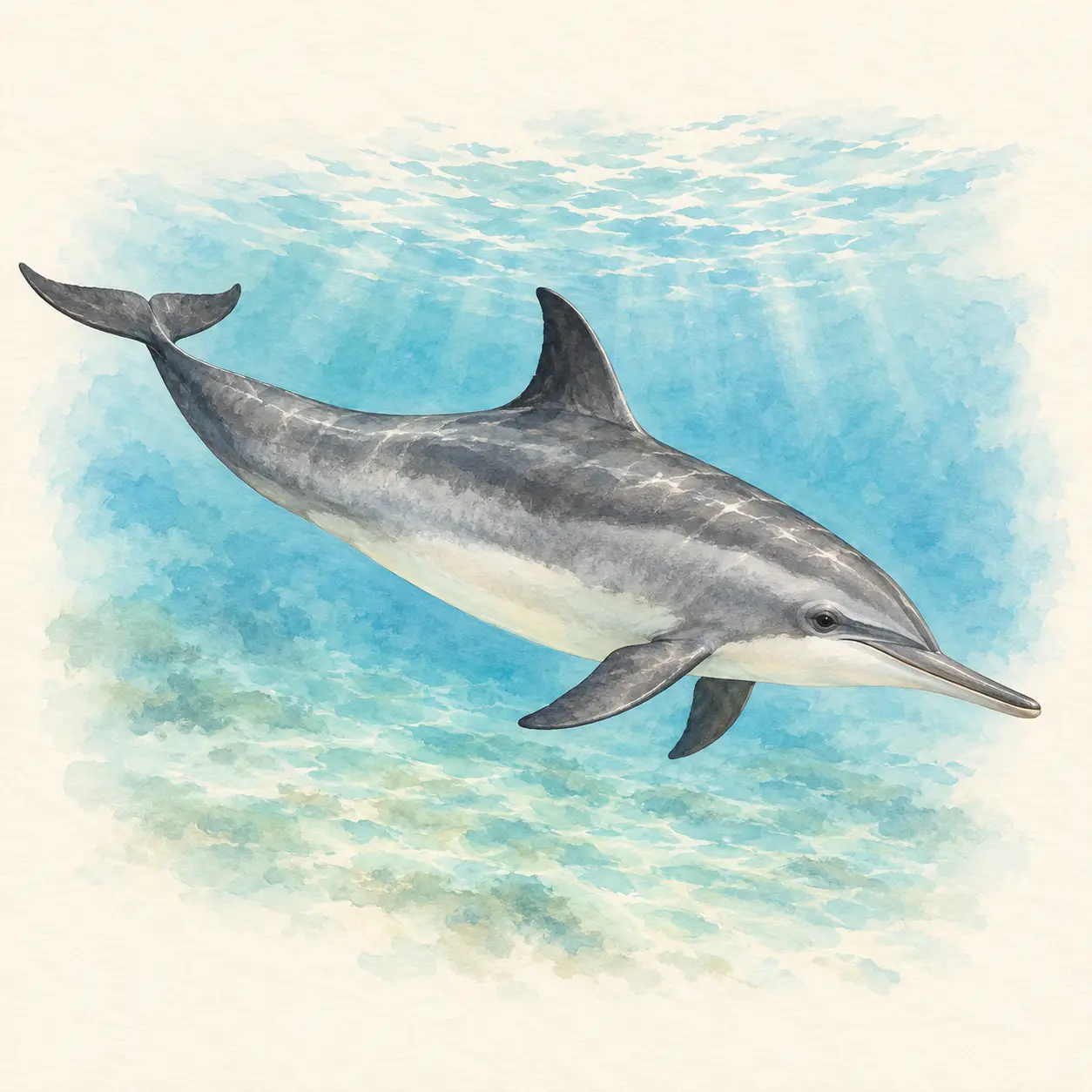
Spinner dolphins are slender dolphins with long narrow beaks.
Species overview
About the Spinner Dolphin
Spinner dolphins are slender dolphins with long narrow beaks. They are known for spinning leaps, although they do not leap on command or during every encounter. They eat prey such as small fish, shrimp and squid, often feeding at night. Color patterns and fin shapes vary among regional forms, including forms in the eastern tropical Pacific. Like other dolphins, they are air-breathing mammals that need undisturbed time for resting and caring for young. Responsible viewing leaves their movements up to them instead of pursuing a performance.
Explorer activity: Compare spinner and bottlenose dolphin outlines. Label the differences in beak length and body shape.
Your discovery notes: Record the date, place and habitat. Add a sketch or a photograph taken from a distance. Write what you observed and one question you would like to investigate. If the species is uncertain, keep that uncertainty in your notes.
Identification
Key Features of the Spinner Dolphin
Slender body and a noticeably long narrow beak.
Dorsal fin often triangular; shape varies with regional form.
Spinning leaps can occur, but behavior alone does not confirm species.
Habitat & range
Costa Rican Pacific marine waters, with locally variable distribution.
Local observations
Recorded in Costa Rica. This is a country-level profile; it does not establish occurrence in every province, town or nature site.
When to observe
Use a responsible operator's local knowledge; neither sightings nor leaps are guaranteed.
Conservation & care
Use a responsible local wildlife operator and follow site rules. Give aquatic mammals room to feed, rest and travel. Do not feed, touch, chase or enter the water to approach them. Keep waste and fishing line out of waterways.
Observation activity
Compare spinner and bottlenose dolphin outlines. Label the differences in beak length and body shape.
Explore by location
Central Pacific · Guanacaste · Oceanic Pacific · Puntarenas & the Gulf Islands · South Pacific · Puntarenas