

Nature Field Guide
South American Snapping Turtle
- Spanish name
- Tortuga lagarto / Tortuga mordedora
- Scientific name
- Chelydra acutirostris
What Do Pico & Tati Think?
Pico: “What clues help us recognize this reptile?”
Tati: “Let’s notice its shape, markings and habitat from a respectful distance.”
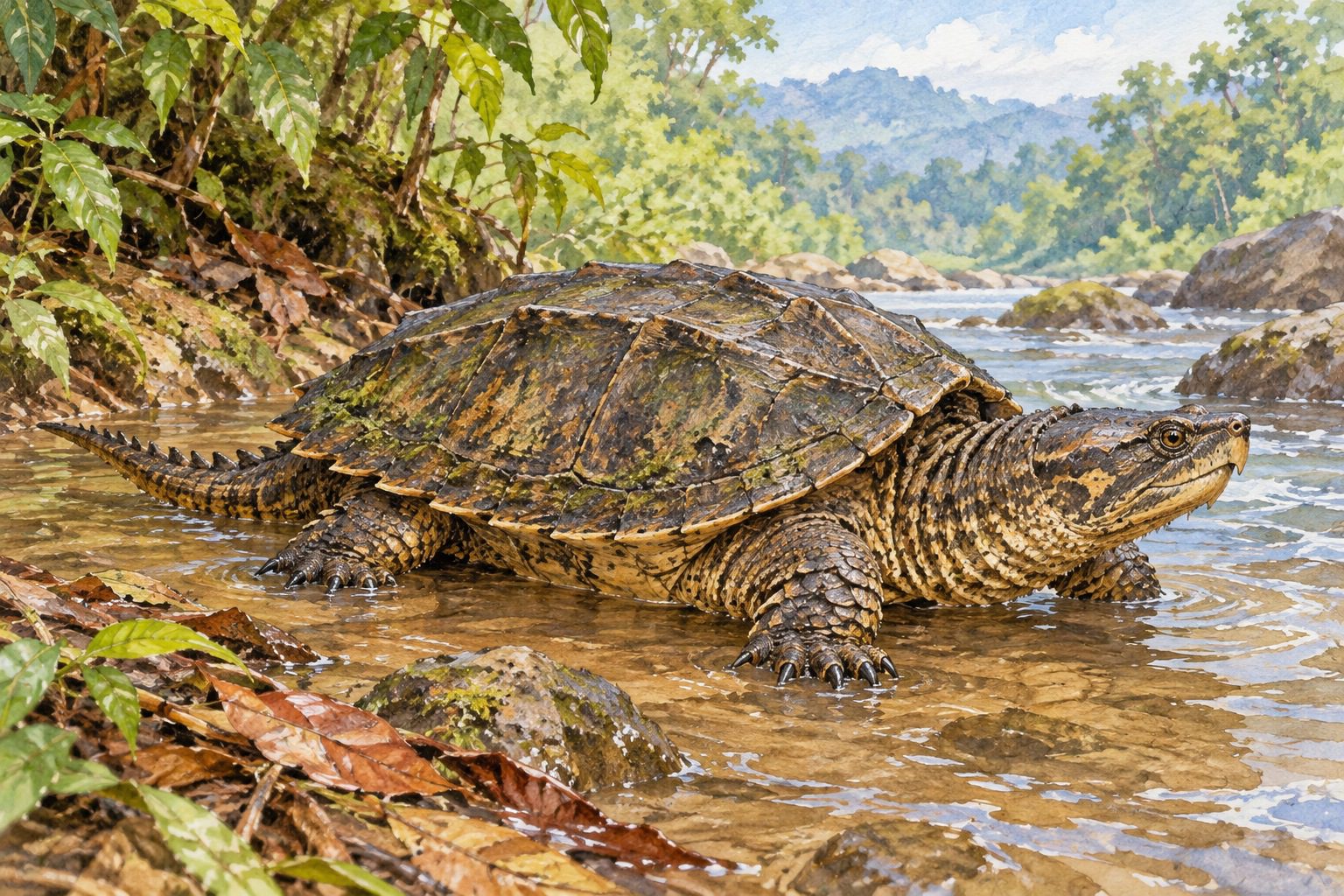
Species overview
About the South American Snapping Turtle
This snapping turtle has a large head, strong limbs and a long tail with raised scales. Its shell can look rough and is often partly hidden by mud or water. It is not the alligator snapping turtle of North America.
Despite its English name, Chelydra acutirostris occurs in Costa Rica as well as farther south. It uses freshwater habitats such as swamps and rivers. Keep hands away, leave bank vegetation undisturbed and never lift a turtle by its tail.
Identification
Key Features of the South American Snapping Turtle
Large powerful head
Long tail with raised scales
Rough shell and strong clawed limbs
Habitat & range
Freshwater wetlands and rivers in Costa Rican lowlands, on both slopes where suitable habitat remains.
Local observations
Native reptile recorded in Costa Rica. Presence varies with suitable habitat and locality.
When to observe
Visibility varies with weather, habitat and the animal’s activity. Observe on an appropriate guided outing; never disturb a hiding animal to obtain a sighting.
Conservation & care
Observe from a safe distance with an adult. Keep hands and pets away from the head and water’s edge. Do not lift, move, feed or handle a snapping turtle, and never lift any turtle by its tail.
Threats & pressures
Protect habitat connections and natural shelters. Avoid road mortality, collection and deliberate killing. Leave reptiles in their habitat rather than keeping or relocating them.
Observation activity
Draw the long tail from the illustration, then compare the silhouette with a wood turtle.
Explore by location
Caribbean · Central Pacific · Guanacaste · Northern Plains · South Pacific · Alajuela · Guanacaste · Heredia · Limón · Puntarenas