

Nature Field Guide
Northern Tamandua
- Spanish name
- Oso hormiguero / Oso colmenero
- Scientific name
- Tamandua mexicana
What Do Pico & Tati Think?
Pico: “Its fur looks like a little vest!”
Tati: “Those claws are tools, so we give it space.”
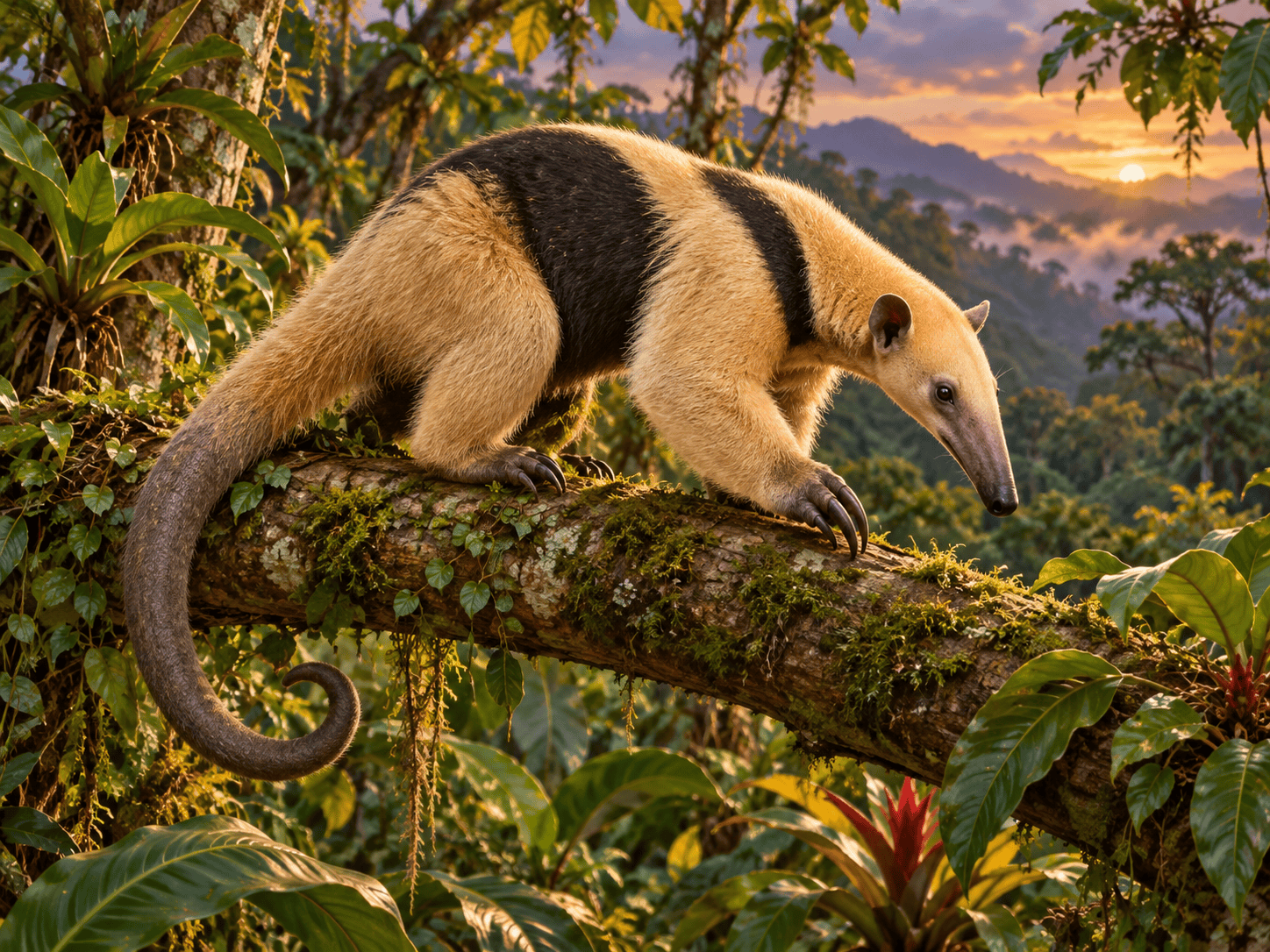
Species overview
About the Northern Tamandua
The Northern Tamandua has pale fur crossed by a dark vest-like marking, a long narrow snout and a grasping tail. Strong curved foreclaws help it open insect nests and climb, while its long sticky tongue collects ants and termites.
This mostly solitary mammal uses trees and also travels on the ground. Its search for insects connects it to both forest branches and fallen wood. Mothers usually carry a single young on their backs. A tamandua’s defensive claws mean a quiet distant view is best for both animal and observer. Preserve nests, logs and vegetation instead of opening them to demonstrate how the animal feeds.
Identification
Key Features of the Northern Tamandua
Pale coat with a dark vest-like pattern.
Long narrow snout and strong curved foreclaws.
Long grasping tail.
Habitat & range
Corcovado’s forest landscape and other suitable dry or humid woodland.
Local observations
SINAC’s Corcovado brochure explicitly names Tamandua mexicana. Puerto Jiménez, Drake and Carate identify park access, not a known individual’s location.
When to observe
Observe from authorized routes with a local guide. Activity, weather and food availability change encounters; a documented location is not a promise of a sighting.
Seasonal Calendar
Breeding possible
Costa Rica; broad natural-history account
Year-round
ACG describes reproduction possible in any season; no local birth peak is assigned.
Event source ↗Conservation & care
Keep a respectful distance and leave an open route for the animal. Stay on authorized paths, secure food and rubbish, and observe without feeding, touching, baiting or chasing.
Threats & pressures
Road collisions, dog attacks and habitat loss are documented pressures.
Observation activity
Draw the snout, claws and tail from an existing photograph, then match each feature to a feeding or climbing task.
Explore by location
Northern Plains · South Pacific · Heredia · Puntarenas · Bahía Drake · Carate · Puerto Jiménez