

Nature Field Guide
Northern Naked-tailed Armadillo
- Spanish name
- Armadillo de cola desnuda
- Scientific name
- Cabassous centralis
What Do Pico & Tati Think?
The northern naked-tailed armadillo is a digging specialist.
What does Least Concern mean?
In the linked conservation assessment, this species does not qualify as threatened or near threatened with extinction. It still needs care: local populations and habitats can face problems even when the species has a lower extinction risk overall.
This label describes conservation status. It does not tell us whether a plant is safe for children or pets. Select the status button to read the assessment.
Species overview
About the Northern Naked-tailed Armadillo
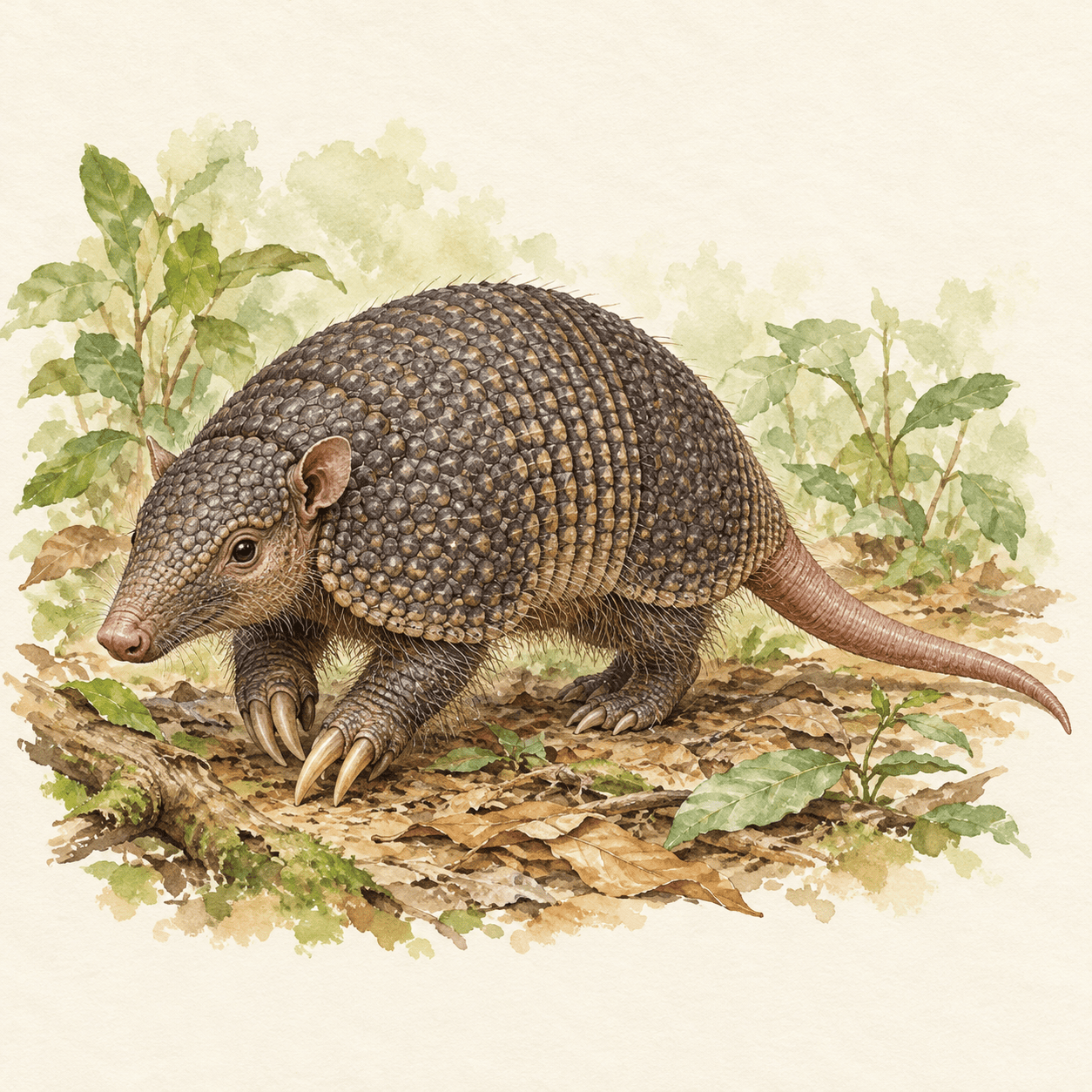
The northern naked-tailed armadillo is a digging specialist. Its strong foreclaws help it search underground for ants and termites. Although its body has an armored covering, the tail lacks the complete armor seen on many other armadillos. It is generally solitary and nocturnal, and spends enough time underground that seeing one is unusual. Costa Rican records include mature forests, secondary forest patches and some disturbed landscapes. Protecting quiet habitat matters even for animals we rarely see.
Explorer activity: Design a paper digging tool, without digging outdoors. Which shape might move soil, and which might grip a branch?
Your discovery notes: Record the date, place and habitat. Add a sketch or a photograph taken from a distance. Write what you observed and one question you would like to investigate. If the species is uncertain, keep that uncertainty in your notes.
Identification
Key Features of the Northern Naked-tailed Armadillo
Dark armored body with flexible bands.
Mostly unarmored tail with thin, widely spaced plates.
Large digging claws and a relatively broad head.
Habitat & range
Forests and wooded edges, including documented Costa Rican secondary-forest sites.
Local observations
Recorded in Costa Rica. This is a country-level profile; it does not establish occurrence in every province, town or nature site.
When to observe
Mostly active at night; observation is difficult because it spends much of its life underground.
Conservation & care
Explore with an adult or local guide. Observe quietly from a distance, stay on established trails and leave shelter undisturbed. Do not feed, touch, capture or corner wildlife. Keep pets away.
Conservation assessment
IUCN specialist-group account reports Least Concern; checked October 2026. The account stresses limited population knowledge. Least Concern does not mean the animal faces no threats.
Observation activity
Design a paper digging tool, without digging outdoors. Which shape might move soil, and which might grip a branch?
Explore by location
Caribbean · Central Highlands · Central Pacific · Guanacaste · Northern Plains · South Pacific · Alajuela · Guanacaste · Limón