

Nature Field Guide
Mexican Long-nosed Armadillo
- Spanish name
- Armadillo de nueve bandas mexicano
- Scientific name
- Dasypus mexicanus
What Do Pico & Tati Think?
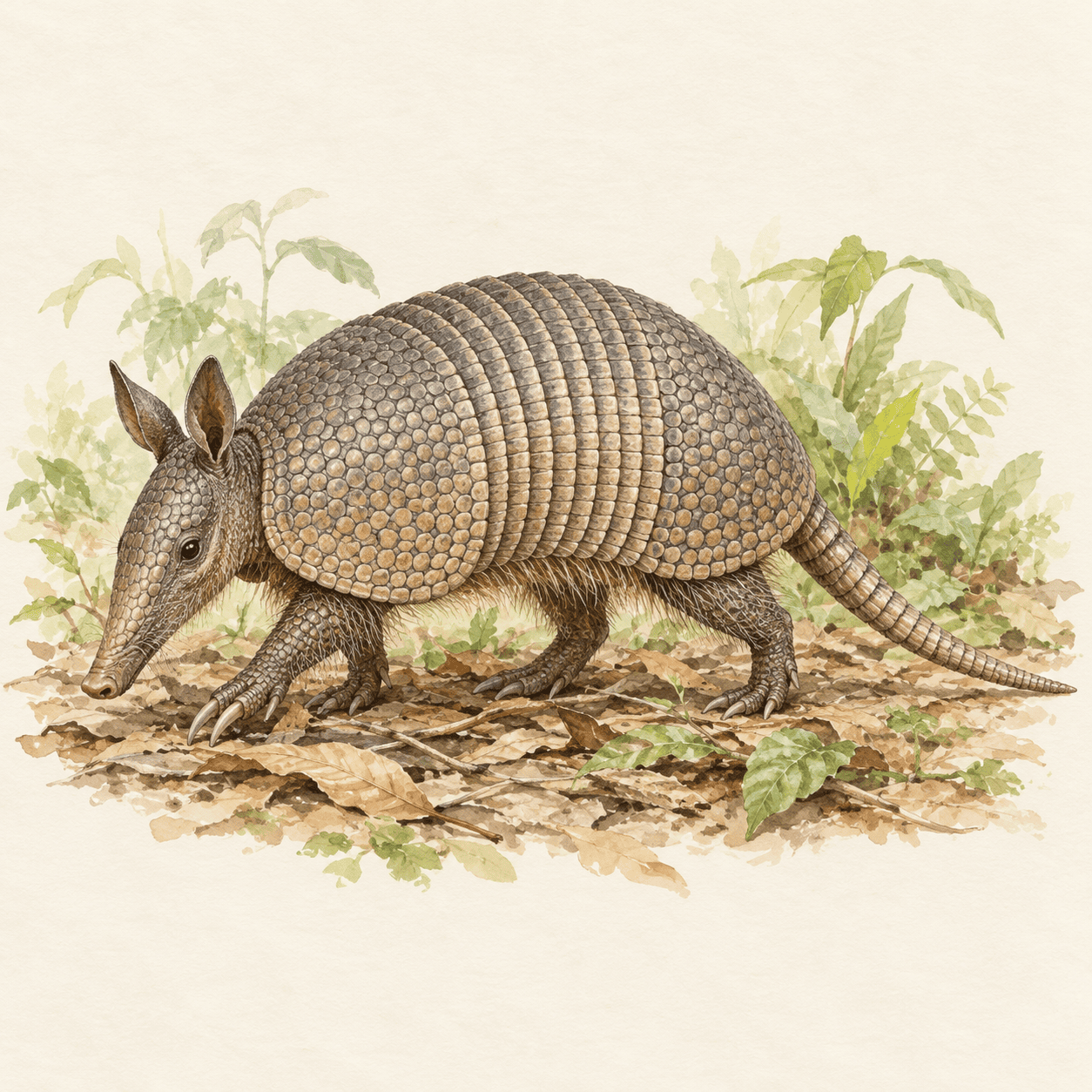
This armadillo wears a covering of bony plates, with flexible bands across its middle so it can bend while walking.
Species overview
About the Mexican Long-nosed Armadillo
This armadillo wears a covering of bony plates, with flexible bands across its middle so it can bend while walking. A long snout helps it investigate the ground, and strong claws help it dig. The tail has armor too, unlike the mostly unarmored tail of the northern naked-tailed armadillo. Recent research separated this species from the wider nine-banded armadillo group. Costa Rica may contain more than one long-nosed armadillo species, so a casual photograph cannot always settle the identification.
Explorer activity: Compare the two armadillo illustrations. Draw the tails and explain which details would help a guide identify an animal.
Your discovery notes: Record the date, place and habitat. Add a sketch or a photograph taken from a distance. Write what you observed and one question you would like to investigate. If the species is uncertain, keep that uncertainty in your notes.
Identification
Key Features of the Mexican Long-nosed Armadillo
Long tapered snout and upright ears.
Flexible bands across the middle of the armored back.
Long tail covered with armor; this alone does not confirm the species.
Habitat & range
Forests, forest edges and other suitable wooded landscapes in Costa Rica.
Local observations
Recorded in Costa Rica. This is a country-level profile; it does not establish occurrence in every province, town or nature site. Current species name follows the Mammal Diversity Database; older Costa Rican references may use the broader former species name.
When to observe
Ask a local guide about activity at the particular site; do not disturb a burrow to obtain a sighting.
Conservation & care
Explore with an adult or local guide. Observe quietly from a distance, stay on established trails and leave shelter undisturbed. Do not feed, touch, capture or corner wildlife. Keep pets away.
Conservation assessment
The Mammal Diversity Database lists this recently separated species as Not Evaluated, checked October 2026. An older assessment for Dasypus novemcinctus should not be applied automatically.
Observation activity
Compare the two armadillo illustrations. Draw the tails and explain which details would help a guide identify an animal.
Explore by location
Caribbean · Central Pacific · Guanacaste · Northern Plains · South Pacific