

Nature Field Guide
Humpback Whale
- Spanish name
- Ballena jorobada
- Scientific name
- Megaptera novaeangliae
What Do Pico & Tati Think?
A humpback whale is a mammal that breathes air through blowholes and nurses its young with milk.
Species overview
About the Humpback Whale
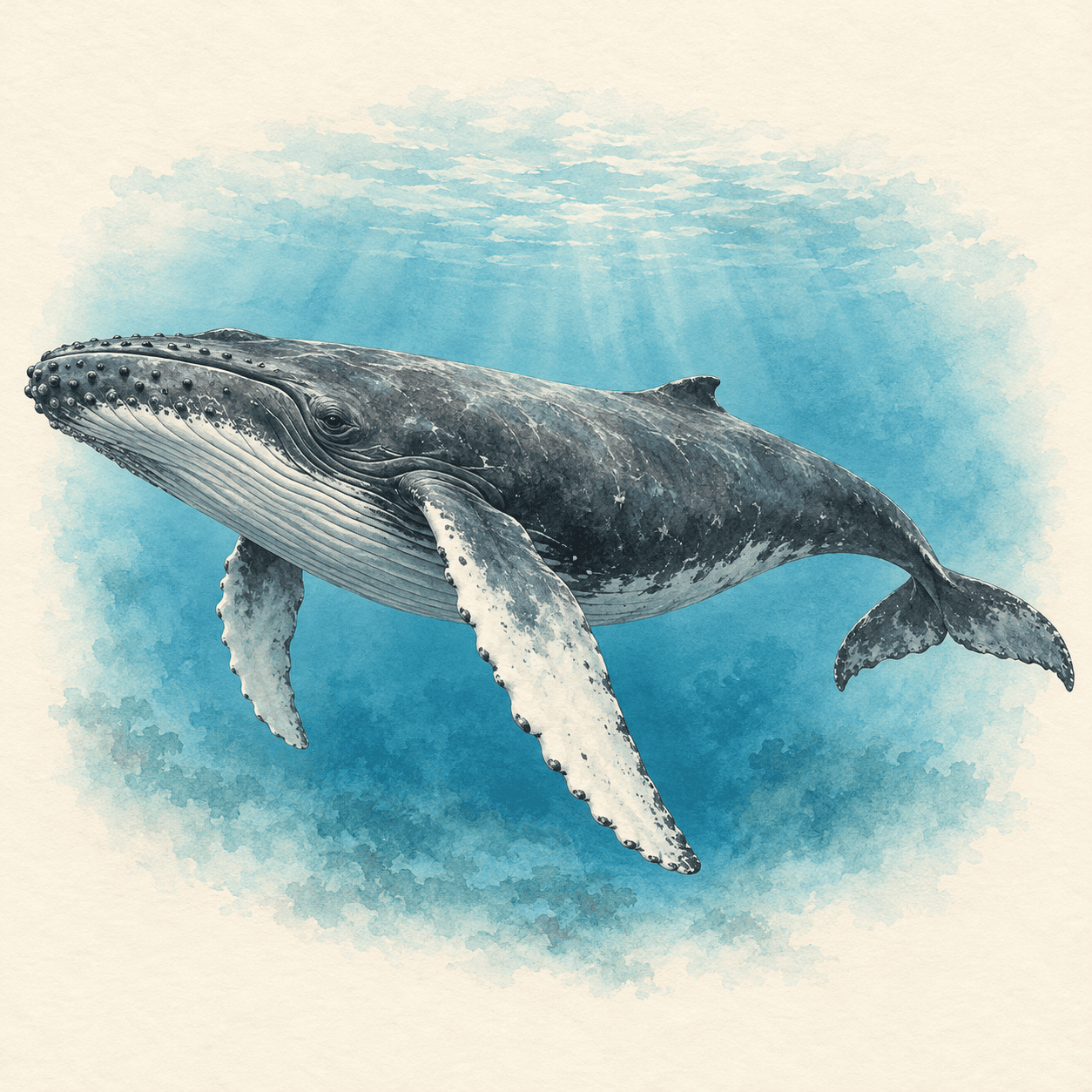
A humpback whale is a mammal that breathes air through blowholes and nurses its young with milk. Its unusually long pectoral flippers, bumpy head and broad tail flukes help distinguish it. Humpbacks use baleen to filter small fish and crustaceans from seawater. Many populations migrate between feeding areas and warmer breeding waters. Whales in Costa Rica should be viewed through responsible local operators who give them space. Scientists can compare photographs of tail patterns to recognize individuals; your drawing can record a pattern without needing a closer approach.
Explorer activity: Invent a paper tail-fluke pattern, then compare it with another drawing. Explain how researchers match patterns without marking the whale.
Your discovery notes: Record the date, place and habitat. Add a sketch or a photograph taken from a distance. Write what you observed and one question you would like to investigate. If the species is uncertain, keep that uncertainty in your notes.
Identification
Key Features of the Humpback Whale
Very long pectoral flippers and bumps on the head.
Small dorsal fin on a raised hump.
Broad tail flukes with variable underside patterns.
Habitat & range
Costa Rican marine waters; arrange viewing with a responsible operator using current local knowledge.
Local observations
Recorded in Costa Rica. This is a country-level profile; it does not establish occurrence in every province, town or nature site.
When to observe
Presence is seasonal and varies by population and site; confirm current conditions locally.
Conservation & care
Use a responsible local wildlife operator and follow site rules. Give aquatic mammals room to feed, rest and travel. Do not feed, touch, chase or enter the water to approach them. Keep waste and fishing line out of waterways.
Observation activity
Invent a paper tail-fluke pattern, then compare it with another drawing. Explain how researchers match patterns without marking the whale.
Explore by location
Central Pacific · Guanacaste · Oceanic Pacific · Puntarenas & the Gulf Islands · South Pacific · Guanacaste · Puntarenas