

Nature Field Guide
Common Bottlenose Dolphin
- Spanish name
- Delfín nariz de botella
- Scientific name
- Tursiops truncatus
What Do Pico & Tati Think?
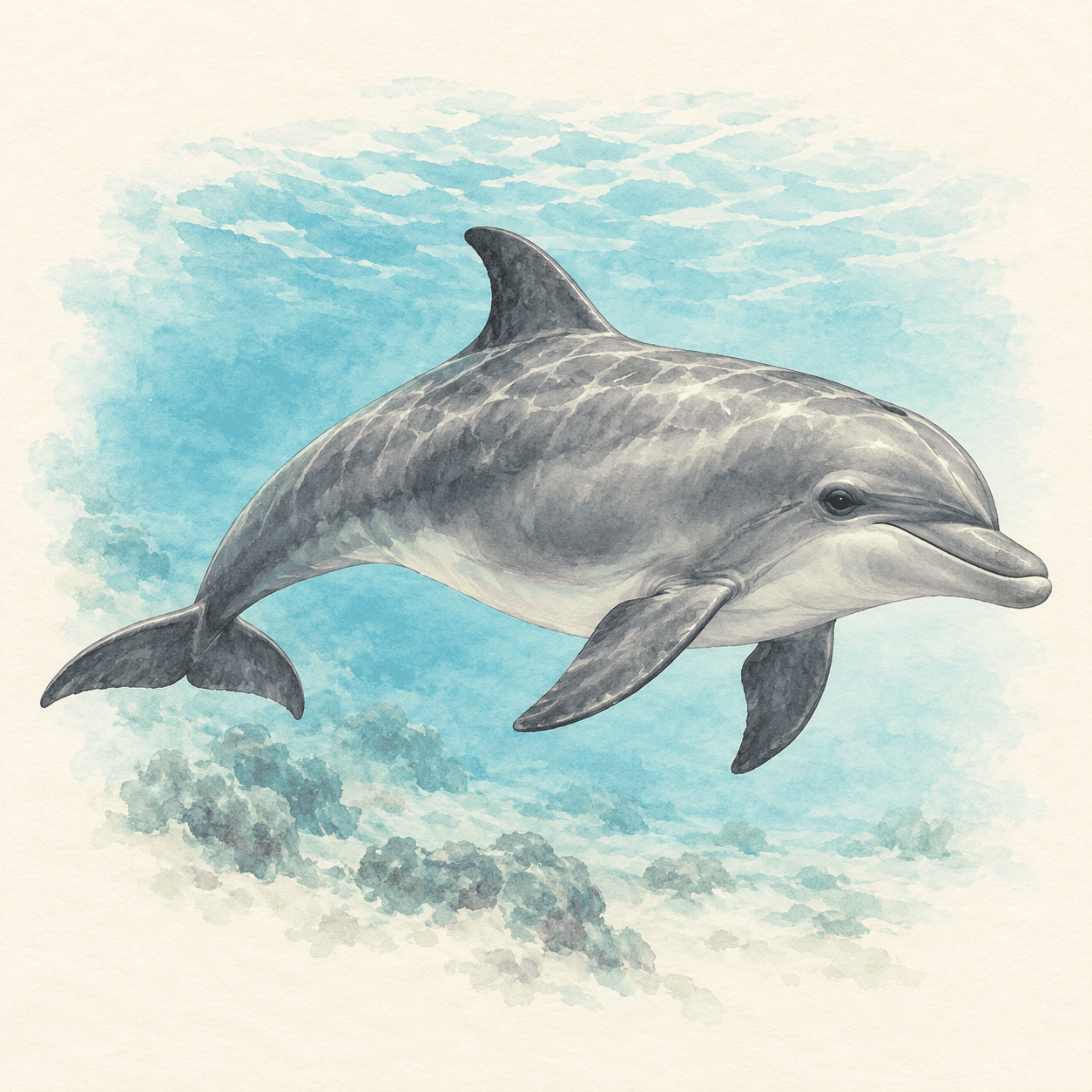
The common bottlenose dolphin has a short thick beak and a generally gray body.
Species overview
About the Common Bottlenose Dolphin
The common bottlenose dolphin has a short thick beak and a generally gray body. It breathes air, gives birth to live young and nurses its calves. It can find prey using sound, including echolocation, and eats animals such as fish, squid and crustaceans. Groups can split and reform rather than remain exactly the same all day. Dolphins need space to feed, travel and rest. A dolphin approaching a boat is not asking for food; feeding it can change its behavior and expose it to harmful interactions.
Explorer activity: Draw a dolphin and a shark. Mark which breathes air and which uses gills, then compare their tail orientation.
Your discovery notes: Record the date, place and habitat. Add a sketch or a photograph taken from a distance. Write what you observed and one question you would like to investigate. If the species is uncertain, keep that uncertainty in your notes.
Identification
Key Features of the Common Bottlenose Dolphin
Short thick beak and robust gray body.
Curved dorsal fin and paler underside.
Horizontal tail flukes; other dolphin species require careful comparison.
Habitat & range
Suitable Costa Rican coastal and offshore waters.
Local observations
Recorded in Costa Rica. This is a country-level profile; it does not establish occurrence in every province, town or nature site.
When to observe
Viewing depends on local conditions; sightings are never guaranteed.
Conservation & care
Use a responsible local wildlife operator and follow site rules. Give aquatic mammals room to feed, rest and travel. Do not feed, touch, chase or enter the water to approach them. Keep waste and fishing line out of waterways.
Observation activity
Draw a dolphin and a shark. Mark which breathes air and which uses gills, then compare their tail orientation.
Explore by location
Caribbean · Central Pacific · Guanacaste · Oceanic Pacific · Puntarenas & the Gulf Islands · South Pacific · Guanacaste · Limón · Puntarenas