

Nature Field Guide
Central American Banded Gecko
- Spanish name
- Geco bandeado centroamericano
- Scientific name
- Coleonyx mitratus
What Do Pico & Tati Think?
Pico: “What can we learn from this reptile’s shape?”
Tati: “Let’s notice its markings and habitat while leaving it plenty of space.”
Species overview
About the Central American Banded Gecko
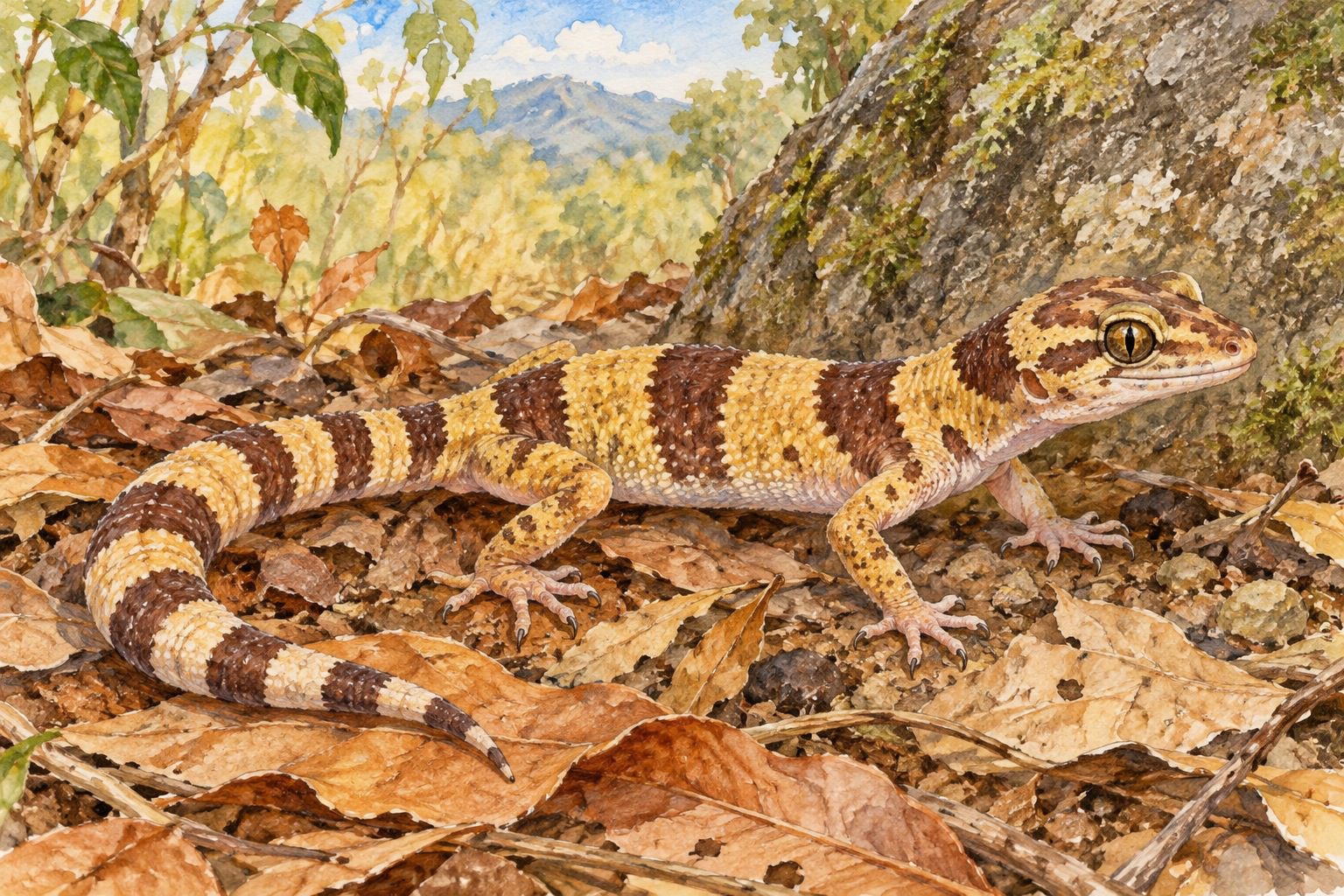
This banded gecko has large eyes, movable eyelids and fine clawed toes. It lacks the broad adhesive toe pads familiar on many house geckos. Dark brown bands and blotches contrast with yellowish or tan areas.
It spends its time near the ground and is active at night. Keep rocks and leaf cover in place rather than opening shelters to search for it. A guided observation can teach us that geckos do not all live on walls, and different feet suit different ways of moving.
Identification
Key Features of the Central American Banded Gecko
Dark bands on yellow-tan tones
Movable eyelids
Clawed toes without broad wall-climbing pads
Habitat & range
Northwestern and western Pacific-slope forests, including Guanacaste and San Luis de Monteverde.
Local observations
Native reptile recorded in Costa Rica. Presence depends on suitable habitat and locality.
When to observe
Primarily active at night. Observe only on an appropriate guided outing and leave daytime shelters undisturbed.
Conservation & care
Observe from permitted paths with an adult. Do not touch, chase, catch or feed reptiles. Leave bark, stones, logs and leaf litter in place. Keep pets away and give animals an open escape route.
Threats & pressures
Protect natural shelters and connected habitat. Avoid collection, unnecessary clearing and deliberate killing. Leave wildlife in its habitat and support responsible observation.
Observation activity
Compare its feet with a house gecko in illustrations. Describe how they differ without handling either.
Explore by location
Central Highlands · Central Pacific · Guanacaste · Puntarenas & the Gulf Islands · Alajuela · Guanacaste · Puntarenas · Monteverde