

Nature Field Guide
Blue Marlin
- Spanish name
- Marlín azul
- Scientific name
- Makaira nigricans
What Do Pico & Tati Think?
Pico: “Its back is such a deep blue!”
Tati: “Let’s compare its fin and bill with the other marlin.”
Species overview
About the Blue Marlin
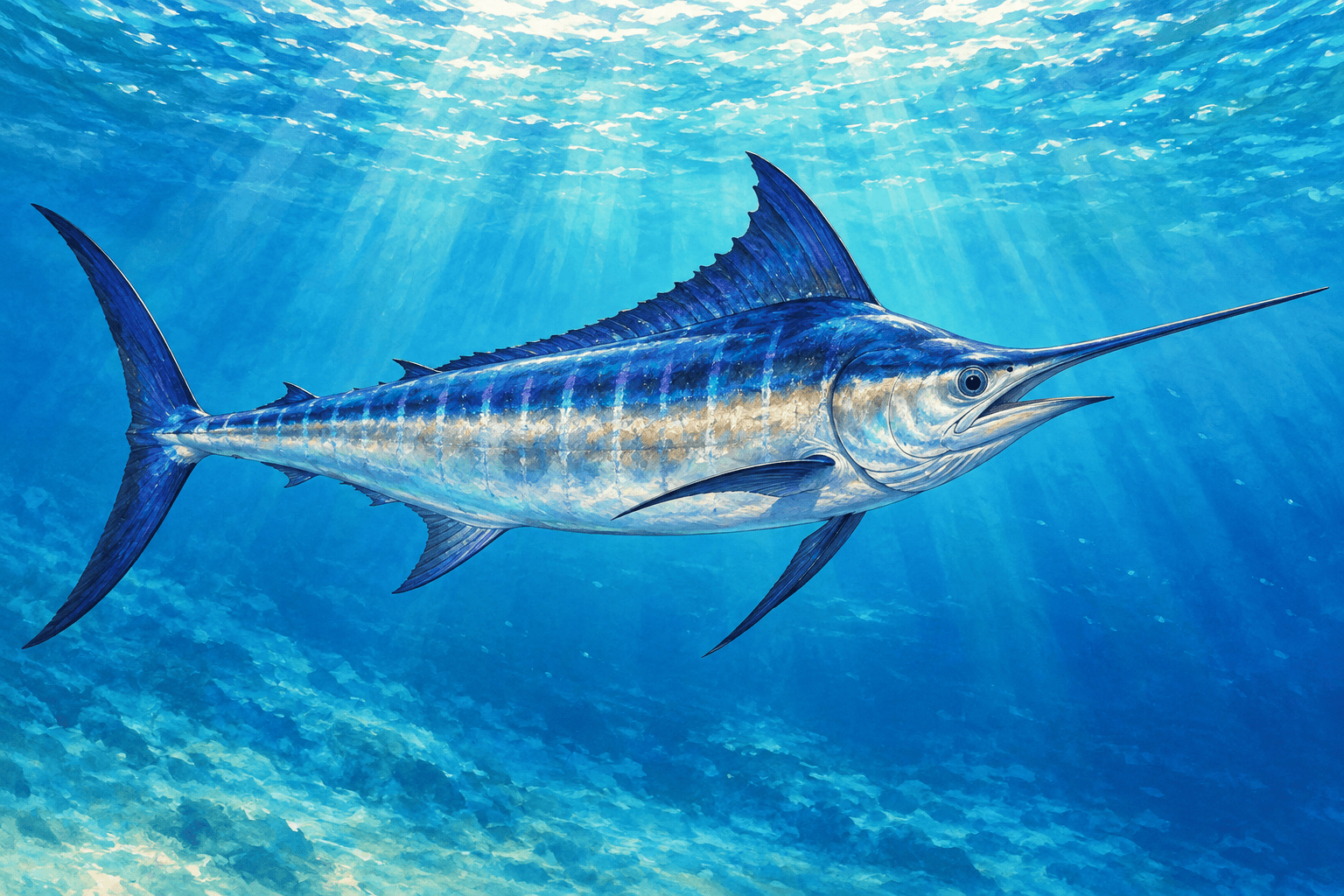
The blue marlin is a large, powerful billfish with a cobalt-blue back and a silvery-white underside. A long spear-shaped upper jaw and a pronounced front dorsal fin give it a distinctive profile.
It lives in warm tropical and subtropical seas and feeds largely on tuna and other open-water fish. Females grow larger than males. Its life takes place in the water column, where moving prey and suitable water conditions shape where it travels.
Long movements can carry marlin across national boundaries. Protecting a migratory animal therefore depends on cooperation across the ocean. A broad fishery stock assessment and a count near Tamarindo describe different things and should never be treated as interchangeable.
Identification
Key Features of the Blue Marlin
A long spear-shaped bill.
A cobalt-blue back and silvery underside.
A pronounced front dorsal fin and crescent-shaped tail.
Habitat & range
Warm tropical and subtropical open water.
Local observations
FECOP includes this species among Costa Rica’s offshore fish. No Tamarindo beach sighting or local population count is implied.
When to observe
Ocean conditions, prey and animal movements affect occurrence. No guaranteed sighting or fixed local viewing season is established here.
Seasonal Calendar
Regional presence
Costa Rican Pacific waters
Year-round
FECOP reports year-round Costa Rican Pacific presence and a historical May–September Guanacaste fishing peak. Catch patterns are not exact migration or breeding dates.
Event source ↗Reported fishing peak
Guanacaste offshore waters
May, Jun, Jul, Aug, Sep
FECOP reports year-round Costa Rican Pacific presence and a historical May–September Guanacaste fishing peak. Catch patterns are not exact migration or breeding dates.
Event source ↗Conservation & care
Observe marine wildlife without feeding, touching or chasing it. Keep litter and discarded fishing line out of waterways. Follow qualified guides and current local rules.
Threats & pressures
Blue marlin can be caught incidentally in longline fisheries targeting tuna and swordfish. Fishing pressure needs monitoring across its migratory range.
Observation activity
Compare a reference photograph of the Blue Marlin with another marine species. Sketch three differences in body shape, fins or markings.
Explore by location
Central Pacific · Guanacaste · Oceanic Pacific · South Pacific