

Nature Field Guide
Royal Tern
- Spanish name
- Pagaza real
- Scientific name
- Thalasseus maximus
What Do Pico & Tati Think?
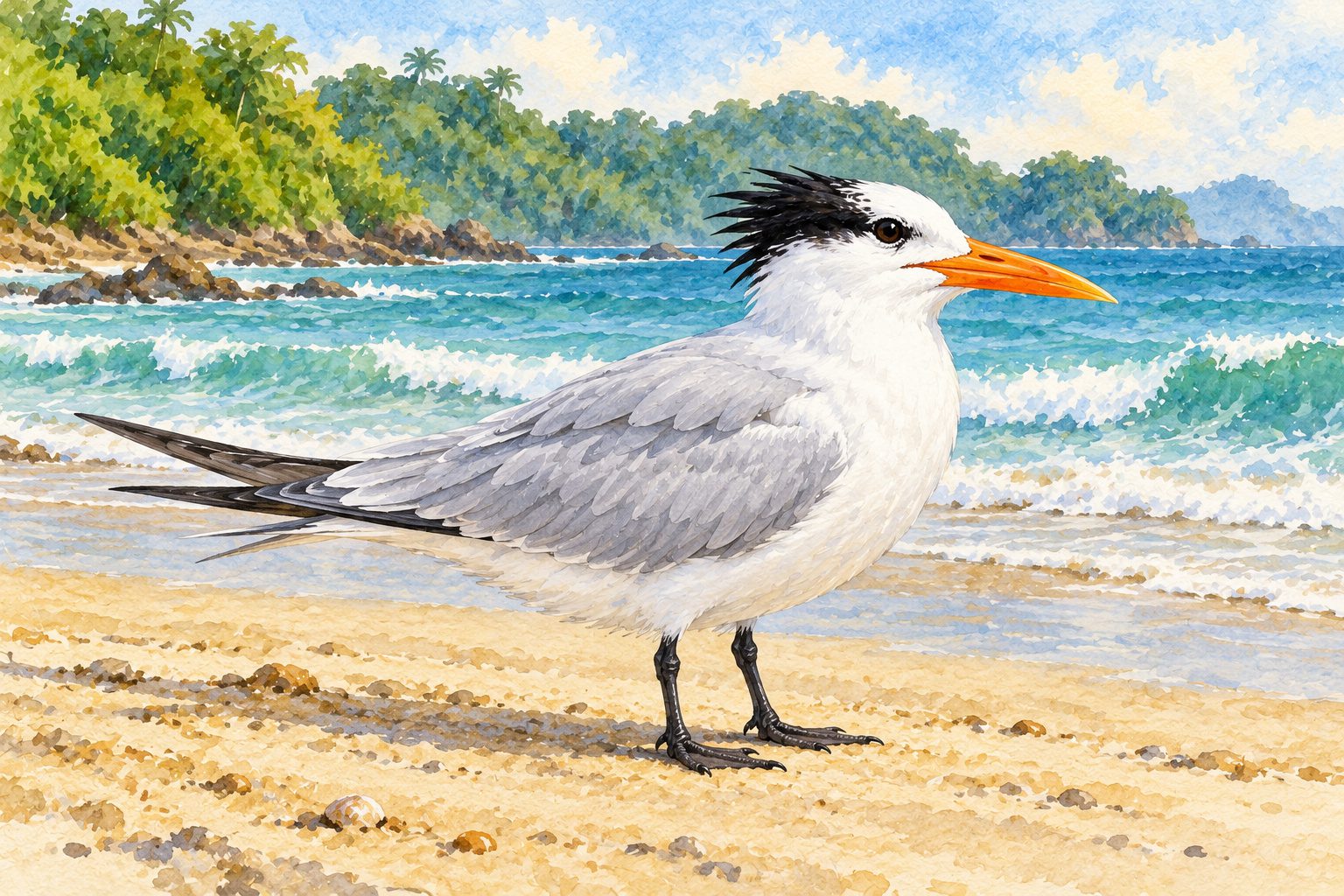
Pico notices an orange bill above the tideline. Tati sketches the crest before the tern returns to fishing.
Species overview
About the Royal Tern
The Royal Tern is a large pale coastal tern with a substantial orange bill and ragged dark crest. It flies over water and dives after fish and small crustaceans. Outside breeding plumage the forehead becomes white while dark feathers remain toward the back of the head. Resting groups need undisturbed beach space between feeding trips.
Identification
Key Features of the Royal Tern
Large orange pointed bill
Pale gray back and white body
Black legs
Dark rear crest, with a white forehead outside breeding
Habitat & range
Scan coastal waters and undisturbed shoreline resting places from a safe public viewpoint. Keep boats and people away from nesting or resting colonies.
Local observations
Both mainland coasts, with concentrations around river mouths and the gulfs of Nicoya and Dulce. Northern Plains has Caño Negro records. Offshore Pacific observations also support the Oceanic Pacific; inland and offshore sightings are less typical than coastal feeding and resting sites.
When to observe
Resident populations occur in suitable habitat. Look during permitted daylight visiting hours; feeding, resting and visibility depend on the site, weather and water levels.
Conservation & care
Give feeding and resting birds space. If a bird stops feeding, repeatedly looks at you or moves away, increase your distance. Keep dogs away from flocks, avoid playback and feeding, and leave nests and natural shoreline debris undisturbed.
Observation activity
Compare the illustrated nonbreeding head with a breeding-plumage reference. Record what changes and what stays useful.
Explore by location
Caribbean · Central Pacific · Guanacaste · Northern Plains · Oceanic Pacific · Puntarenas & the Gulf Islands · South Pacific