

Nature Field Guide
Magnificent Frigatebird
- Spanish name
- Rabihorcado magnífico
- Scientific name
- Fregata magnificens
What Do Pico & Tati Think?
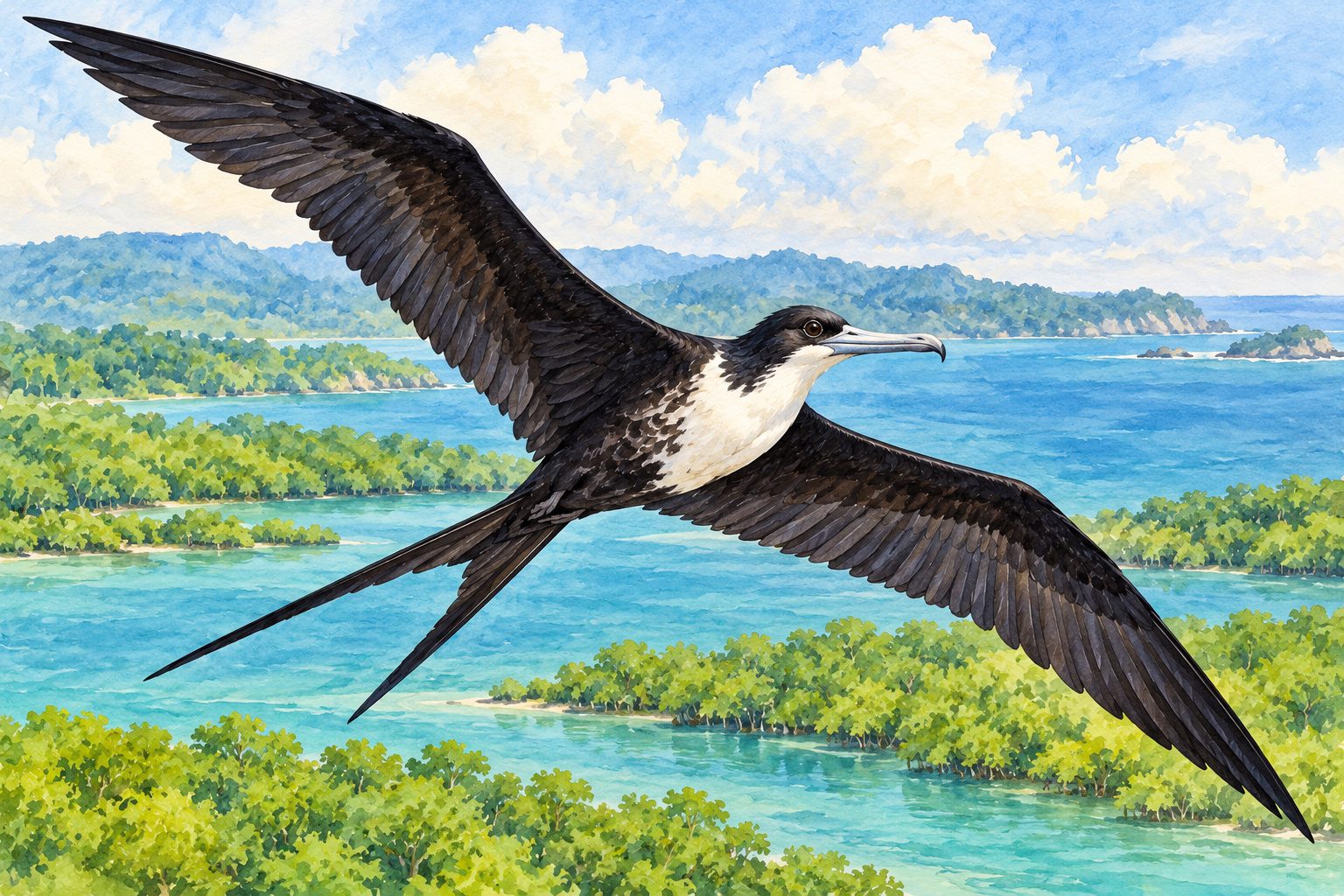
Pico draws a bird that barely seems to flap. Tati adds a deeply forked tail to finish its sky silhouette.
Species overview
About the Magnificent Frigatebird
Frigatebirds use very long wings and a deeply forked tail to soar above tropical coasts. They take food near the surface and may chase other seabirds for it. Males are dark with a red throat pouch used in display; females have a white chest. They do not behave like ducks resting on the sea, so watch their aerial shape rather than expecting a floating bird.
Identification
Key Features of the Magnificent Frigatebird
Very long angular wings
Deeply forked tail
Adult male dark with red throat skin
Adult female has a white chest
Habitat & range
Scan coastal waters and undisturbed shoreline resting places from a safe public viewpoint. Keep boats and people away from nesting or resting colonies.
Local observations
Present along both mainland coasts, generally more numerous on the Pacific. Northern Plains is supported by inland Caño Negro records and should be read as local/irregular occurrence, not normal inland seabird habitat. Oceanic Pacific: uncommon visitor in the official Isla del Coco checklist, rather than ordinary year-round habitat.
When to observe
Resident populations occur in suitable habitat. Look during permitted daylight visiting hours; feeding, resting and visibility depend on the site, weather and water levels.
Conservation & care
Give feeding and resting birds space. If a bird stops feeding, repeatedly looks at you or moves away, increase your distance. Keep dogs away from flocks, avoid playback and feeding, and leave nests and natural shoreline debris undisturbed.
Observation activity
Trace a forked tail and a rounded tail on paper. Compare how different the silhouettes look against the sky.
Explore by location
Caribbean · Central Pacific · Guanacaste · Northern Plains · Oceanic Pacific · Puntarenas & the Gulf Islands · South Pacific