

Nature Field Guide
White Mangrove
- Spanish name
- Mangle blanco
- Scientific name
- Laguncularia racemosa
What Do Pico & Tati Think?
Pico: “Rounded leaves and two tiny stalk glands are useful mangrove clues.”
Tati: “Let’s notice the leaves, flowers and habitat without disturbing the plant.”
Species overview
About the White Mangrove
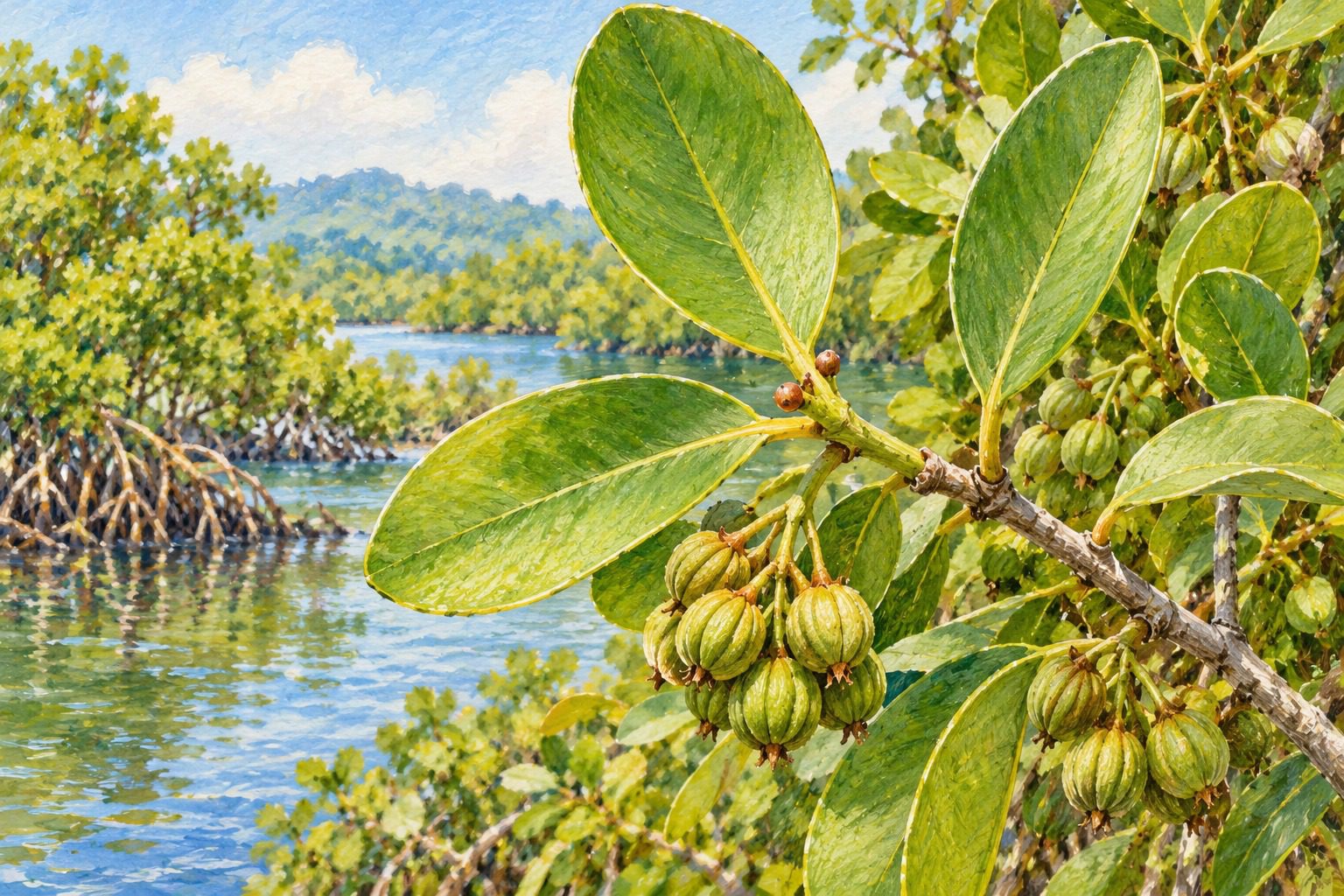
White mangrove has opposite leaves with rounded tips. A close photograph can show a pair of small glands on the leaf stalk near the blade. Clusters of small fruits provide another clue when present.
Its common name does not mean every part of the tree is white. Mangroves are best compared using several features together. Study an accessible leaf with a guide rather than breaking a twig or wading into the root zone.
Identification
Key Features of the White Mangrove
Opposite rounded leaves
Two small glands on the leaf stalk
Clusters of small ribbed fruits
Habitat & range
Coastal estuaries and mangrove margins; documented Pacific sites include Guanacaste and Tivives. Gandoca provides a documented Caribbean example.
Local observations
Native to Costa Rica. Local presence and abundance depend on suitable habitat and growing conditions.
When to observe
Leaves and growth form can be observed whenever the plant is accessible. Flowering and fruiting vary with location, weather and the individual plant; ask a local guide about current conditions.
Conservation & care
Stay on permitted paths or boardwalks with an adult. Do not break twigs, remove propagules or walk through mangrove roots and tidal mud.
Threats & pressures
Protect suitable habitat, mature trees and natural regeneration. Avoid trampling, unauthorized clearing and collection.
Observation activity
On a close leaf photograph, mark the two glands and trace the rounded tip.
Explore by location
Caribbean · Central Pacific · Guanacaste · Puntarenas & the Gulf Islands · South Pacific · Guanacaste · Limón · Puntarenas