

Nature Field Guide
White-lipped Peccary
- Spanish name
- Chancho de monte / Saíno labiblanco
- Scientific name
- Tayassu pecari
What Do Pico & Tati Think?
Pico: “There may be more animals behind the ones we see!”
Tati: “We keep far away and let the herd pass.”
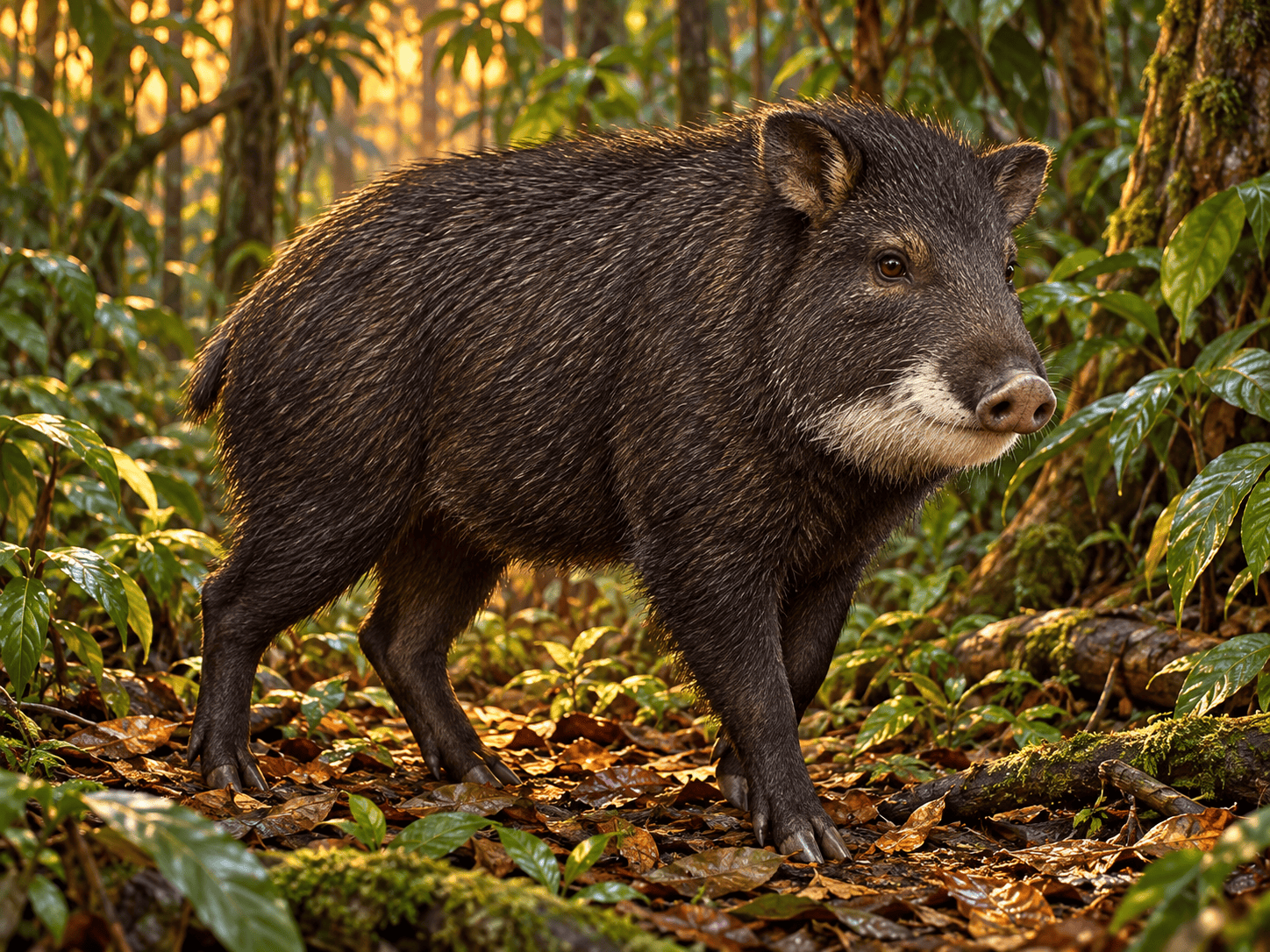
Species overview
About the White-lipped Peccary
The White-lipped Peccary has a dark bristly coat and a clear pale patch on its lips and chin. It differs from the Collared Peccary, whose pale marking forms a collar around the neck. Correct identification matters when interpreting a herd or a camera-trap image.
White-lipped peccaries are highly social and can travel in large herds while searching for fruit, seeds and other foods. Their movements depend on enough habitat to find resources across the landscape. Fragmentation and hunting can therefore affect whole groups, not just isolated animals. Observe with a guide from a substantial distance and give a moving herd an uninterrupted route.
Identification
Key Features of the White-lipped Peccary
Pale lips and chin on a dark body.
No clear neck collar like a Collared Peccary.
Can travel in large, closely associated herds.
Habitat & range
Documented ACG rainforest sectors and Caño Negro Wildlife Refuge’s surrounding habitat.
Local observations
ACG has Quica, Pitilla records. A published UNED study reports rediscovery within Caño Negro refuge, where it had been considered locally extinct.
When to observe
Observe from authorized routes with a local guide. Activity, weather and food availability change encounters; a documented location is not a promise of a sighting.
Seasonal Calendar
Breeding possible
Costa Rica; broad natural-history account
Year-round
ACG describes year-round reproduction; local timing and herd movements vary.
Event source ↗Conservation & care
Keep a respectful distance and leave an open route for the animal. Stay on authorized paths, secure food and rubbish, and observe without feeding, touching, baiting or chasing.
Threats & pressures
Clearing and fragmentation for farming and livestock, plus illegal hunting, threaten herds and their habitat.
Documented impact
A 2016 UNED paper reported that the species’ distribution in Costa Rica had contracted by 89%. This is a historical change in occupied range, not an 89% population count or a 2026 census.
Protection & recovery
Costa Rica’s government wildlife guide explicitly identifies this species as protected nationally. This legal designation is separate from its global IUCN category.
Conservation assessment
Global IUCN category as reported by the linked source, checked 7 October 2026. The source does not give an assessment year here. National legal protection and local abundance are separate questions.
Observation activity
Compare the pale lip patch with a Collared Peccary’s neck marking using photographs; never move toward a herd for identification.
Explore by location
Guanacaste · Northern Plains · Alajuela · Guanacaste · Caño Negro