

Nature Field Guide
Northern Silky Anteater
- Spanish name
- Hormiguero sedoso norteño
- Scientific name
- Cyclopes dorsalis
What Do Pico & Tati Think?
The northern silky anteater is tiny compared with the northern tamandua already in your guide.
Species overview
About the Northern Silky Anteater
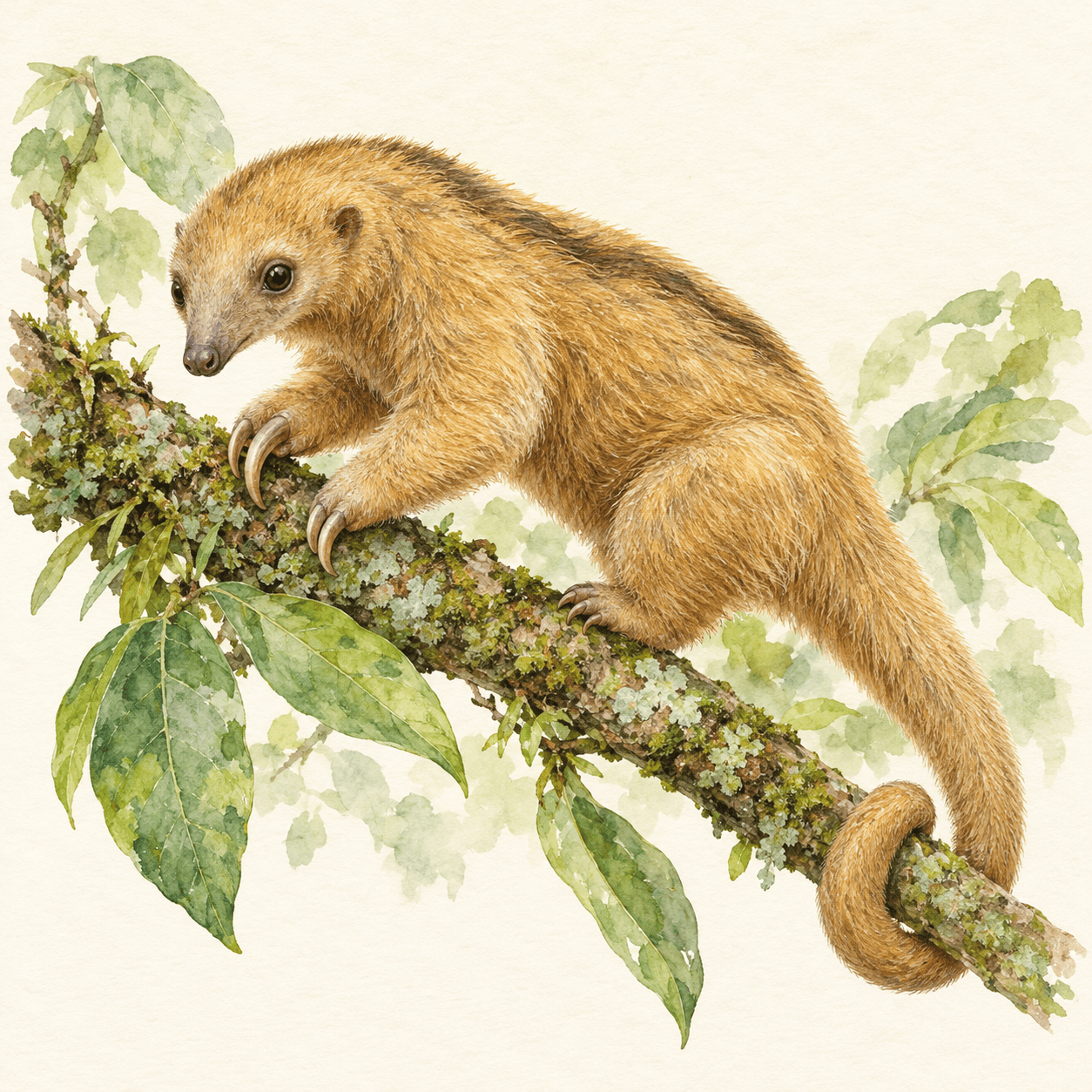
The northern silky anteater is tiny compared with the northern tamandua already in your guide. It lives in trees, uses a prehensile tail and has curved foreclaws. Its silky golden coat can make a resting animal resemble part of the surrounding vegetation. It is solitary and nocturnal, feeding on ants and termites. During the day it may rest curled on a branch. Costa Rican research documents this species, including in a Sarapiquí forest fragment. Never unwrap leaves or shake branches while searching for a hidden animal.
Explorer activity: Compare this anteater with the tamandua card. Draw one feature they share and two features that differ.
Your discovery notes: Record the date, place and habitat. Add a sketch or a photograph taken from a distance. Write what you observed and one question you would like to investigate. If the species is uncertain, keep that uncertainty in your notes.
Identification
Key Features of the Northern Silky Anteater
Tiny body with soft golden or yellowish fur.
Short tapered snout and strong curved foreclaws.
Long gripping tail; much smaller than a tamandua.
Habitat & range
Suitable forest canopy, including documented Sarapiquí habitat.
Local observations
Recorded in Costa Rica. This is a country-level profile; it does not establish occurrence in every province, town or nature site.
When to observe
Active at night; a daytime animal may be resting and must be left undisturbed.
Conservation & care
Explore with an adult or local guide. Observe quietly from a distance, stay on established trails and leave shelter undisturbed. Do not feed, touch, capture or corner wildlife. Keep pets away.
Observation activity
Compare this anteater with the tamandua card. Draw one feature they share and two features that differ.