

Nature Field Guide
Northern Olingo
- Spanish name
- Olingo norteño
- Scientific name
- Bassaricyon gabbii
What Do Pico & Tati Think?
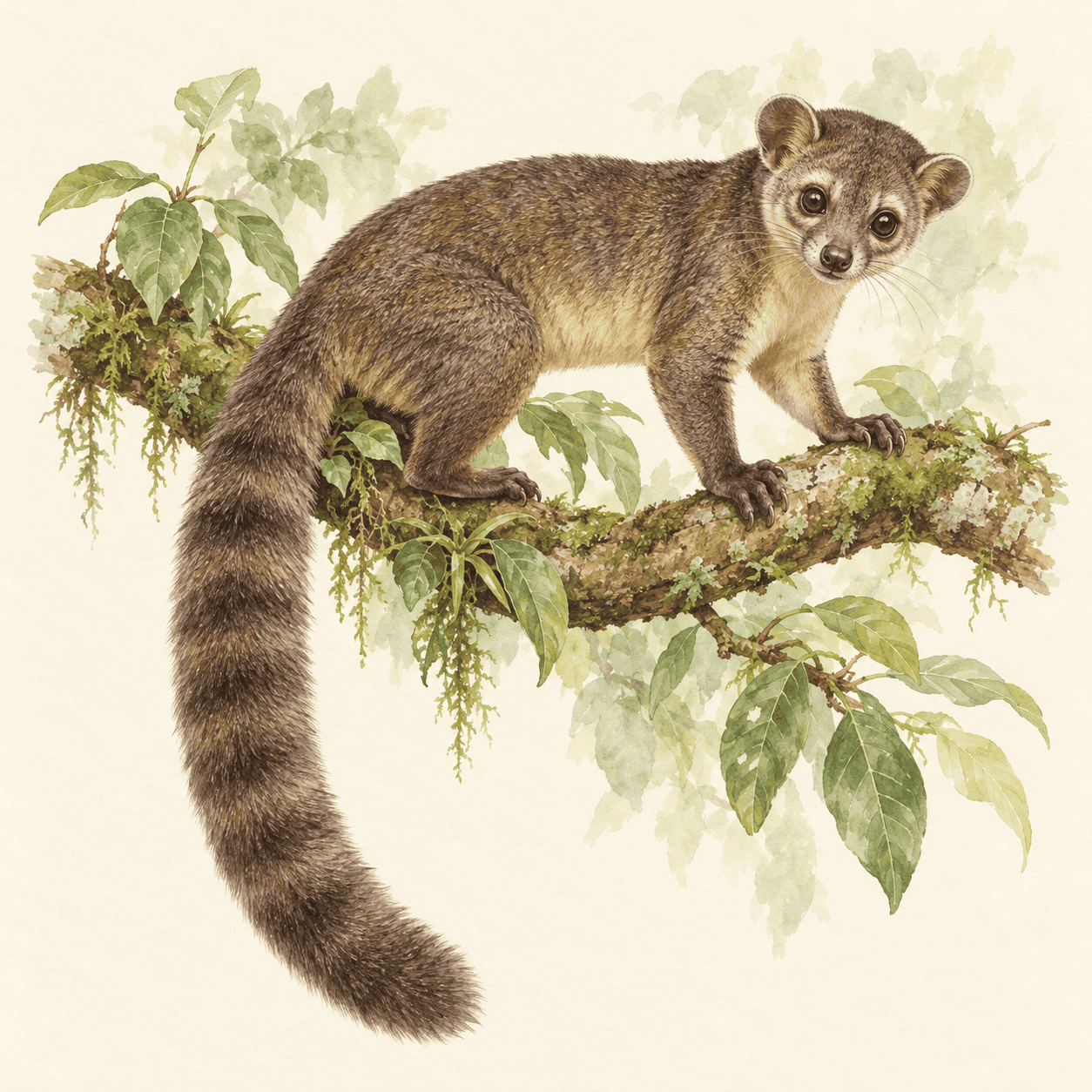
The northern olingo is a forest mammal that moves among branches and eats fruit, with nectar also reported in its diet.
Species overview
About the Northern Olingo
The northern olingo is a forest mammal that moves among branches and eats fruit, with nectar also reported in its diet. It belongs to the raccoon family, rather than the monkey family. It can be confused with a kinkajou, but its bushy tail does not grip branches like a kinkajou's prehensile tail. Research documents this species in Costa Rica, including Monteverde. Olingos are primarily nocturnal, although daytime activity has also been observed. Connected forest branches provide routes between feeding and resting places.
Explorer activity: Compare the olingo and kinkajou cards. Draw their tails and describe the difference between balance and gripping.
Your discovery notes: Record the date, place and habitat. Add a sketch or a photograph taken from a distance. Write what you observed and one question you would like to investigate. If the species is uncertain, keep that uncertainty in your notes.
Identification
Key Features of the Northern Olingo
Gray-brown fur, rounded ears and a fairly pointed muzzle.
Long bushy tail that is not prehensile.
Compare several features with a kinkajou; a quick glimpse may be inconclusive.
Habitat & range
Forested canopies, including documented Monteverde sites.
Local observations
Recorded in Costa Rica. This is a country-level profile; it does not establish occurrence in every province, town or nature site.
When to observe
Primarily at night; daytime records also exist.
Conservation & care
Explore with an adult or local guide. Observe quietly from a distance, stay on established trails and leave shelter undisturbed. Do not feed, touch, capture or corner wildlife. Keep pets away.
Observation activity
Compare the olingo and kinkajou cards. Draw their tails and describe the difference between balance and gripping.