

Nature Field Guide
Many-scaled Anole
- Spanish name
- Anolis de muchas escamas
- Scientific name
- Anolis polylepis
What Do Pico & Tati Think?
Pico: “What helps this reptile fit into its habitat?”
Tati: “Let’s look at its shape, colors and surroundings while giving it plenty of space.”
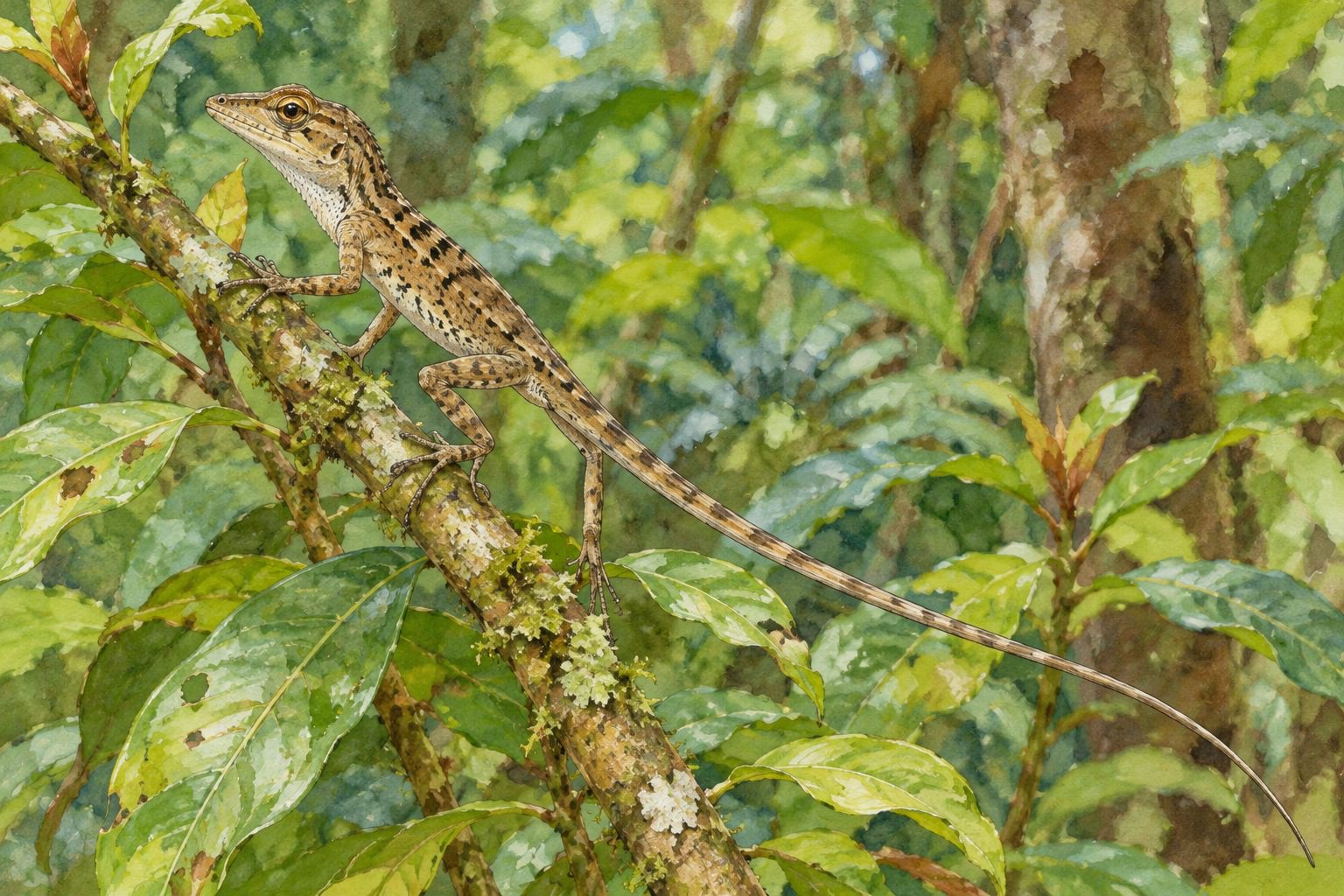
Species overview
About the Many-scaled Anole
This delicate anole has a narrow body, long hind legs and a very long tail. Brown markings make it inconspicuous among twigs and fallen leaves. Males can extend an orange throat fan, but the fan is often folded out of sight.
It lives in humid forest and nearby vegetation on the central and southern Pacific slope. Small brown anoles are not interchangeable: similar-looking species can live near one another. Record the perch and locality as well as the lizard’s appearance, and never make an animal display for a photograph.
Identification
Key Features of the Many-scaled Anole
Slender brown body
Long hind legs and a fine tail
Orange male throat fan when naturally displayed
Habitat & range
Humid Central and South Pacific forests and foothills, including San Vito. Osa populations have also been treated as Anolis osa in some references.
Local observations
Native species recorded in Costa Rica. Sightings depend on suitable habitat and locality.
When to observe
Observe on a suitable guided outing. Activity varies with weather, season and locality; do not disturb a resting or hidden animal.
Conservation & care
Observe with an adult from permitted paths. Do not touch, chase, catch or feed reptiles. Leave bark, logs, stones and leaf litter in place. Keep pets away and allow an open escape route.
Threats & pressures
Protect connected habitat and natural shelters. Avoid collection, unnecessary clearing and deliberate killing. Leave wildlife in place and support responsible observation.
Observation activity
Make a perch chart: leaf, twig, trunk or ground. Record only what you can see without disturbing wildlife.
Explore by location
Central Pacific · South Pacific · Puntarenas · San José · San Vito