

Nature Field Guide
King Angelfish
- Spanish name
- Ángel real / Ángel bandera
- Scientific name
- Holacanthus passer
What Do Pico & Tati Think?
Pico: “That fish has a bright stripe!”
Tati: “Let’s compare the adult pattern with a young fish before deciding what we see.”
Species overview
About the King Angelfish
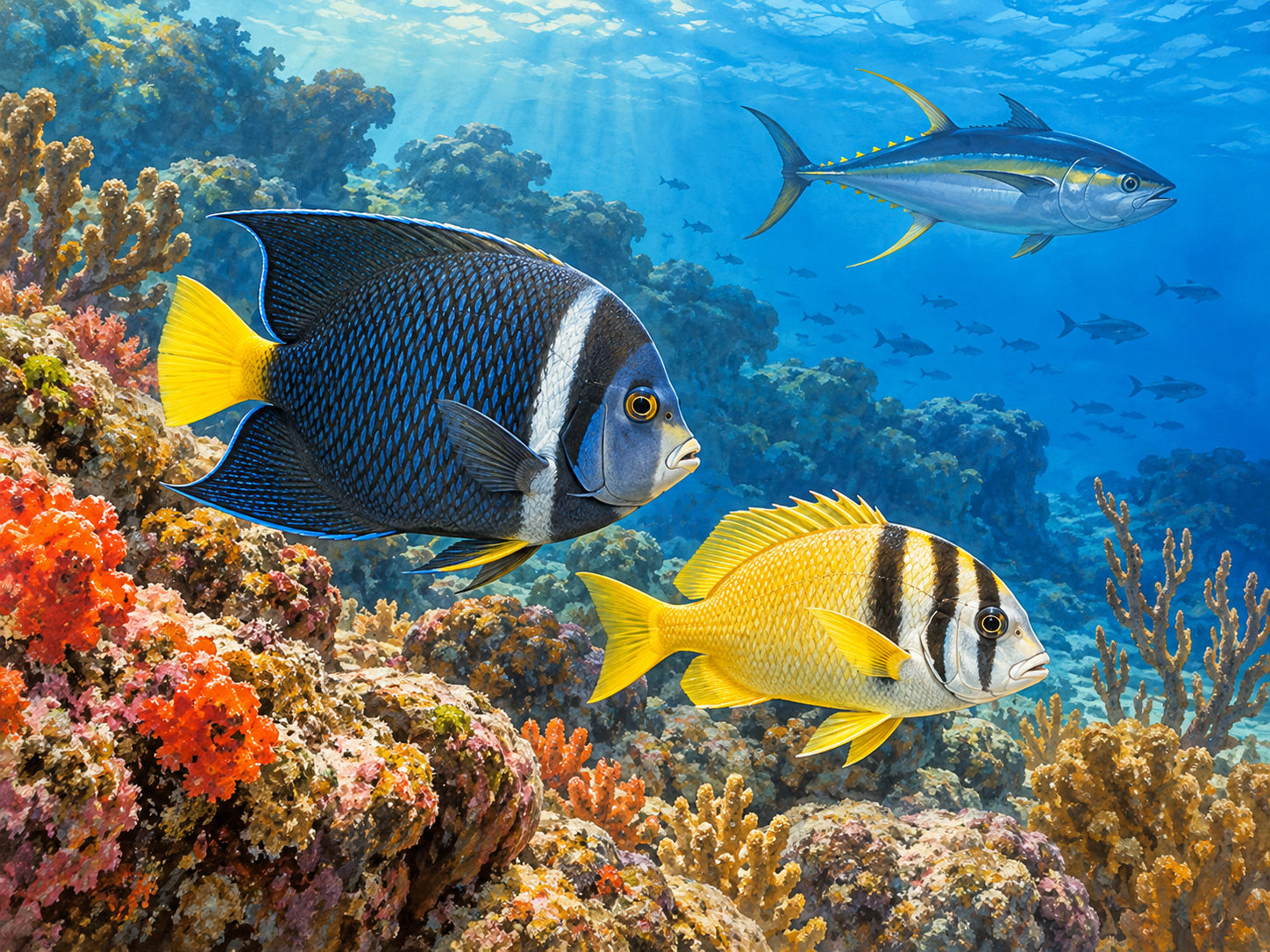
The king angelfish has a tall, flattened body that gives it a distinctive side profile. Adults are predominantly dark blue-gray, with a narrow white bar on the side and a yellow tail. The small mouth contains brush-like teeth.
Juveniles have a different pattern, including orange, dark areas and lighter bars. This change with age makes a single color description insufficient for every individual. Look at body shape and several markings together.
Park documentation records king angelfish at Isla del Coco. The species also has a wider eastern Pacific distribution. A record at an offshore island does not automatically establish occurrence on a nearby mainland beach.
Identification
Key Features of the King Angelfish
A deep, flattened body and small mouth.
Adults have a narrow white bar against a dark blue-gray body.
A yellow tail; juveniles have a different barred pattern.
Habitat & range
Reef-associated eastern Pacific marine habitats. Costa Rican records used here include Isla del Coco, the Salinas/Santa Elena area of Guanacaste, and Isla del Caño in the South Pacific. These are documented examples, not a complete range map.
Local observations
The Isla del Coco tourism plan lists king angelfish among species associated with its marine observation sites. The record is site documentation rather than a population assessment.
When to observe
Observations depend on route, visibility, currents and animal movements. No fixed viewing season or guaranteed sighting is established by this profile.
Conservation & care
Follow park rules and qualified guides. Do not feed, touch, chase or collect marine wildlife. Maintain distance and avoid contact with reef habitat.
Observation activity
Use a verified identification image to sketch three distinguishing features. During any guided observation, record the place, date and behavior without moving closer to the animal.