

Nature Field Guide
Central American Squirrel Monkey
- Spanish name
- Mono tití / Mono ardilla
- Scientific name
- Saimiri oerstedii
What Do Pico & Tati Think?
Pico: “The little monkeys are moving together!”
Tati: “Let’s watch the troop without following it off the trail.”
Species overview
About the Central American Squirrel Monkey
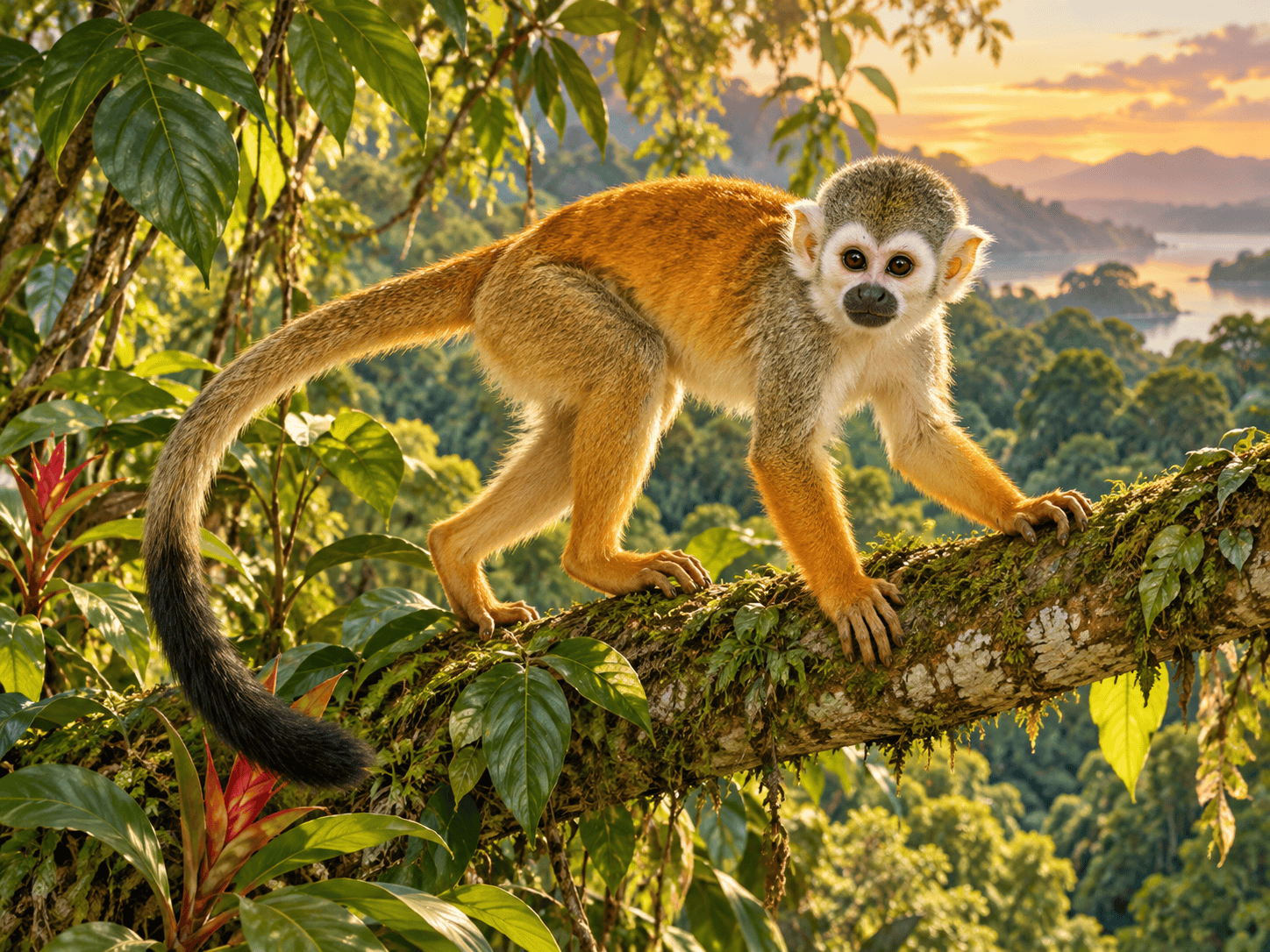
The Central American Squirrel Monkey is a small, slender primate with a long tail, pale facial markings and warm-colored fur on its back. Its natural range is limited to parts of Costa Rica and Panama, making it a particularly regional member of the country’s wildlife.
These monkeys forage socially during the day, searching for fruit and small animal foods, including insects. Their quick movements can make a passing troop hard to count. Forest cover provides routes between feeding places, while nearby streams and regenerating vegetation can be part of their habitat. An encounter should preserve the troop’s movement rather than interrupting it for a closer photograph.
Identification
Key Features of the Central American Squirrel Monkey
Small slender monkey with pale facial markings.
Warm reddish or yellow-brown back.
Long tail and rapid movements through vegetation.
Habitat & range
Manuel Antonio National Park near Quepos; this species also occupies parts of the southern Pacific lowlands.
Local observations
SINAC records Saimiri oerstedii citrinellus in Manuel Antonio. The profile describes the species; the local record identifies that subspecies.
When to observe
Observe from authorized routes with a local guide. Activity, weather and food availability change encounters; a documented location is not a promise of a sighting.
Conservation & care
Keep a respectful distance and leave an open route for the animal. Stay on authorized paths, secure food and rubbish, and observe without feeding, touching, baiting or chasing.
Threats & pressures
Forest destruction is a serious pressure for a species with a restricted geographic range.
Protection & recovery
Costa Rica’s government wildlife guide explicitly identifies this species as protected nationally. This legal designation is separate from its global IUCN category.
Conservation assessment
Global IUCN category as reported by the linked source, checked 7 October 2026. The source does not give an assessment year here. National legal protection and local abundance are separate questions.
Observation activity
Count only the individuals visible from one position. Label the result “monkeys seen,” not the size of the entire troop.
Explore by location
Central Pacific · South Pacific · Puntarenas · Manuel Antonio · Quepos