

Nature Field Guide
Baird’s Tapir
- Spanish name
- Danta
- Scientific name
- Tapirus bairdii
What Do Pico & Tati Think?
Pico: “Its nose can reach the leaves!”
Tati: “Let’s keep the path open and give it plenty of room.”
Species overview
About the Baird’s Tapir
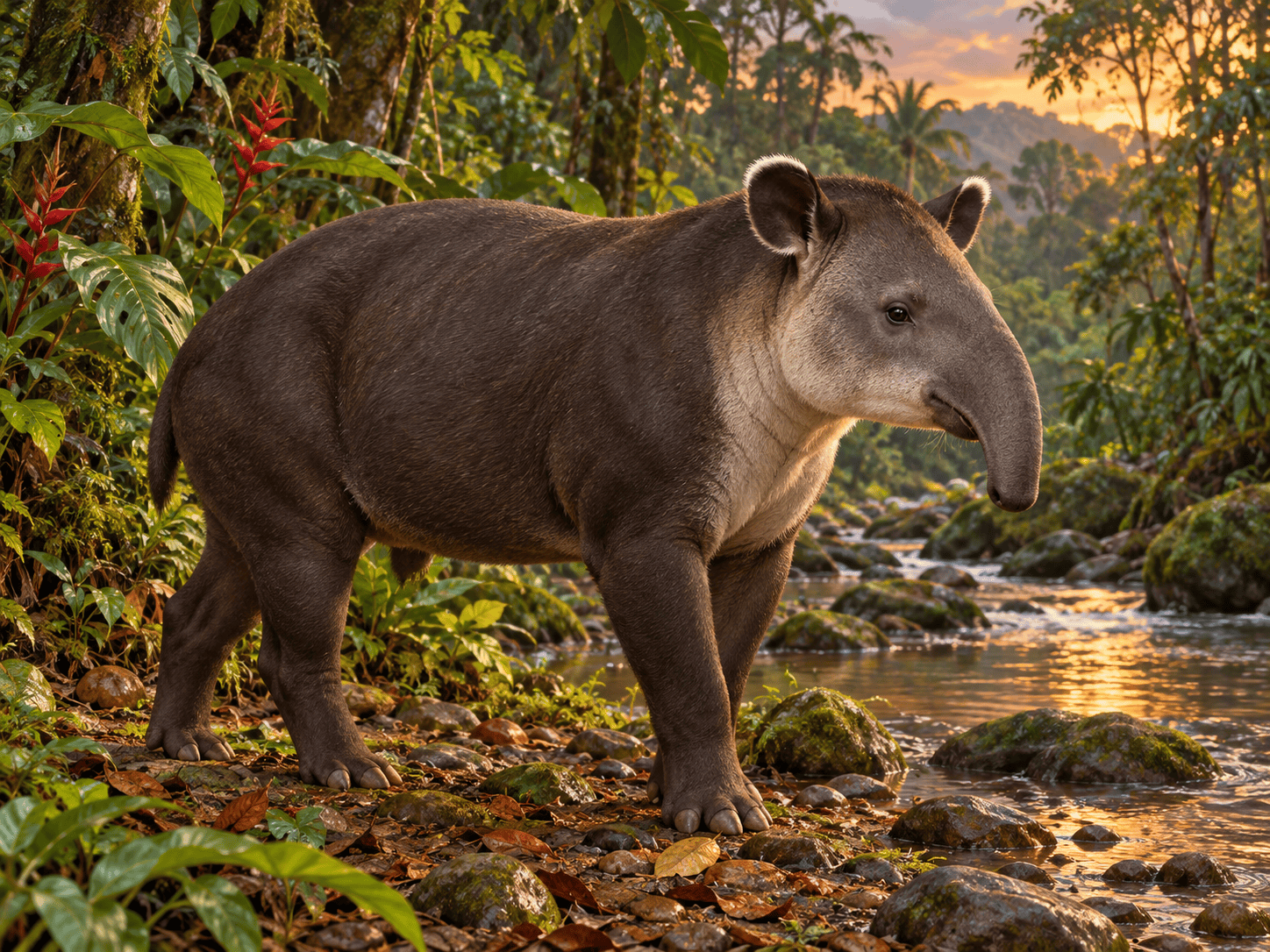
Baird’s Tapir is a large, heavy-bodied plant eater with a short, flexible trunk-like snout. Pale ear edges contrast with its dark adult coat. Calves look very different: spots and stripes help camouflage them before their coats become more uniform.
Tapirs eat leaves, shoots, fruit and other plant material. As they move and pass seeds, they help connect feeding behavior with forest regeneration. Water provides refuge, and tapirs can swim well. A female typically has one calf after a long pregnancy, so population recovery is slow. Large connected habitats, safe movement routes and protection from hunting all support the future of this distinctive mammal.
Identification
Key Features of the Baird’s Tapir
Large dark body and short flexible snout.
Pale edges around the ears.
Young calves have pale spots and stripes.
Habitat & range
Corcovado National Park’s forest and wetland landscape, including the Sirena area. Puerto Jiménez, Bahía Drake and Carate are gateways.
Local observations
SINAC documents tapirs in Corcovado. Town tags identify access communities; they are not a claim of tapirs on urban streets.
When to observe
Observe from authorized routes with a local guide. Activity, weather and food availability change encounters; a documented location is not a promise of a sighting.
Conservation & care
Keep a respectful distance and leave an open route for the animal. Stay on authorized paths, secure food and rubbish, and observe without feeding, touching, baiting or chasing.
Threats & pressures
Habitat clearing and fragmentation, hunting and vehicle collisions threaten tapirs. Slow reproduction limits rapid recovery.
Conservation assessment
Global IUCN category as reported by the linked source, checked 7 October 2026. The source does not give an assessment year here. National legal protection and local abundance are separate questions.
Observation activity
From a distant viewing point, note the snout, ears and walking posture. Never stand between a tapir and its calf or its escape route.
Explore by location
Caribbean · Central Highlands · Guanacaste · Northern Plains · South Pacific · Heredia · Puntarenas · Bahía Drake · Carate · Puerto Jiménez