

Nature Field Guide
Central American Rattlesnake
- Spanish name
- Cascabel / Crótalo
- Scientific name
- Crotalus simus
What Do Pico & Tati Think?
Pico: “What clues help us recognize this reptile?”
Tati: “Let’s notice its shape, markings and habitat from a respectful distance.”
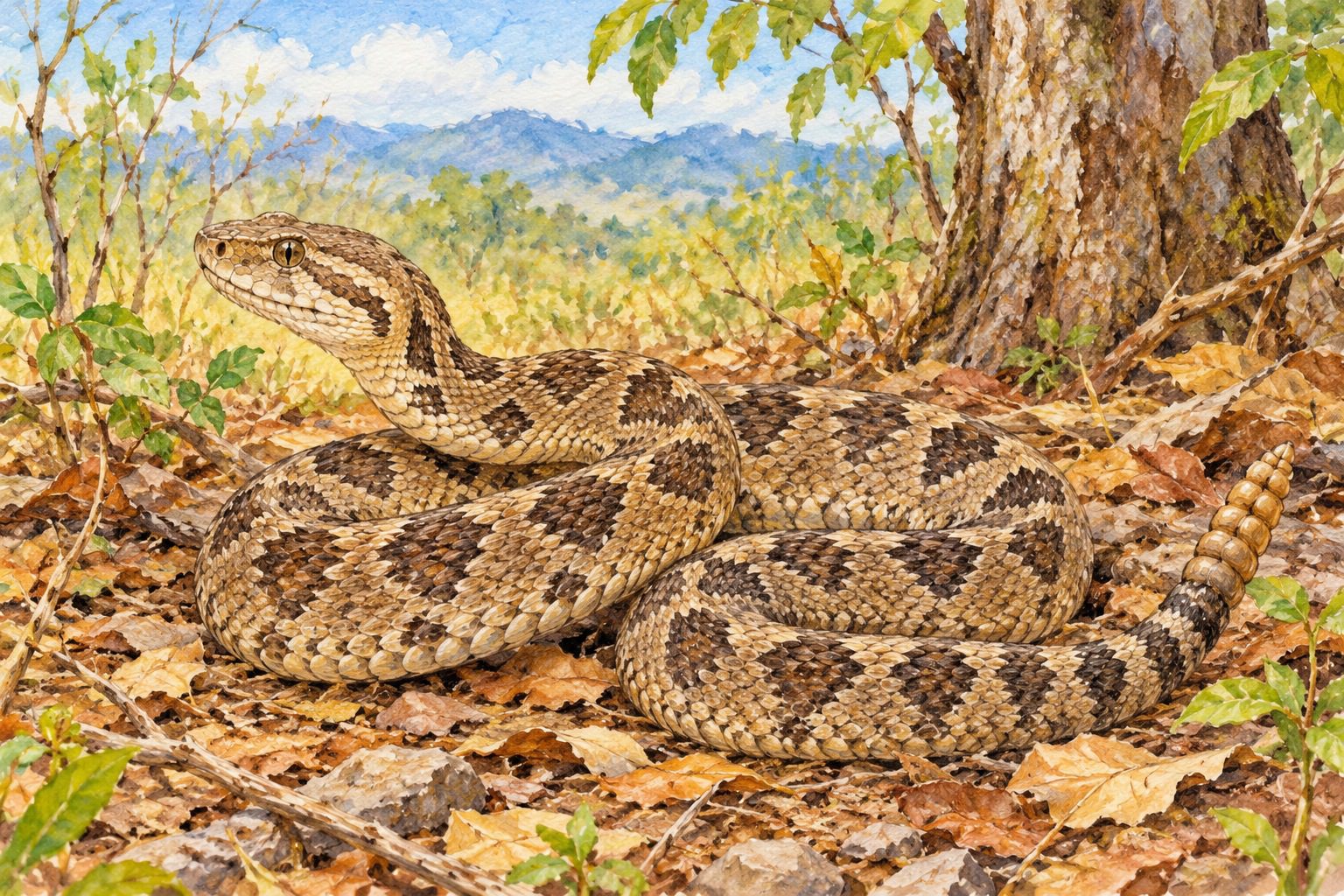
Species overview
About the Central American Rattlesnake
The Central American rattlesnake has a robust body, strongly keeled scales and dark diamondlike markings on a lighter background. The tail ends in a segmented rattle. A rattle can be damaged, and a snake may remain silent.
In Costa Rica this venomous species belongs especially to the dry lowlands of Guanacaste and northern Puntarenas. Never approach to make it rattle or to count segments. A rattle is not a reliable record of a snake’s age.
Identification
Key Features of the Central American Rattlesnake
Dark diamondlike back markings
Strongly keeled scales
Segmented rattle at the tail tip
Habitat & range
Dry lowlands of Guanacaste and northern Puntarenas, especially forest edges and less disturbed ground.
Local observations
Native reptile recorded in Costa Rica. Presence varies with suitable habitat and locality.
When to observe
Visibility varies with weather, habitat and the animal’s activity. Observe on an appropriate guided outing; never disturb a hiding animal to obtain a sighting.
Conservation & care
VENOMOUS. Observe only at a distance with a qualified guide. Never approach, touch, catch or provoke this snake. Keep children and pets well away and do not reach into nearby vegetation or hiding places.
Threats & pressures
Protect habitat connections and natural shelters. Avoid road mortality, collection and deliberate killing. Leave reptiles in their habitat rather than keeping or relocating them.
Observation activity
Draw the rattle from a reference picture. Write why you must never make a real snake demonstrate its sound.
Explore by location
Guanacaste · Puntarenas & the Gulf Islands · Guanacaste · Puntarenas