

Nature Field Guide
Western Sandpiper
- Spanish name
- Correlimos occidental
- Scientific name
- Calidris mauri
What Do Pico & Tati Think?
A tiny gray bird makes Pico slow down. Tati learns that some identifications deserve a question mark.
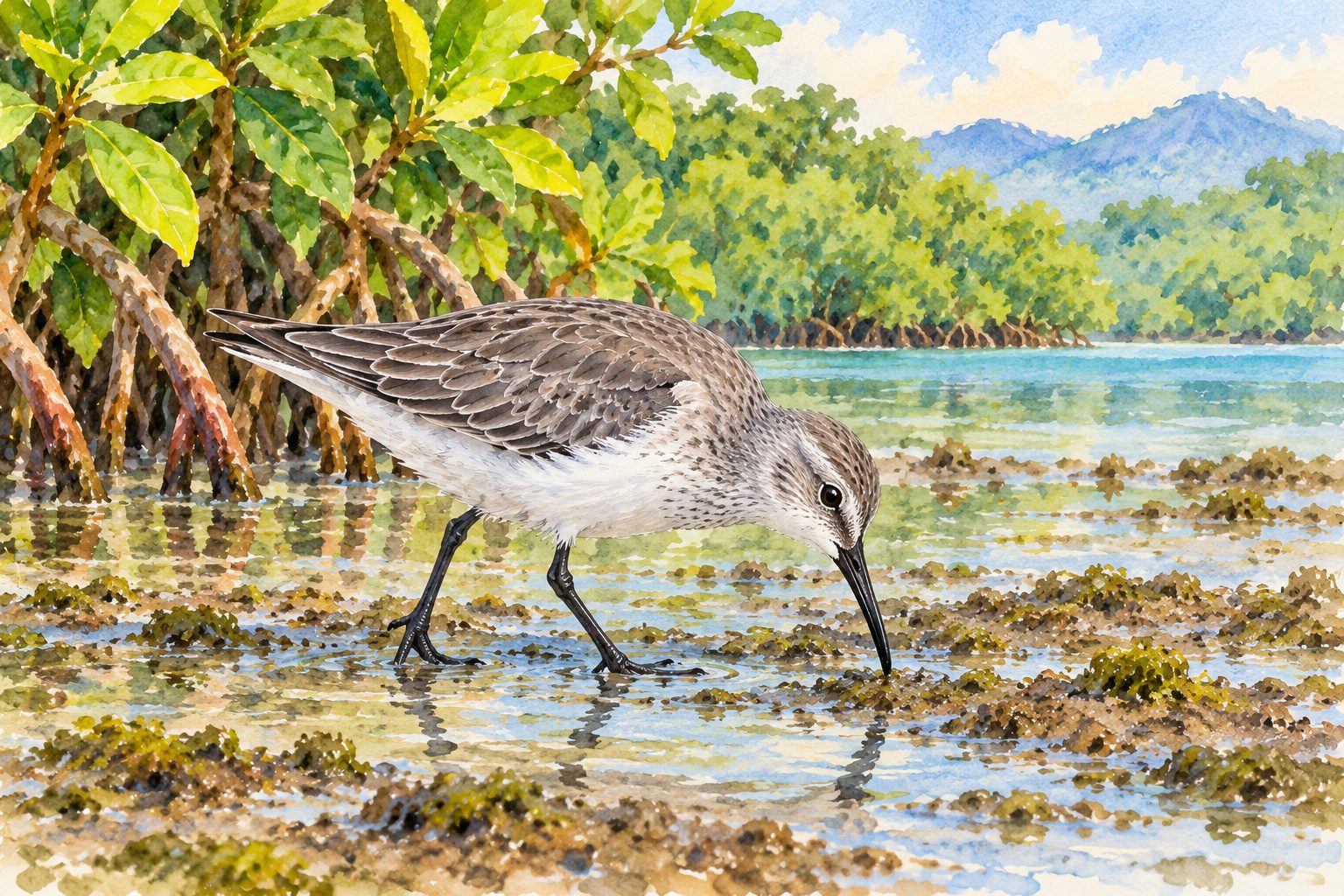
Species overview
About the Western Sandpiper
Western Sandpipers are tiny migratory shorebirds that feed on tidal flats. Nonbreeding adults are mostly gray above and white below. A fine bill often curves slightly downward toward the tip, but bill length varies. Similar small sandpipers can be difficult to separate, and a distant bird may be best recorded simply as an unidentified sandpiper rather than given an uncertain name.
Identification
Key Features of the Western Sandpiper
Very small gray-and-white nonbreeding bird
Fine dark bill often slightly downcurved
Dark legs
Compare carefully with other small sandpipers
Habitat & range
Scan exposed shoreline feeding areas and nearby resting places with binoculars. The tide changes which flats are available; remain on a safe established route.
Local observations
Most numerous on coastal flats, particularly the gulfs of Nicoya and Dulce; also present on the Caribbean coast. Small numbers use inland ponds up to about 1500 m. Caño Negro supports Northern Plains; Central Valley and lower Central Highlands matches refer to occasional inland wetland use, not high mountain habitat. Oceanic Pacific: casual visitor in the official Isla del Coco checklist, rather than ordinary year-round habitat.
When to observe
For migratory shorebirds, November–March is the broad nonbreeding observation window in Costa Rica, with southbound passage mainly August–October and northbound passage April–May. Individual species and sites vary; some birds remain outside these months. Check current local observations and the tide.
Conservation & care
Give feeding and resting birds space. If a bird stops feeding, repeatedly looks at you or moves away, increase your distance. Keep dogs away from flocks, avoid playback and feeding, and leave nests and natural shoreline debris undisturbed.
Observation activity
Make an observation with two confident clues and one uncertainty. An honest question mark is good exploring.
Explore by location
Caribbean · Central Highlands · Central Pacific · Central Valley · Guanacaste · Northern Plains · Oceanic Pacific · Puntarenas & the Gulf Islands · South Pacific