

Nature Field Guide
Southern Spotted Skunk
- Spanish name
- Zorro hediondo manchado
- Scientific name
- Spilogale angustifrons
What Do Pico & Tati Think?
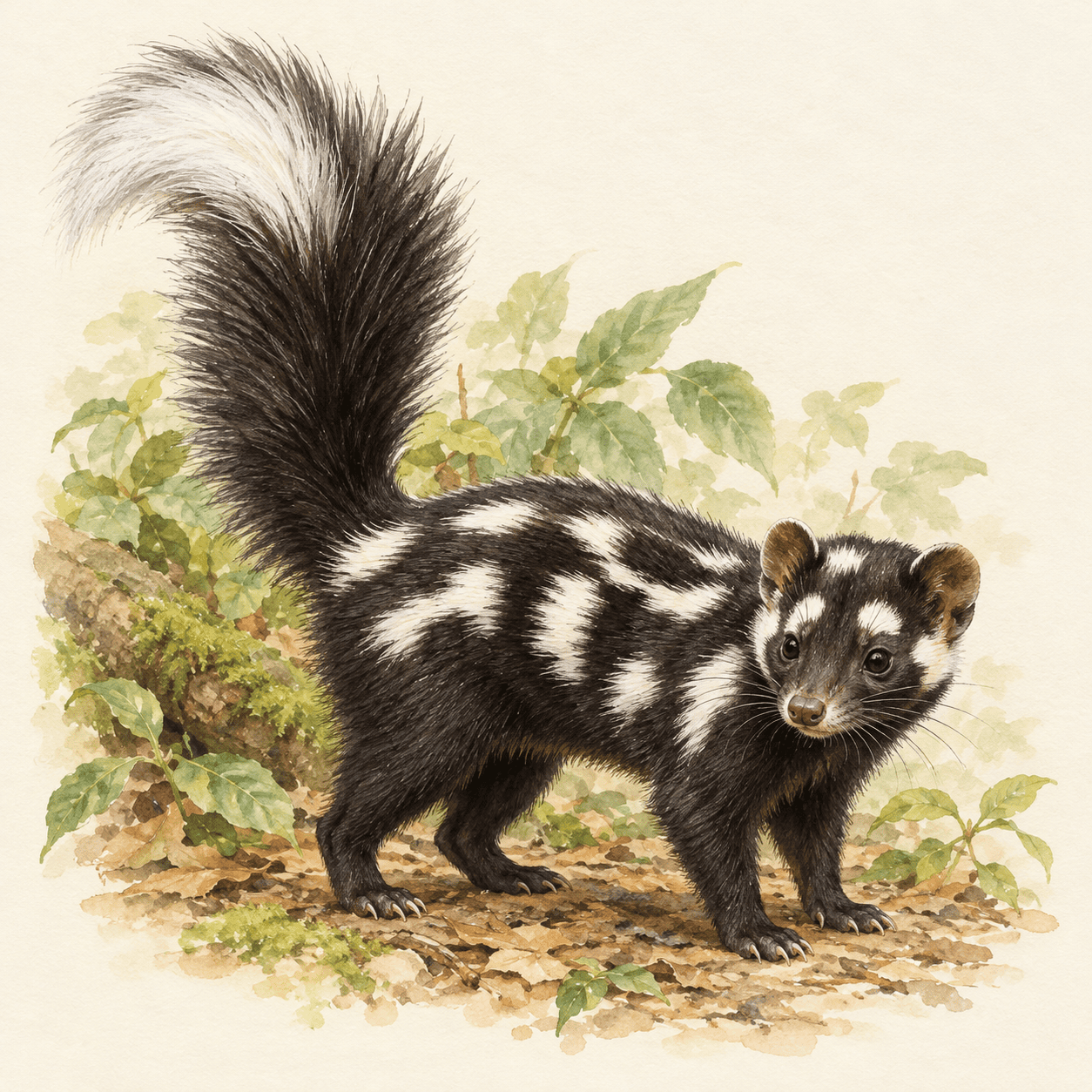
This small skunk has a dark coat patterned with broken pale stripes and patches.
What does Least Concern mean?
In the linked conservation assessment, this species does not qualify as threatened or near threatened with extinction. It still needs care: local populations and habitats can face problems even when the species has a lower extinction risk overall.
This label describes conservation status. It does not tell us whether a plant is safe for children or pets. Select the status button to read the assessment.
Species overview
About the Southern Spotted Skunk
This small skunk has a dark coat patterned with broken pale stripes and patches. Its markings are different from the broad continuous stripes of the hog-nosed skunk. Costa Rican camera-trap research records the species in Guanacaste dry-forest habitat. Like other skunks, it has a chemical defense and should be viewed from a distance. Forest patches can provide habitat even when they look small on a map. Exploring responsibly means respecting the animal's shelter and recording observations without following it into vegetation.
Explorer activity: Draw two black-and-white coat patterns. Explain why recording the arrangement of markings can be more useful than recording only the colors.
Your discovery notes: Record the date, place and habitat. Add a sketch or a photograph taken from a distance. Write what you observed and one question you would like to investigate. If the species is uncertain, keep that uncertainty in your notes.
Identification
Key Features of the Southern Spotted Skunk
Small slender skunk with contrasting black-and-white markings.
Broken pale stripes and patches rather than just two broad back stripes.
Bushy tail; markings can vary among individuals.
Habitat & range
Suitable dry-forest and edge habitats, with research records in Guanacaste.
Local observations
Recorded in Costa Rica. This is a country-level profile; it does not establish occurrence in every province, town or nature site.
When to observe
Mostly at night; guided observation or camera-trap evidence is more useful than disturbing a den.
Conservation & care
Explore with an adult or local guide. Observe quietly from a distance, stay on established trails and leave shelter undisturbed. Do not feed, touch, capture or corner wildlife. Keep pets away. If a skunk notices you, give it room and calmly move away.
Conservation assessment
Global IUCN category reported by Mammal Diversity Database, checked October 2026. A global Least Concern category does not replace Costa Rican national threat classifications.
Observation activity
Draw two black-and-white coat patterns. Explain why recording the arrangement of markings can be more useful than recording only the colors.