

Nature Field Guide
Striped Hog-nosed Skunk
- Spanish name
- Zorro hediondo de nariz de cerdo
- Scientific name
- Conepatus semistriatus
What Do Pico & Tati Think?
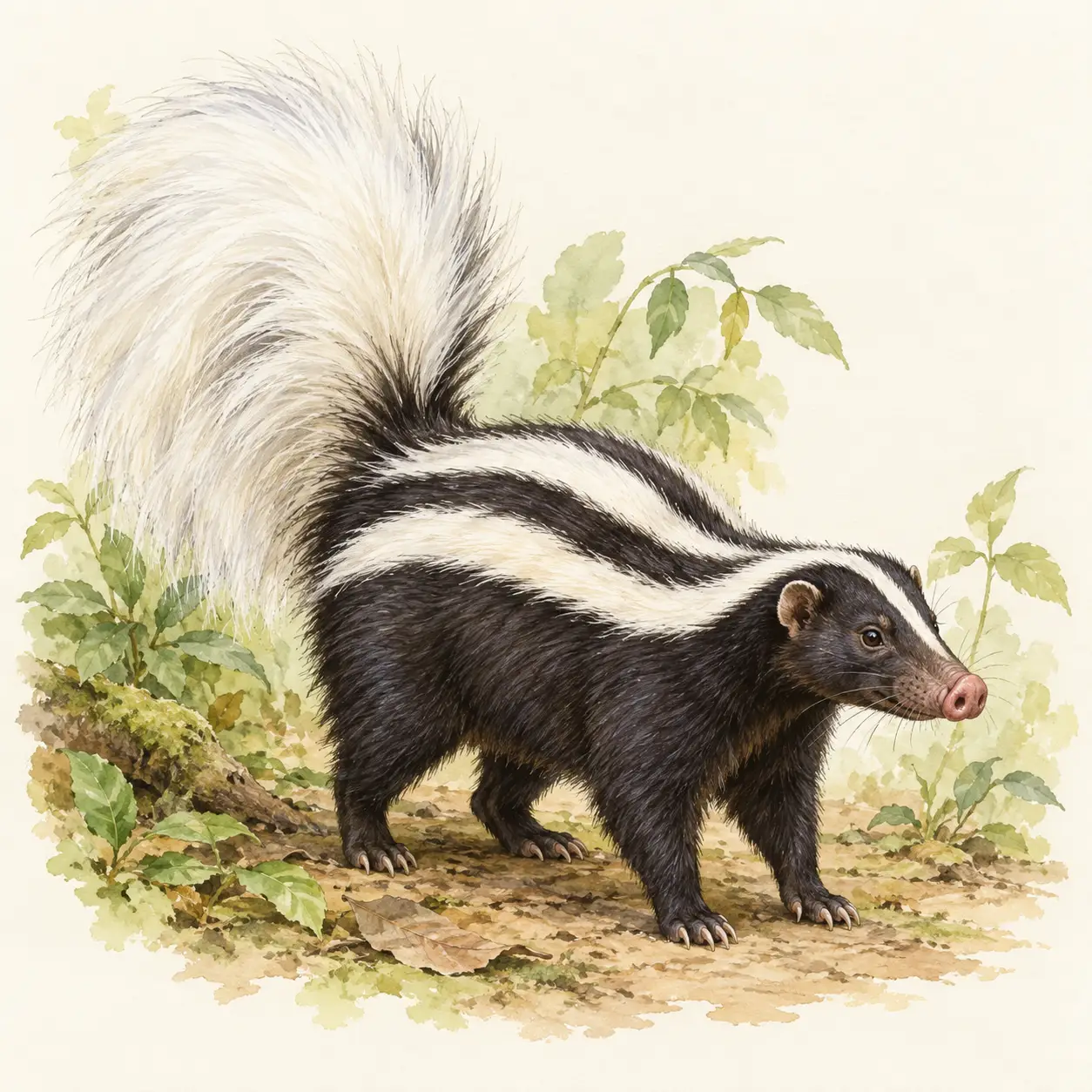
The striped hog-nosed skunk has a broad bare nose that helps distinguish it from other skunks.
Species overview
About the Striped Hog-nosed Skunk
The striped hog-nosed skunk has a broad bare nose that helps distinguish it from other skunks. It searches on the ground for food, including insects and other small animals. Strong claws are useful for digging. Two pale stripes run along its dark back, and the tail is often conspicuously white. Like other skunks, it can defend itself with a strong-smelling spray. The best way to appreciate this animal is to give it plenty of space. Do not follow it, corner it or allow a pet to approach.
Explorer activity: Compare the two skunk illustrations. List the nose and coat-pattern clues that would help you describe an animal from a distance.
Your discovery notes: Record the date, place and habitat. Add a sketch or a photograph taken from a distance. Write what you observed and one question you would like to investigate. If the species is uncertain, keep that uncertainty in your notes.
Identification
Key Features of the Striped Hog-nosed Skunk
Broad bare hog-like nose on an extended muzzle.
Dark body with two broad pale back stripes.
Bushy tail, often mostly white.
Habitat & range
Seasonally dry forests, shrublands and suitable open woodland landscapes.
Local observations
Recorded in Costa Rica. This is a country-level profile; it does not establish occurrence in every province, town or nature site.
When to observe
Generally nocturnal; observe only as part of a guided night activity.
Conservation & care
Explore with an adult or local guide. Observe quietly from a distance, stay on established trails and leave shelter undisturbed. Do not feed, touch, capture or corner wildlife. Keep pets away. If a skunk notices you, give it room and calmly move away.
Observation activity
Compare the two skunk illustrations. List the nose and coat-pattern clues that would help you describe an animal from a distance.