

Nature Field Guide
Common Opossum
- Spanish name
- Zorro pelón común
- Scientific name
- Didelphis marsupialis
What Do Pico & Tati Think?
The common opossum is a marsupial: its young complete an important part of their development attached to their mother's teats, protected in her pouch.
Species overview
About the Common Opossum
The common opossum is a marsupial: its young complete an important part of their development attached to their mother's teats, protected in her pouch. It explores mainly at night and can walk on the ground or climb. Its menu includes fruit, insects and other available foods. A long bare tail can help it grip while moving among branches. Its name does not make it a fox; an opossum belongs to a very different mammal family. Several opossum species live in Costa Rica, so record details before assigning a name.
Explorer activity: Make a nighttime food-web sketch connecting an opossum to fruit, insects and forest habitat. Label observations separately from guesses.
Your discovery notes: Record the date, place and habitat. Add a sketch or a photograph taken from a distance. Write what you observed and one question you would like to investigate. If the species is uncertain, keep that uncertainty in your notes.
Identification
Key Features of the Common Opossum
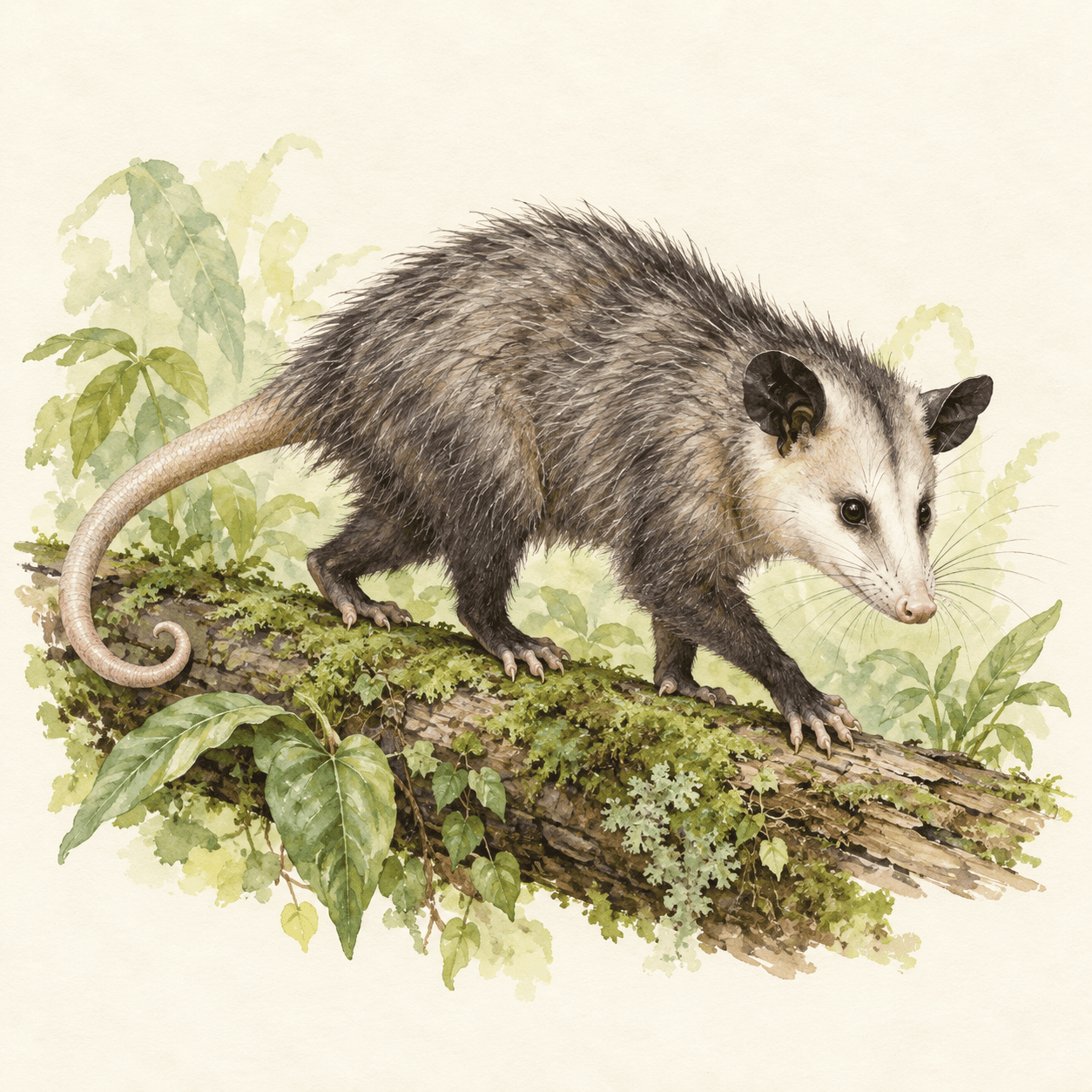
Coarse gray to dark fur and a pale pointed face.
Dark, largely hairless ears and a pink nose.
Long mostly bare tail; other opossums can look similar.
Habitat & range
Forests, wooded edges and some human-modified landscapes.
Local observations
Recorded in Costa Rica. This is a country-level profile; it does not establish occurrence in every province, town or nature site.
When to observe
Mostly at night; let a guide plan any night walk.
Conservation & care
Explore with an adult or local guide. Observe quietly from a distance, stay on established trails and leave shelter undisturbed. Do not feed, touch, capture or corner wildlife. Keep pets away.
Observation activity
Make a nighttime food-web sketch connecting an opossum to fruit, insects and forest habitat. Label observations separately from guesses.
Explore by location
Caribbean · Central Pacific · Guanacaste · Northern Plains · South Pacific · Heredia