

Nature Field Guide
Geoffroy’s Spider Monkey
- Spanish name
- Mono araña / Mono colorado
- Scientific name
- Ateles geoffroyi
What Do Pico & Tati Think?
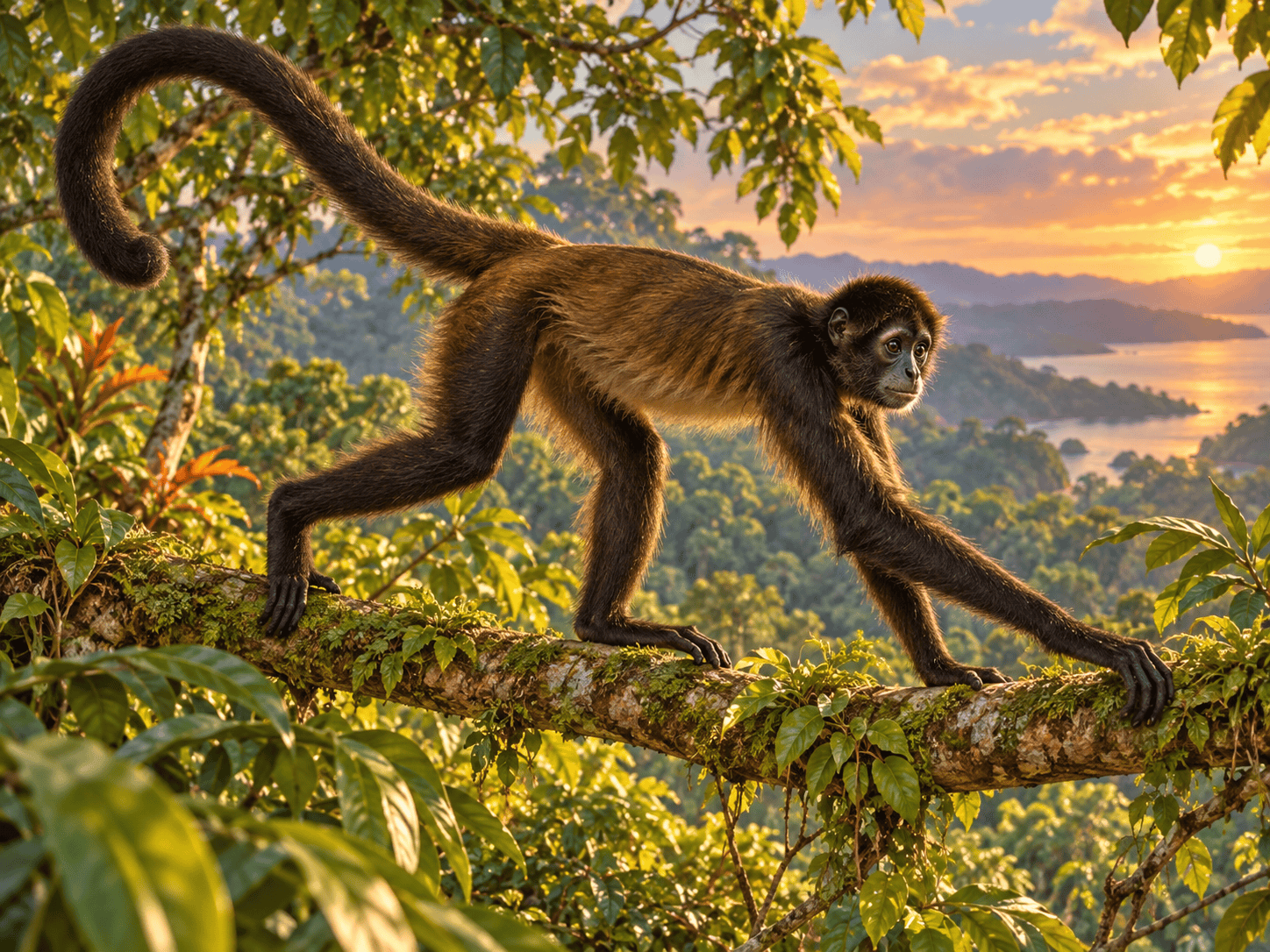
Pico: “Its tail is holding a branch too!”
Tati: “The forest needs connected treetops.”
Species overview
About the Geoffroy’s Spider Monkey
Geoffroy’s Spider Monkey has a slender body, very long limbs and a strong prehensile tail. The tail can support the animal while its hands reach or move between branches, creating the spread-out outline behind the name “spider monkey.”
It is mainly a daytime canopy animal and eats large amounts of ripe fruit, with other plant foods supplementing its diet. Social groups communicate through calls, gestures and expressions. Mothers care for a single infant for an extended period, and births are spaced apart. This slow reproductive pace means populations cannot quickly replace animals lost to hunting, capture or habitat damage; connected mature forest is especially important.
Identification
Key Features of the Geoffroy’s Spider Monkey
Very long limbs and slender body.
Strong grasping tail with a bare gripping surface near its tip.
Brown to reddish fur; color varies.
Habitat & range
Manuel Antonio’s forest landscape; ACG also documents this species in rainforest at Botarrama.
Local observations
SINAC’s Manuel Antonio management-plan list records Ateles geoffroyi. ACG publishes a Botarrama record; park tags do not indicate a guaranteed viewing tree.
When to observe
Observe from authorized routes with a local guide. Activity, weather and food availability change encounters; a documented location is not a promise of a sighting.
Conservation & care
Keep a respectful distance and leave an open route for the animal. Stay on authorized paths, secure food and rubbish, and observe without feeding, touching, baiting or chasing.
Threats & pressures
Forest loss, capture for pets and hunting combine with slow reproduction to make recovery difficult.
Conservation assessment
Global IUCN category as reported by the linked source, checked 7 October 2026. The source does not give an assessment year here. National legal protection and local abundance are separate questions.
Observation activity
Draw a canopy route using only connected branches you can see. Discuss how a cleared gap changes that route.
Explore by location
Central Pacific · Guanacaste · Northern Plains · South Pacific · Heredia · Puntarenas · Manuel Antonio · Quepos