

Nature Field Guide
Red Mangrove
- Spanish name
- Mangle rojo
- Scientific name
- Rhizophora mangle
What Do Pico & Tati Think?
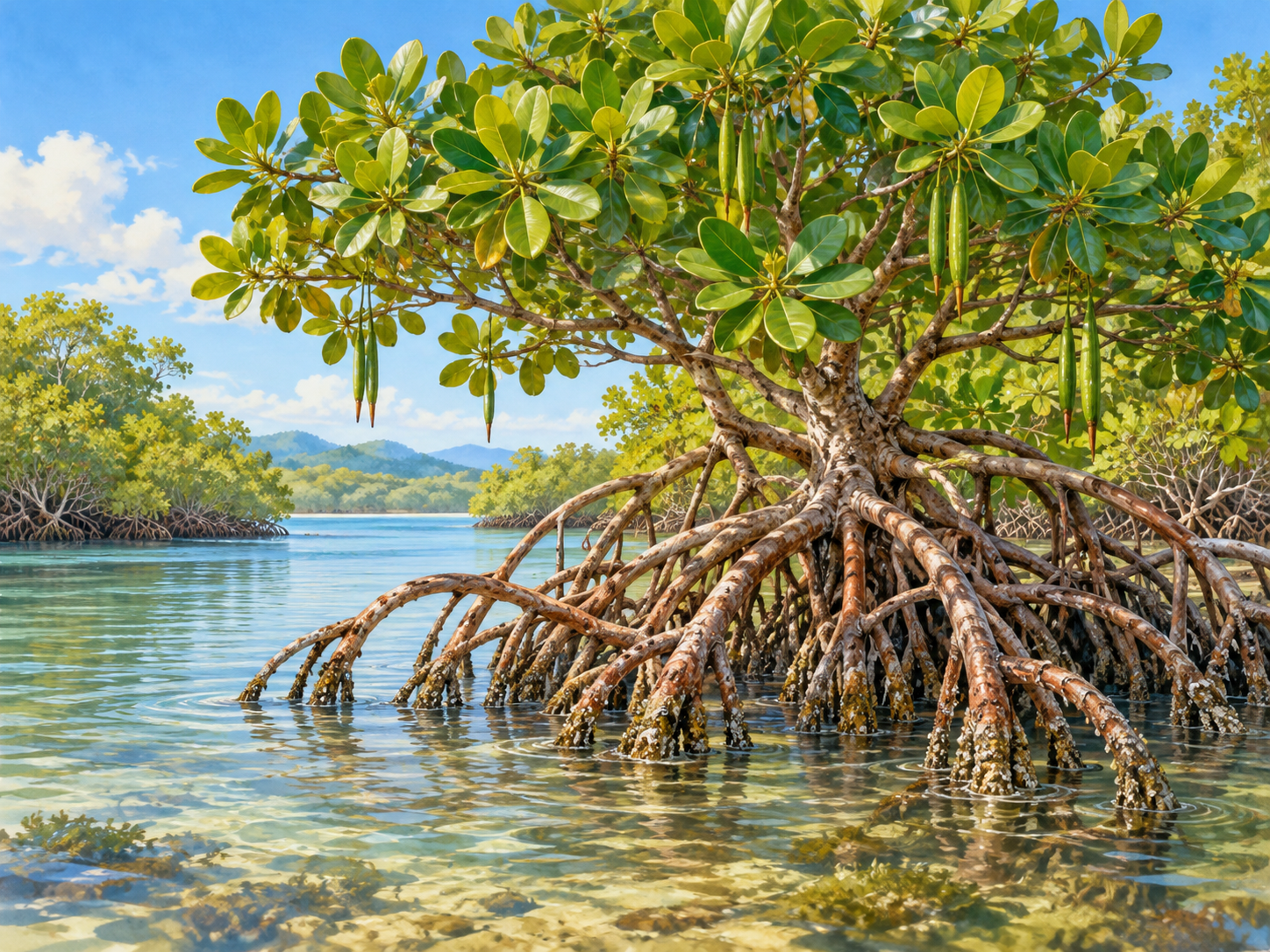
Red mangrove grows beside tidal water. Its arching prop roots and long propagules offer useful identification clues during a guided estuary visit.
What does Least Concern mean?
In the linked conservation assessment, this species does not qualify as threatened or near threatened with extinction. It still needs care: local populations and habitats can face problems even when the species has a lower extinction risk overall.
This label describes conservation status. It does not tell us whether a plant is safe for children or pets. Select the status button to read the assessment.
Species overview
About the Red Mangrove
Height: Large trees in favorable conditions can reach approximately 20–30 meters (66–98 feet), according to Costa Rica Tree Atlas. Exposed coastal trees can be much shorter.
Red mangrove lives where tidal water meets muddy land. Arching prop roots help support the tree in soft ground. Long propagules—young plants that begin growing while still attached to the parent—can later float away with the water.
The roots create shelter for small aquatic animals and help trap sediment along the shore. A guided estuary visit lets you observe this busy habitat from an appropriate viewing place. Notice the water level, root shapes and animals you can actually see.
Identification
Key Features of the Red Mangrove
Arching prop roots extend from the trunk and branches.
Long, slender propagules may hang from the tree.
Look for the tree beside tidal or brackish water.
Habitat & range
Mangrove habitat beside tidal channels. Explore the Tamarindo estuary with a local guide who can confirm the species from several features.
Local observations
SINAC lists red mangrove among the mangrove types in Las Baulas. Local abundance and specific observation points are not established by this profile.
When to observe
The tide changes how much of the roots you can see. Let your guide choose the route and conditions.
Seasonal Calendar
Flowering
Panama reference population
Year-round
Panama reference: some flowers may occur at any time of year. This is general species biology, not a measured Tamarindo flowering calendar.
Event source ↗Conservation & care
Child Safety: Not verified. Observe with an adult. Do not taste leaves, seeds, fruit or other tree parts.
Pet Safety: Not verified. Keep pets from chewing or swallowing tree parts. Check with a veterinarian before treating this species as pet-safe.
Stay in the boat or on authorized paths and follow your guide. Do not enter the water, climb on roots or collect propagules. Mangrove habitat is a shared home.
Conservation assessment
Global species assessment: Least Concern (IUCN Red List). Status checked on 7 October 2026. This category is not a guarantee that every local population or habitat is secure, and it is separate from legal protection in Costa Rica.
Observation activity
Root detective: From the boat or authorized viewing area, sketch the arching roots. Ask your guide how the roots help the tree stay upright.
Tide explorer: Record whether much or little of the roots is exposed. Ask how the view changes with the tide.
Experience notes: Draw an animal you actually saw, or write one question about life among the roots.
Explore by location
Caribbean · Central Pacific · Guanacaste · Puntarenas & the Gulf Islands · South Pacific · Tamarindo