

Nature Field Guide
Beach Morning Glory
- Spanish name
- Churristate de playa / Pudre oreja
- Scientific name
- Ipomoea pes-caprae
What Do Pico & Tati Think?
Pico: “These flowers grow right across the sand!”
Tati: “Let’s look at the shape of the leaves without stepping on the vine.”
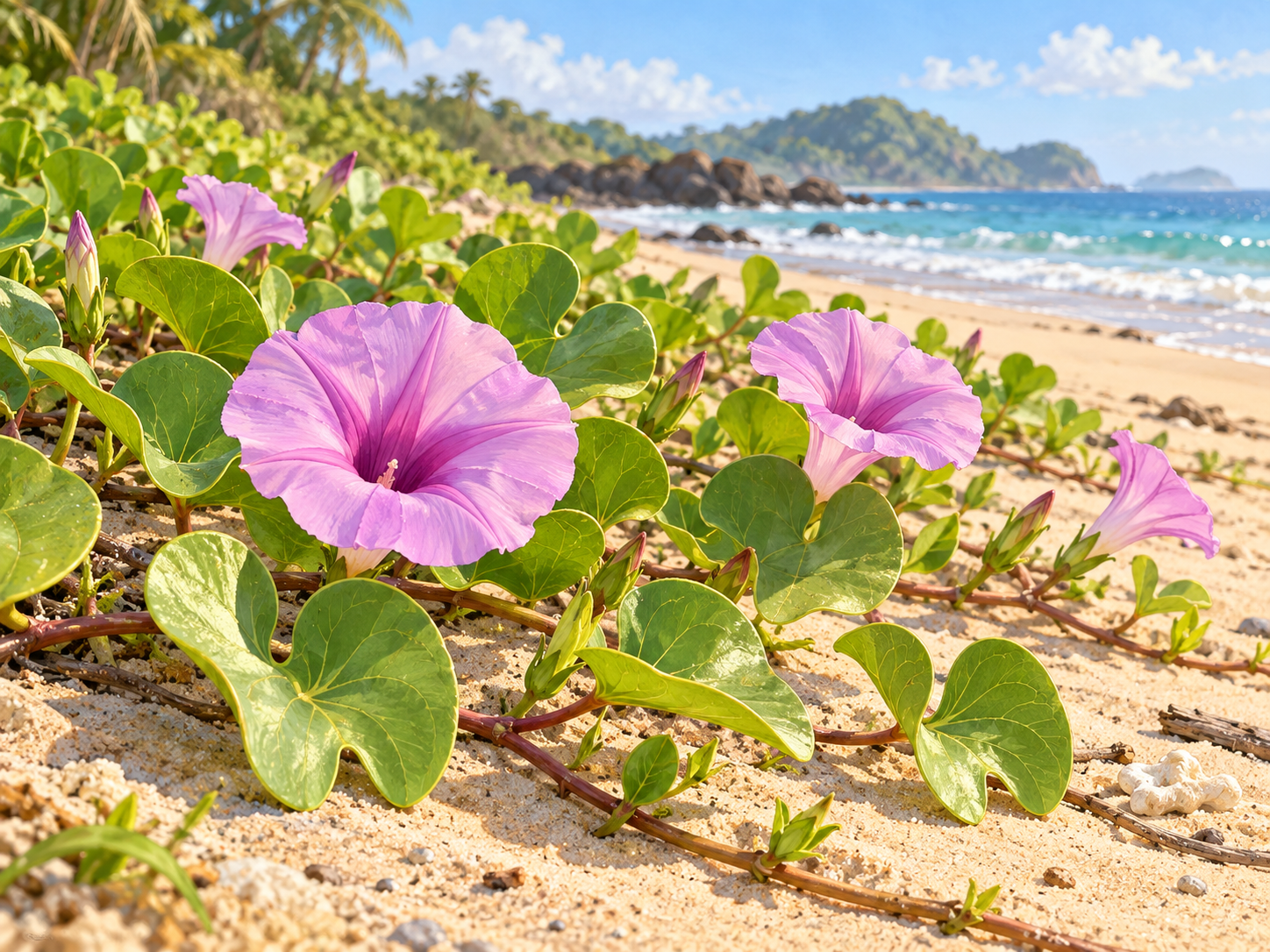
Species overview
About the Beach Morning Glory
Beach morning glory is a creeping coastal vine that spreads across sandy ground. Its trailing stems, notched leaves and pink-purple flowers make it a useful plant to study without collecting.
The leaves have a shape often compared with a goat’s hoof. The flowers form a joined, funnel-like corolla. On Costa Rican beaches, this vine may grow alongside beach bean, a different plant with leaves divided into three leaflets. Comparing leaf structure helps separate the two.
The species name pes-caprae refers to a goat’s foot, reflected in the notched shape of its leaves. Each leaf is simple, whereas the nearby coastal vine known as beach bean has leaves divided into three leaflets. Their similar growth form and flower colors can otherwise be misleading.
The trailing stems grow through sandy beach vegetation. Costa Rican coastal observations describe strong flowering during the rainy season, although the appearance on any visit depends on local conditions. A regional plant description should be followed by a verified local record before it is presented as part of a particular town’s flora.
Identification
Key Features of the Beach Morning Glory
Creeping stems extending across beach sand.
Simple leaves with a notch giving a goat’s-hoof appearance.
Pink-purple flowers with a joined, funnel-like corolla.
Habitat & range
Upper sandy beaches in tropical coastal habitats. Observe vegetation from established access routes rather than stepping across vines.
Local observations
ACG documents this plant in Costa Rican coastal vegetation. A specific Tamarindo occurrence has not yet been verified for this collection, so the profile is intentionally not assigned to Tamarindo.
When to observe
ACG describes substantial flowering during the rainy season on Costa Rican coasts. Actual flowering depends on local conditions.
Seasonal Calendar
Main flowering window
Costa Rican coastal populations
Jul, Aug, Sep, Oct, Nov
ACG reports abundant flowers July–November and seed maturation December–April on Costa Rican coasts. Typical seasonal windows, not exact dates.
Event source ↗Seed maturation
Costa Rican coastal populations
Jan, Feb, Mar, Apr, Dec
ACG reports abundant flowers July–November and seed maturation December–April on Costa Rican coasts. Typical seasonal windows, not exact dates.
Event source ↗Conservation & care
Do not uproot vines, pick flowers or taste plant parts. Use existing beach paths and avoid trampling coastal vegetation.
Observation activity
Photograph a leaf and flower without picking them. Compare a simple leaf with a nearby plant whose leaf is divided into leaflets.
Explore by location
Caribbean · Central Pacific · Guanacaste · Puntarenas & the Gulf Islands · South Pacific