

learning adventuresMy First Surf Stance
Make a paper surfboard, discover its parts and try a playful surfer pose on dry land. Your printable footprints turn a small space into a first surfing adventure.
Ages: 4–10 with an adult · Time: 15–20 minutes
Get Ready to Explore
Print the two-page pack. Color the board and cut out the footprint markers on page 2. Use those markers for the floor game; they are markers, not full-size templates for your feet.
What to Bring
- Printed activity pack, crayons and a pencil
- Removable tape and clear, nonslip floor space
- An adult to help cut and lead the game
Follow the Clues
1. Make your paper board
Color the surfboard on your sheet. Circle the nose at the front and the tail at the back. Give your board a name or draw a design inside it.
2. Set up the floor game
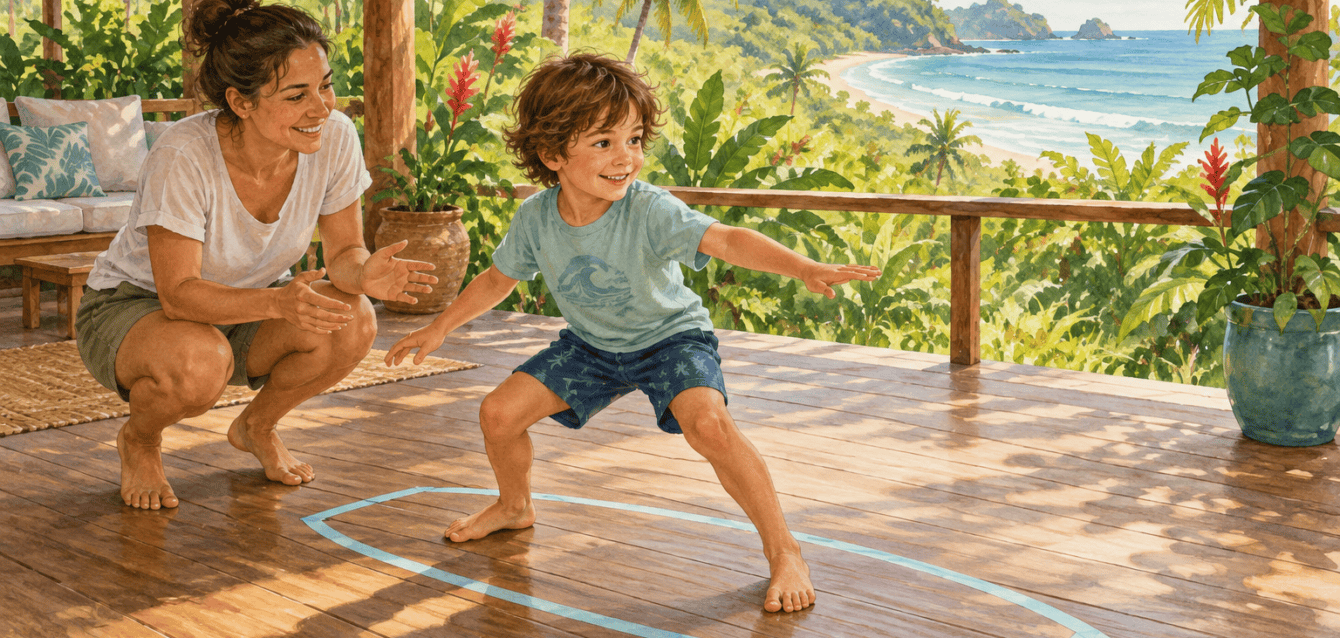
An adult places the two paper footprints on a flat, nonslip floor and secures their edges with removable tape. Put one slightly ahead of the other, with enough room for your own comfortable sideways stance. Stand beside the markers if the paper is slippery.
3. Find a comfortable stance
With your adult beside you, stand sideways with feet apart and knees gently bent. Try facing the other way too. This is a dry-land discovery game; your surf instructor can help choose your stance during a real lesson.
4. Play ready, wave, freeze
Your adult calls Ready, Imaginary wave and Freeze. Keep your feet on the floor, look ahead and hold your comfortable pose for three counts. Rest and repeat if you want. No jumping or wobble boards are needed.
5. Make a wave with your arms
While standing comfortably, use your arms to show a tiny wave and then a wider wave. Tell your adult which pose feels steady. Take turns leading the game without pushing or testing each other.
6. Finish your surfboard page
Draw two footprints inside your paper board. Add a face or word to show how you felt. Tell your adult where the nose and tail are and what you did when you heard Freeze.
Pico Asks. Tati Wonders.
Discover together
- The nose is the front of a surfboard; the tail is the back. Can you point to both on your drawing?
- What changed when you bent your knees gently? There is no need to choose a winning stance.
- A floor game introduces the idea of a stance. Learning to surf in water needs an instructor and suitable conditions.
Your Detective Challenge
Little Explorers (4–6): color your board, point to nose and tail, and try the freeze game. Junior Explorers (7–10): add labels and explain which position felt comfortable and why.
Explore with Care
Keep this game on a flat, clear floor with an adult nearby. Do not stand on loose paper or raised equipment. Water activities belong in an instructor-led lesson, not this floor game.
Bring the Discovery Home
Keep your board drawing as the first page of a surf scrapbook. If you take a lesson later, add one new thing your instructor taught you.
bring the adventure homeThe story continues with you.
Read together. Color with imagination. Bring Pico and Tati’s world into your home with books that invite children to explore, learn and care for God’s creation.
Our Promise
At Tico Explorers, we encourage children to explore with curiosity, learn with kindness, and care for God’s creation.
Our adventures invite families to notice the world together, respect local communities, and leave the places they visit cared for.
Explore • Learn • Protect
-
 Select options This product has multiple variants. The options may be chosen on the product page
-
 Select options This product has multiple variants. The options may be chosen on the product page
-
 Select options This product has multiple variants. The options may be chosen on the product page
-
 Select options This product has multiple variants. The options may be chosen on the product page