

Nature Field Guide
Mourning Gecko
- Spanish name
- Geco enlutado
- Scientific name
- Lepidodactylus lugubris
What Do Pico & Tati Think?
Pico: “What clues help us recognize this reptile?”
Tati: “Let’s notice its shape, markings and habitat from a respectful distance.”
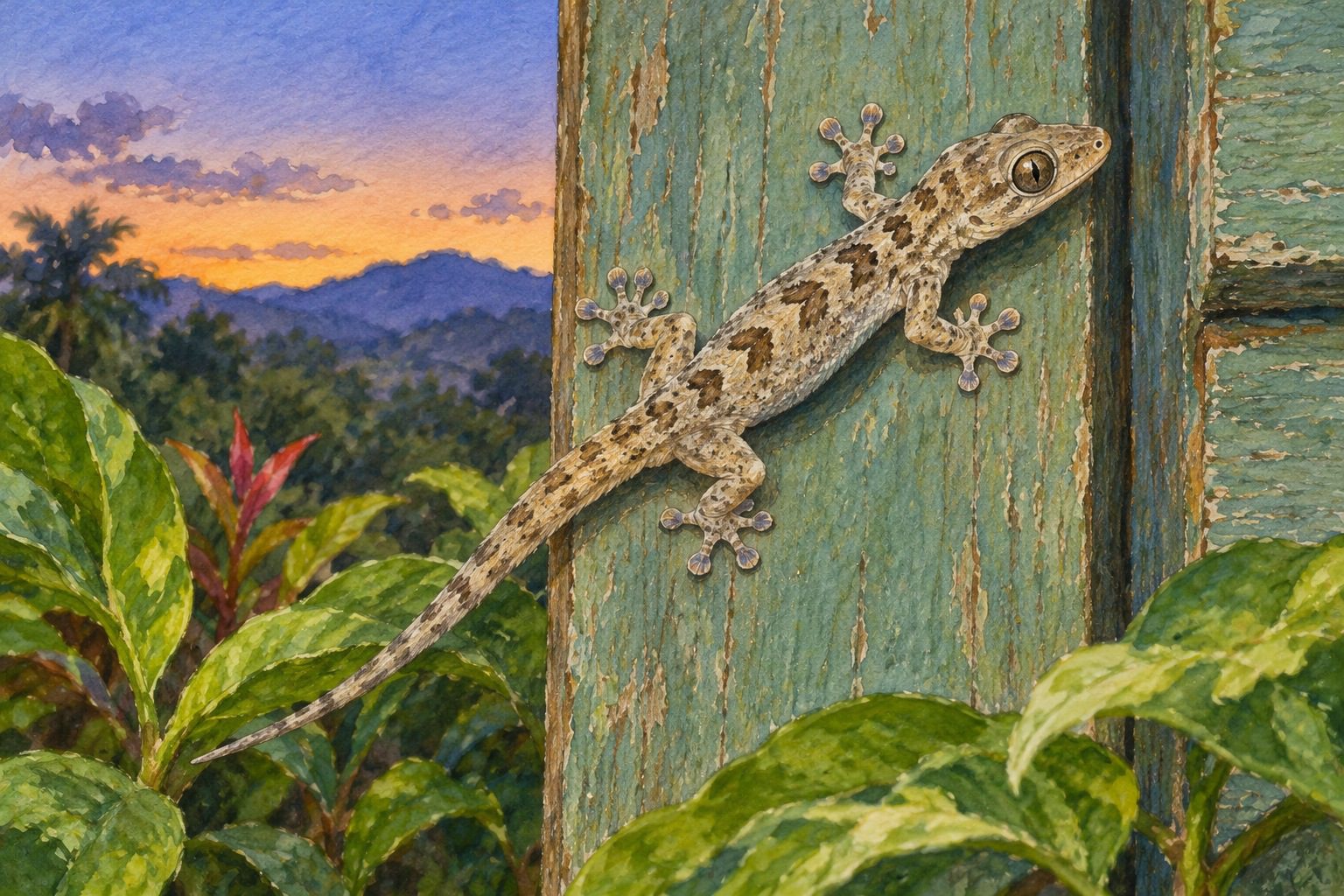
Species overview
About the Mourning Gecko
The mourning gecko is a small pale-brown or grayish gecko with dark marks along its back and adhesive toe pads. It often uses structures and nearby vegetation, especially after dark. Superficially similar house geckos can occur nearby.
It is introduced in Costa Rica. A 2024 study documented it in Cabo Blanco and discussed its expanding distribution. Learning about an introduced animal does not mean moving it elsewhere: never transport geckos, eggs or occupied plant material between places.
Identification
Key Features of the Mourning Gecko
Small pale-brown body
Paired dark back markings
Adhesive toe pads
Habitat & range
Buildings and vegetation in established introduced populations, including documented Pacific coastal areas and Cabo Blanco.
Local observations
Introduced in Costa Rica; originally from the Indo-Pacific region. Presence varies with suitable habitat and locality.
When to observe
Visibility varies with weather, habitat and the animal’s activity. Observe on an appropriate guided outing; never disturb a hiding animal to obtain a sighting.
Conservation & care
Observe without catching or moving the gecko. Do not transport reptiles, eggs or occupied plant material between sites. Keep pets away and wash hands after ordinary outdoor exploration.
Threats & pressures
Protect habitat connections and natural shelters. Avoid road mortality, collection and deliberate killing. Leave reptiles in their habitat rather than keeping or relocating them.
Observation activity
Explain why an explorer should record an introduced species without moving it.
Explore by location
Caribbean · Central Pacific · Guanacaste · Puntarenas & the Gulf Islands · South Pacific · Guanacaste · Limón · Puntarenas