

Nature Field Guide
Black Mangrove
- Spanish name
- Mangle negro / Palo de sal
- Scientific name
- Avicennia germinans
What Do Pico & Tati Think?
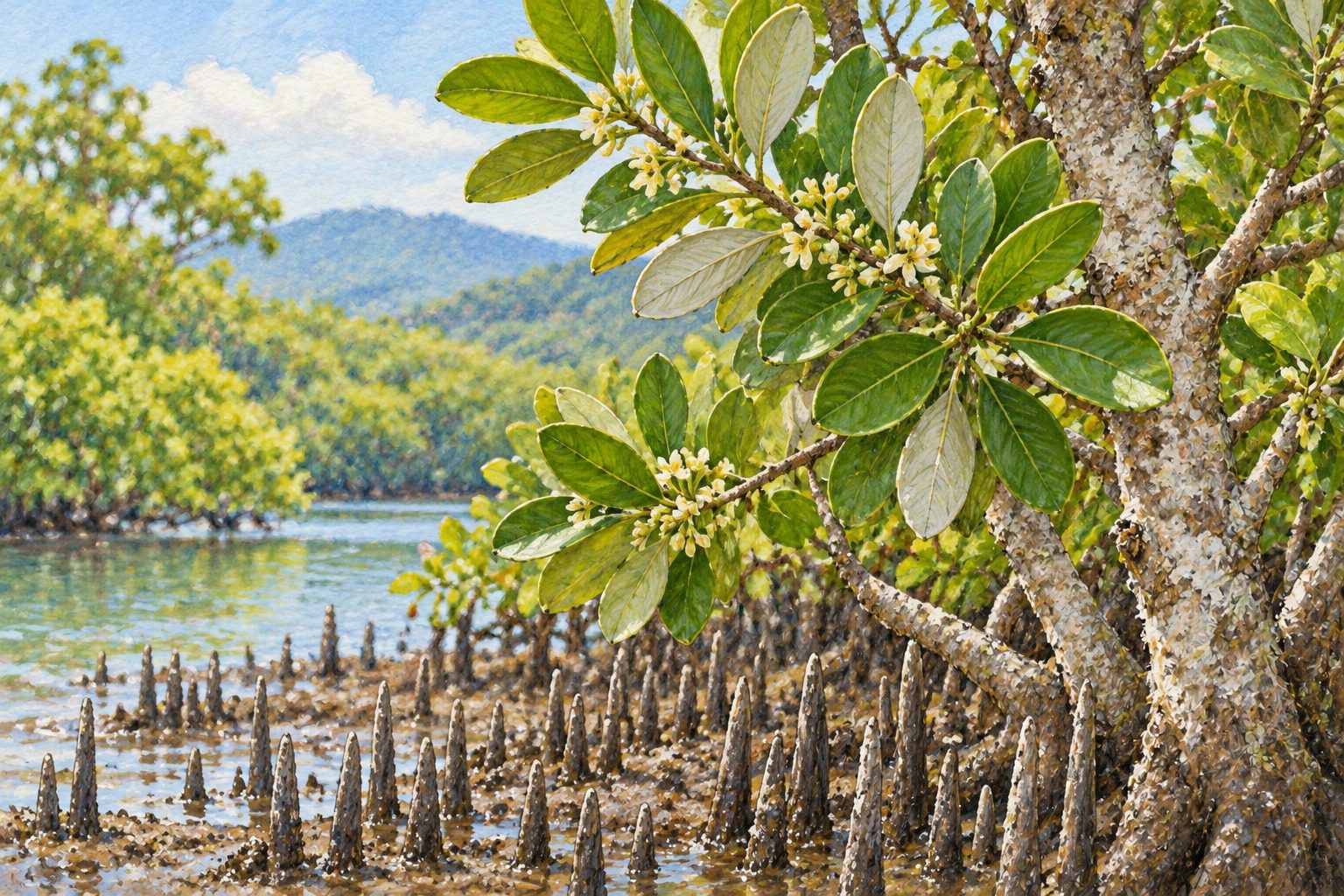
Pico: “Pencil-shaped breathing roots rise from the mud around this mangrove.”
Tati: “Let’s notice the leaves, flowers and habitat without disturbing the plant.”
Species overview
About the Black Mangrove
Black mangrove often has opposite oval leaves with pale undersides. Upright pencil-shaped roots, called pneumatophores, project above the surrounding mud. These look different from the arching prop roots of red mangrove.
Mangrove species can grow side by side, and root appearance changes with water level. Use the leaves and a reliable field guide as well as the roots. View the habitat from a boardwalk or permitted route without stepping on the delicate root field.
Identification
Key Features of the Black Mangrove
Opposite oval leaves with pale undersides
Upright pencil-shaped roots
Small pale flowers
Habitat & range
Coastal mangroves; Pacific documentation includes Guanacaste and Tivives near the Gulf of Nicoya. Gandoca provides a documented Caribbean example.
Local observations
Native to Costa Rica. Local presence and abundance depend on suitable habitat and growing conditions.
When to observe
Leaves and growth form can be observed whenever the plant is accessible. Flowering and fruiting vary with location, weather and the individual plant; ask a local guide about current conditions.
Conservation & care
Explore mangroves only with an adult on permitted paths or a guided route. Do not step on roots, collect seedlings or enter mud and tidal channels. Leave leaves and wildlife undisturbed.
Threats & pressures
Protect suitable habitat, mature trees and natural regeneration. Avoid trampling, unauthorized clearing and collection.
Observation activity
Draw pencil roots beside a drawing of red mangrove prop roots. Label the two different shapes.
Explore by location
Caribbean · Central Pacific · Guanacaste · Puntarenas & the Gulf Islands · South Pacific · Guanacaste · Limón · Puntarenas