

Nature Field Guide
Costa Rica Forest Rabbit
- Spanish name
- Conejo de monte de Costa Rica
- Scientific name
- Sylvilagus gabbi
What Do Pico & Tati Think?
The Costa Rica forest rabbit is a native forest rabbit, not a domestic bunny living outdoors.
What does Least Concern mean?
In the linked conservation assessment, this species does not qualify as threatened or near threatened with extinction. It still needs care: local populations and habitats can face problems even when the species has a lower extinction risk overall.
This label describes conservation status. It does not tell us whether a plant is safe for children or pets. Select the status button to read the assessment.
Species overview
About the Costa Rica Forest Rabbit
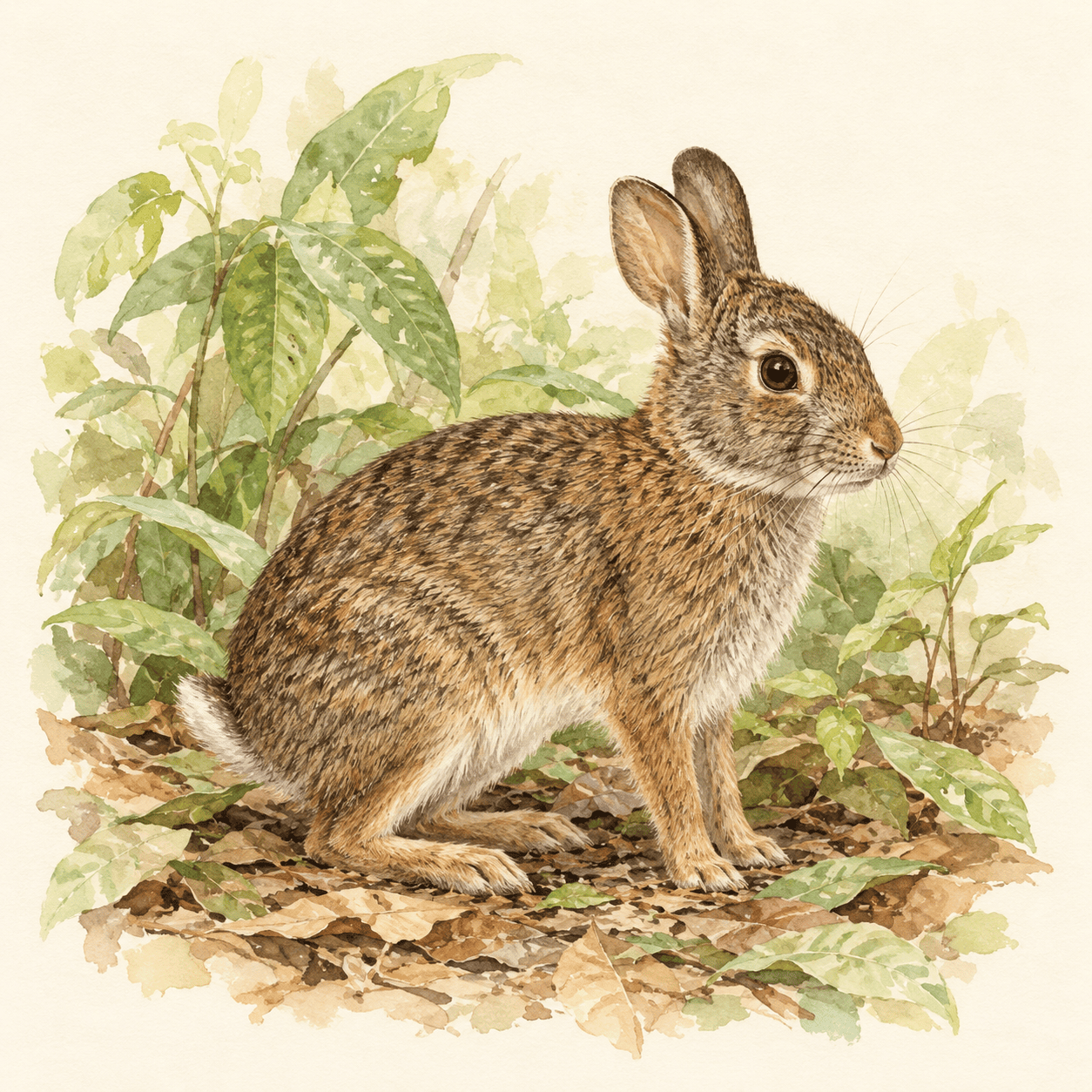
The Costa Rica forest rabbit is a native forest rabbit, not a domestic bunny living outdoors. Its scientific name is Sylvilagus gabbi; some older references placed it in a broader rabbit group under a different species name. Its small brown body can be difficult to notice among leaves and vegetation. The original type locality is in Costa Rica's Talamanca region. Similar rabbit species can be hard to distinguish from a quick glimpse, so location and an identified reference photograph matter. Leave the animal's hiding cover undisturbed.
Explorer activity: Sketch a rabbit hidden among leaves. Which colors and shapes make it harder to see? Keep the habitat in your drawing.
Your discovery notes: Record the date, place and habitat. Add a sketch or a photograph taken from a distance. Write what you observed and one question you would like to investigate. If the species is uncertain, keep that uncertainty in your notes.
Identification
Key Features of the Costa Rica Forest Rabbit
Small brown forest rabbit with a compact body.
Relatively short ears and an inconspicuous tail.
Use locality and expert advice to distinguish similar rabbits.
Habitat & range
Suitable wooded lowland landscapes and forest cover; local distribution varies.
Local observations
Recorded in Costa Rica. This is a country-level profile; it does not establish occurrence in every province, town or nature site.
When to observe
Ask a local guide about opportunities for quiet observation; do not approach a resting rabbit.
Conservation & care
Explore with an adult or local guide. Observe quietly from a distance, stay on established trails and leave shelter undisturbed. Do not feed, touch, capture or corner wildlife. Keep pets away.
Conservation assessment
Global IUCN category reported by the linked specialist or Mammal Diversity Database account, checked October 2026. Least Concern does not mean there are no threats or that every local population is secure.
Observation activity
Sketch a rabbit hidden among leaves. Which colors and shapes make it harder to see? Keep the habitat in your drawing.