

Nature Field Guide
Lowland Paca
- Spanish name
- Tepezcuintle
- Scientific name
- Cuniculus paca
What Do Pico & Tati Think?
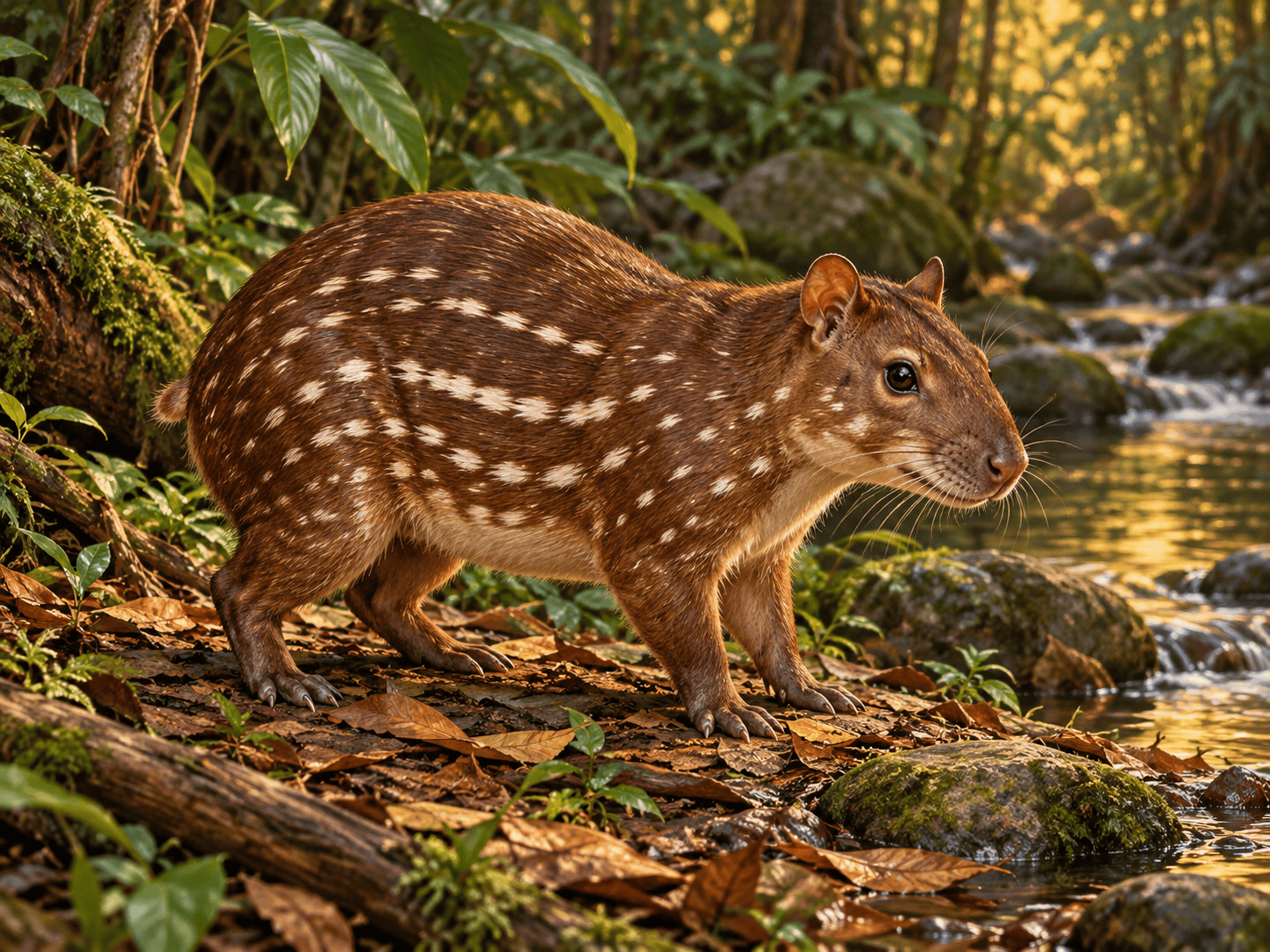
Pico: “Its white spots make neat rows!”
Tati: “A burrow is someone’s home; we leave it alone.”
Species overview
About the Lowland Paca
The Lowland Paca is a heavy-bodied rodent with short legs, a tiny tail and pale spots arranged along its sides. Its large head and rounded cheeks give it a different outline from the slimmer Agouti. The older scientific name Agouti paca appears in some sources.
Pacas are mainly nocturnal and spend daylight hours in burrows. They eat fruit, seeds and other plant material and often use habitat near water, where swimming can help them escape danger. Mothers usually have a single well-developed young. Protecting cover, waterways and undisturbed shelters supports this mammal without needing to expose a burrow or seek a close nighttime encounter.
Identification
Key Features of the Lowland Paca
Stocky brown body with rows of pale side spots.
Short legs and almost no visible tail.
Large rounded head and cheeks.
Habitat & range
La Amistad’s forest landscape, accessed from Biolley; ACG also has Quica, Pitilla camera-trap records.
Local observations
SINAC names Cuniculus paca at La Amistad. Biolley identifies Pacific-side access, not a surveyed animal within the town.
When to observe
Mainly nocturnal. Learn from existing camera-trap images or undisturbed signs on permitted routes; do not enter or illuminate a burrow.
Seasonal Calendar
Breeding possible
Costa Rica; broad natural-history account
Year-round
ACG describes reproduction through the year, not a fixed local birth season.
Event source ↗Conservation & care
Keep a respectful distance and leave an open route for the animal. Stay on authorized paths, secure food and rubbish, and observe without feeding, touching, baiting or chasing.
Threats & pressures
Hunting, habitat destruction and conflict over crops are documented pressures.
Observation activity
Sketch three features from a safe viewing point. Note the habitat and what the animal actually does; keep “seen”, “heard” and “possible tracks” as separate observations.
Explore by location
Guanacaste · Northern Plains · South Pacific · Heredia · Puntarenas · Biolley