

Nature Field Guide
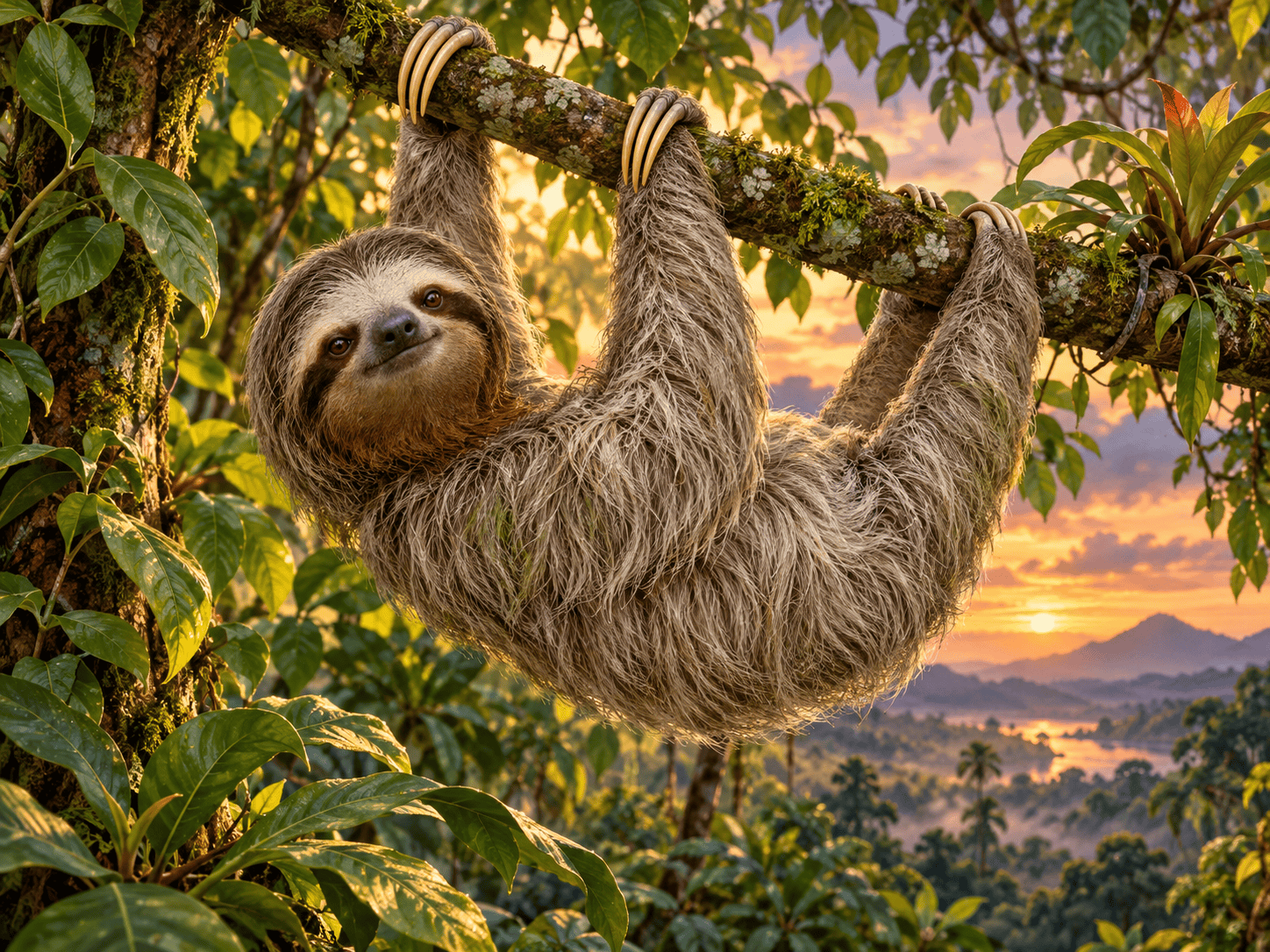
Brown-throated Three-toed Sloth
- Spanish name
- Perezoso de tres dedos
- Scientific name
- Bradypus variegatus
What Do Pico & Tati Think?
Pico: “That shape looks like part of the tree!”
Tati: “Let’s use binoculars and give it time.”
Species overview
About the Brown-throated Three-toed Sloth
The Brown-throated Three-toed Sloth lives among tree branches, where slow movements and camouflage can make it hard to find. Three long claws on each forelimb distinguish it from Costa Rica’s two-toed sloth. Its fur can support algae and small organisms, creating a miniature living community.
Leaves supply much of its food, and a slow metabolism suits this relatively low-energy diet. Connected trees provide feeding places and routes through the canopy. Studies in Caribbean cacao landscapes show why riverside forest and living fences matter alongside larger forest patches. A sloth in a farm landscape still depends on shelter, food and safe connections.
Identification
Key Features of the Brown-throated Three-toed Sloth
Three claws on each forelimb, if naturally visible.
Rounded face with a dark eye mask.
Gray-brown fur may have a greenish appearance.
Habitat & range
Manuel Antonio National Park and the studied cacao landscape at FINMAC, Pueblo Nuevo / Villa Francia, Limón.
Local observations
SINAC’s Manuel Antonio management plan records the species. Published research documents FINMAC; this is a study site, not an advertised visitor attraction. Quepos is a park gateway.
When to observe
Observe from authorized routes with a local guide. Activity, weather and food availability change encounters; a documented location is not a promise of a sighting.
Seasonal Calendar
Observed birth concentration
FINMAC cacao landscape, Pueblo Nuevo / Villa Francia
Jan, Feb, Mar
In 2010–2012, 59% of observed births occurred in these months; births also occurred outside this window.
Event source ↗Conservation & care
Keep a respectful distance and leave an open route for the animal. Stay on authorized paths, secure food and rubbish, and observe without feeding, touching, baiting or chasing.
Threats & pressures
Forest loss breaks canopy connections. Caribbean research identifies risks from domestic dogs and emphasizes retaining riverside forest and living fences.
Observation activity
Sketch the branches connecting the resting tree to nearby trees. Do not move leaves or encourage the sloth to descend.
Explore by location
Caribbean · Central Pacific · Northern Plains · Heredia · Limón · Puntarenas · Manuel Antonio · Pueblo Nuevo (Villa Francia) · Quepos