

Nature Field Guide
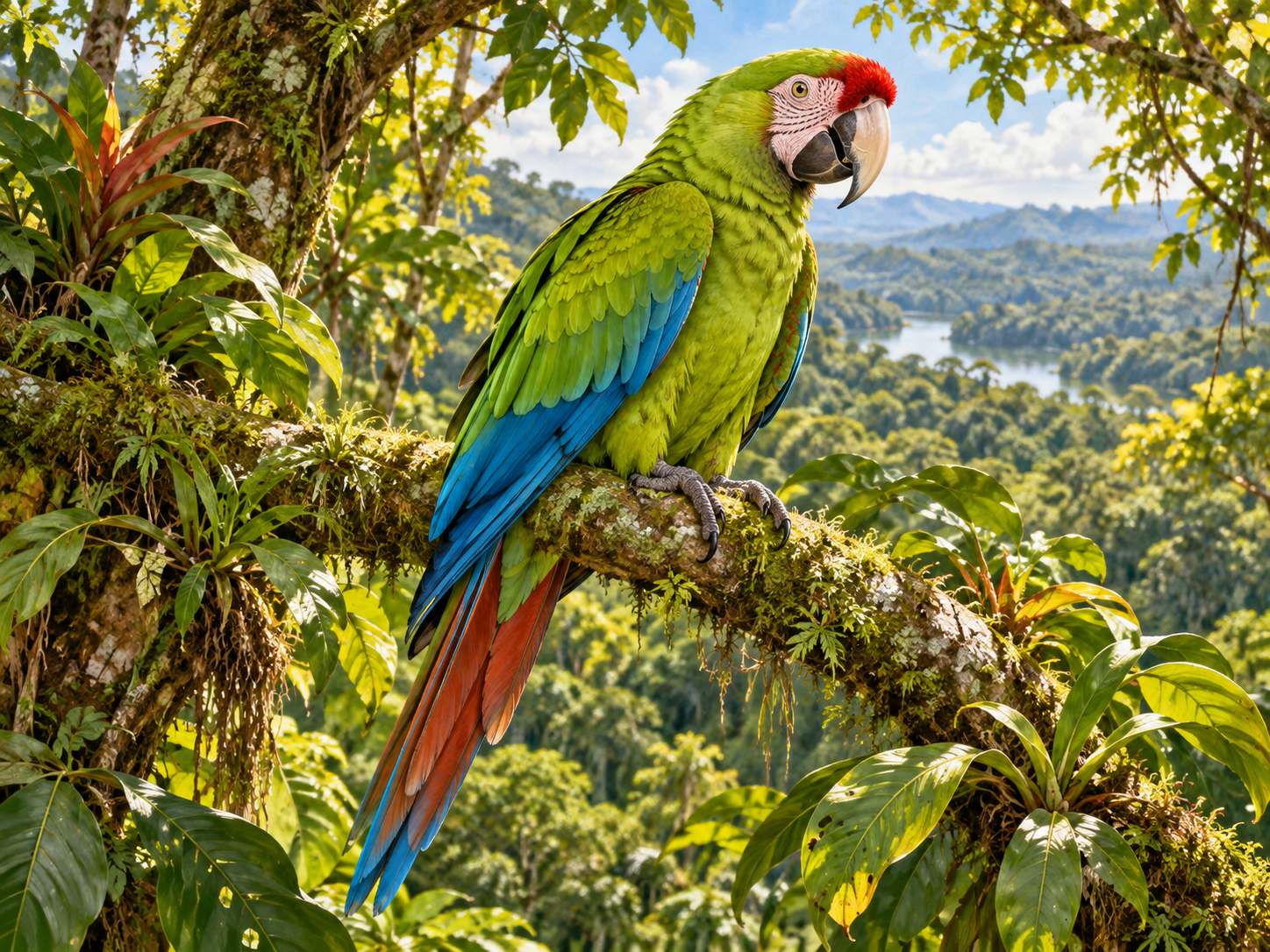
Great Green Macaw
- Spanish name
- Lapa verde
- Scientific name
- Ara ambiguus
What Do Pico & Tati Think?
Pico: “That green bird almost matches the treetops!”
Tati: “Its forest needs room for feeding and nesting.”
Species overview
About the Great Green Macaw
The Great Green Macaw is a large parrot of the Caribbean lowlands. It feeds on varied plant foods, with almendro seeds particularly important in Costa Rica. Pairs and small groups move through the forest in search of food, and breeding takes place in tree hollows.
Large trees and connected forests supply resources that young woodland cannot immediately replace. Costa Rica also has a reintroduced population around Manzanillo, distinct from the remaining northern populations. Nest monitoring, habitat restoration and artificial nest cavities support recovery. These actions show why conservation involves both individual birds and the forests that sustain them.
Identification
Key Features of the Great Green Macaw
Mainly green plumage with a reddish forehead.
Blue in the wings and a long tail.
Large, powerful bill.
Habitat & range
Humid northern and Caribbean lowland forest. Birds move with food availability. Northern Plains and Caribbean are broad browsing areas, not claims of continuous occupation.
Local observations
SINAC identifies Tortuguero as feeding and breeding habitat. World Parrot Trust documents the South Caribbean reintroduction at Manzanillo; these are distinct local populations.
When to observe
Plan a quiet observation with a local guide. Weather, food availability and the chosen habitat affect what you may see; a location record does not guarantee a sighting.
Seasonal Calendar
Breeding
Costa Rica; broad national window
Jan, Feb, Mar, Apr, Dec
Costa Rican dry-season breeding window; individual sites vary.
Event source ↗Conservation & care
Stay on authorized trails or viewing routes. Give birds space, keep voices low and leave nests undisturbed. Observe without bait, feeding or recorded calls.
Threats & pressures
Habitat disturbance, logging of important nesting trees and illegal capture threaten this species.
Documented impact
BirdLife’s 2021 Red List update reported a 99% decline over three generations for Nicaragua/Costa Rica. This historical regional estimate is not a 2026 local census.
Protection & recovery
World Parrot Trust reports 50 chicks fledged from artificial nests in the Ara Manzanillo project in 2022, and more than 60 in 2023. These are project breeding outcomes, not the total wild population.
Conservation assessment
World Parrot Trust reports IUCN Critically Endangered. Source checked 7 October 2026. This is a global species category, not a count of birds in the tagged towns.
Observation activity
Record three features you actually observe: shape, movement and habitat. Draw the bird from a respectful distance and compare your notes with a field guide.
Explore by location
Caribbean · Northern Plains · Limón · Manzanillo (Limón) · Tortuguero