

Nature Field Guide
White Ibis
- Spanish name
- Ibis blanco
- Scientific name
- Eudocimus albus
What Do Pico & Tati Think?
Pico: “Its bill curves down like a little hook.”
Tati: “I wonder what we can learn by watching how it searches for food.”
Species overview
About the White Ibis
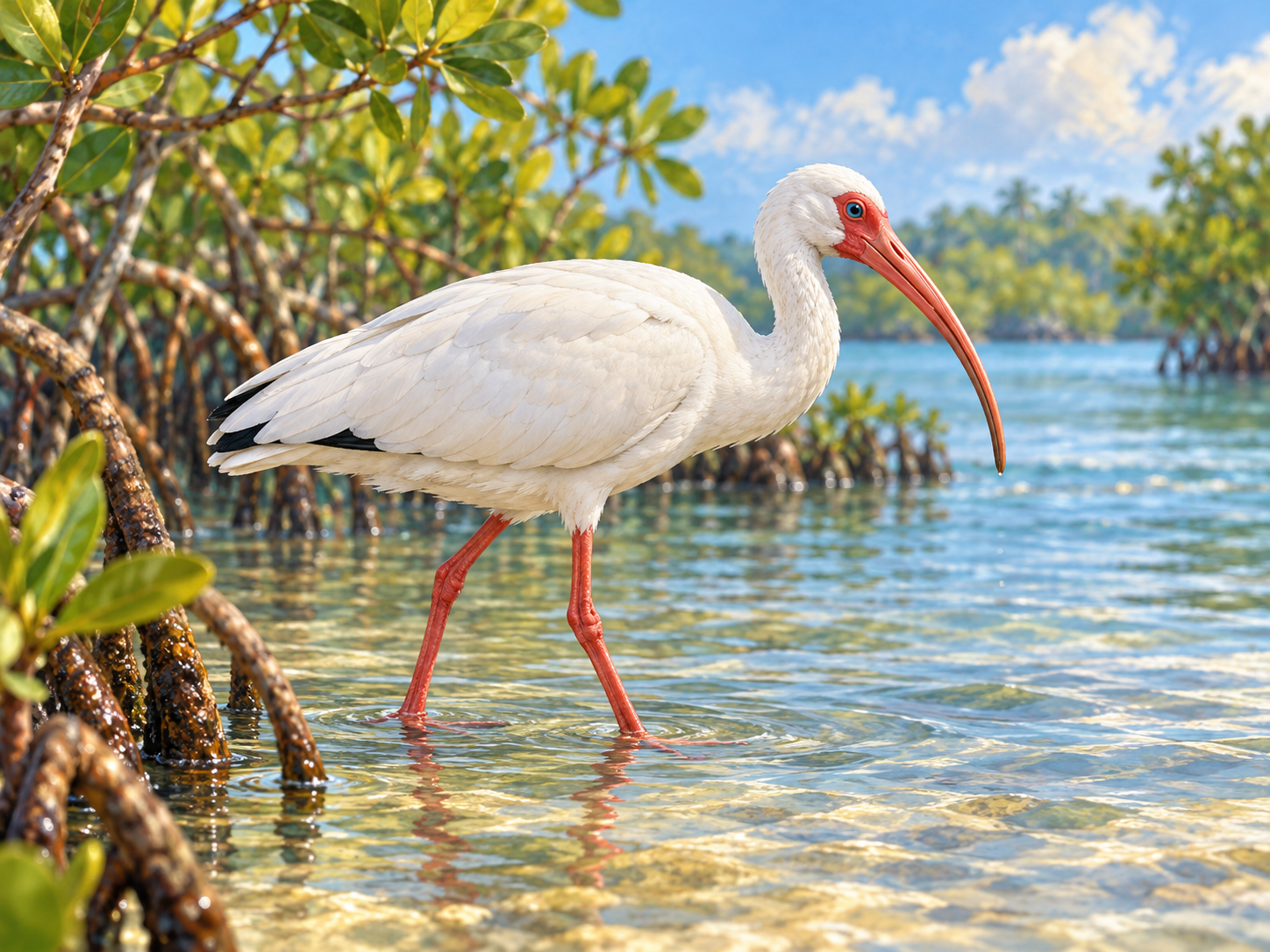
The white ibis is a wetland bird with a long bill that curves downward. Adults have predominantly white plumage, reddish legs and bill, and black wing tips that are especially useful to notice in flight.
Young birds are brown and white rather than entirely white. Ibises forage in shallow wetlands, probing the surface for small food items. Watching the bill and the bird’s movements helps distinguish it from straight-billed herons.
The curved bill is especially helpful when comparing an ibis with a heron or egret. Both may stand in shallow water, but the ibis probes with a downward-curving bill. In flight, an adult’s black wing tips contrast with its white body.
Juvenile birds can cause confusion because they retain brown plumage. An identification should combine bill shape, body shape and age-related colors. Wetland records are most useful when they also describe the habitat, date and whether birds were feeding, resting or flying.
Identification
Key Features of the White Ibis
A long, downward-curving bill.
Adults have white plumage with black wing tips.
Reddish legs and bill on adults; younger birds are brown and white.
Habitat & range
Strongest around the Tempisque basin and Gulf of Nicoya, with seasonal occurrence in Rio Frio and local Pacific wetlands. Rare scattered records elsewhere are not used to populate every region.
Local observations
A Tamarindo estuary operator, Valled Tours, lists white ibis among its locally encountered species. This is a local operator report rather than a measured abundance estimate.
When to observe
Tides and water levels affect available feeding areas. Let the guide choose the route rather than expecting a sighting at a particular hour.
Conservation & care
Keep enough distance that birds continue their natural activity. Stay out of nesting and roosting areas.
Observation activity
Observe how an ibis uses its curved bill. Record the color of the plumage and whether the bird is walking, feeding or flying.
Explore by location
Central Pacific · Guanacaste · Northern Plains · Puntarenas & the Gulf Islands · South Pacific · Tamarindo